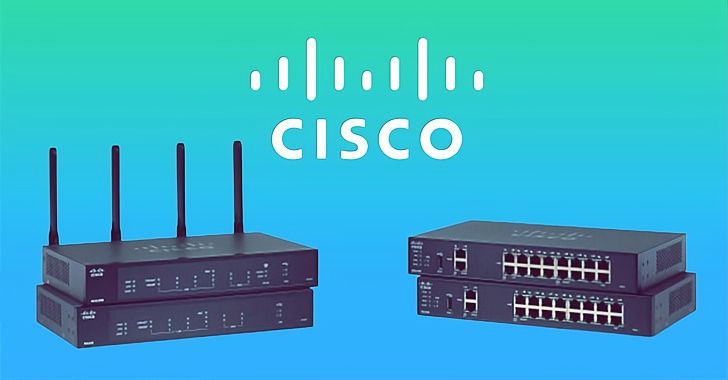
Cisco has patched multiple critical security vulnerabilities[1] impacting its RV Series
routers that could be weaponized to elevate privileges and execute
arbitrary code on affected systems, while also warning of the
existence of proof-of-concept (PoC) exploit code targeting some of
these bugs.
Three of the 15 flaws, tracked as CVE-2022-20699,
CVE-2022-20700, and CVE-2022-20707, carry the highest CVSS rating
of 10.0, and affect its Small Business RV160, RV260, RV340, and
RV345 Series routers.
Additionally, the flaws could be exploited to bypass
authentication and authorization protections, retrieve and run
unsigned software, and even cause denial-of-service (DoS)
conditions.
The networking equipment maker acknowledged that it’s “aware
that proof-of-concept exploit code is available for several of the
vulnerabilities” but didn’t share any further specifics on the
nature of the exploit or the identity of the threat actors that may
be exploiting them.
CVE-2022-20699 concerns a case of remote code execution that
could be exploited by an attacker by sending specially crafted HTTP
requests to a device that functions as an SSL VPN Gateway,
effectively leading to the execution of malicious code with root
privileges.
CVE-2022-20700, CVE-2022-20701 (CVSS score: 9.0), and
CVE-2022-20702 (CVSS score: 6.0), which the company said stems from
an insufficient authorization enforcement mechanism, could be
abused to elevate privileges to root and execute arbitrary commands
on the affected system.
CVE-2022-20707, the third flaw to receive a 10.0 score on the
CVSS scale, is due to insufficient validation of user-supplied
input, enabling the adversary to inject malicious commands and get
them on the underlying Linux operating system.
Other flaws fixed by Cisco are as follows:
- CVE-2022-20703 (CVSS score: 9.3) – Cisco Small
Business RV Series Routers Digital Signature Verification Bypass
Vulnerability - CVE-2022-20704 (CVSS score: 4.8) – Cisco Small
Business RV Series Routers SSL Certificate Validation
Vulnerability - CVE-2022-20705 (CVSS score: 5.3) – Cisco Small
Business RV Series Routers Improper Session Management
Vulnerability - CVE-2022-20706 (CVSS score: 8.3) – Cisco RV
Series Routers Open Plug and Play Command Injection
Vulnerability - CVE-2022-20708 and CVE-2022-20749 (CVSS
scores: 7.3) – Cisco RV340, RV340W, RV345, and RV345P Dual WAN
Gigabit VPN Routers Command Injection Vulnerabilities - CVE-2022-20709 (CVSS score: 5.3) – Cisco
RV340, RV340W, RV345, and RV345P Dual WAN Gigabit VPN Routers
Arbitrary File Upload Vulnerability - CVE-2022-20710 (CVSS score: 5.3) – Cisco Small
Business RV Series Routers GUI Denial of Service Vulnerability - CVE-2022-20711 (CVSS score: 8.2) – Cisco
RV340, RV340W, RV345, and RV345P Dual WAN Gigabit VPN Routers
Arbitrary File Overwrite Vulnerability - CVE-2022-20712 (CVSS score: 7.3) – Cisco Small
Business RV Series Routers Upload Module Remote Code Execution
Vulnerability
Cisco also stressed that there are no workarounds that address
these aforementioned weaknesses, urging customers to update to the
latest version of the software as soon as possible to counter any
potential attacks.
References
- ^
security
vulnerabilities (tools.cisco.com)
Read more https://thehackernews.com/2022/02/critical-flaws-discovered-in-cisco.html