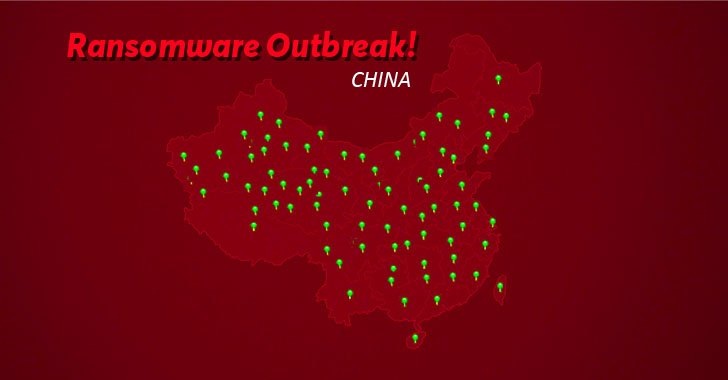
that has already infected more than 100,000 computers in the last
four days as a result of a supply-chain attack, and the number is
continuously increasing every hour.
What’s Interesting? Unlike almost every ransomware
malware, the new virus doesn’t demand ransom payments in
Bitcoin.
Instead, the attackers are asking victims to pay 110 yuan
(nearly USD 16) in ransom via WeChat Pay—instant payment feature of
China’s most popular messaging app developed by Tencent.

that caused worldwide chaos last year, the new Chinese ransomware
has been targeting only Chinese users and includes an additional
ability to steal users’ passwords for Alipay, NetEase’s 163 email
service, Baidu Cloud Disk, Jingdong (JD.com), Taobao, Tmall ,
AliWangWang, and QQ accounts.
A Supply Chain Attack — According to Chinese cybersecurity
and anti-virus firm Velvet
Security[3], the attackers injected
malicious code into the “EasyLanguage” programming software used by
a large number of application developers.
The maliciously modified programming software, promoted via
various Chinese forums, has been designed to hide ransomware virus
into every application and software product (a list of a few of
them as shown below) compiled through it—another example of a
software supply-chain attack to spread the virus rapidly.
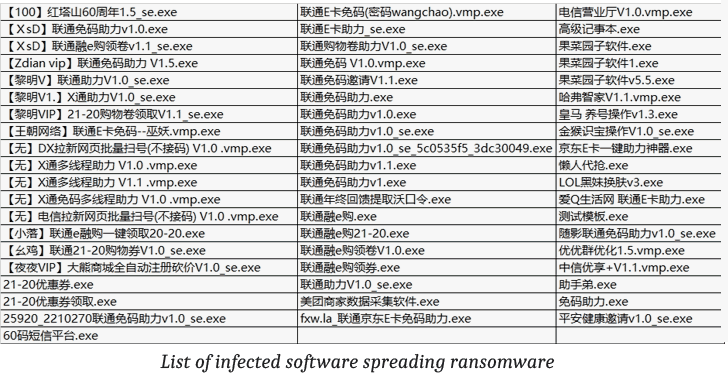
infected applications got their systems compromised. The ransomware
has been designed to encrypt users’ files on the infected system,
except files with gif, exe, and tmp extensions.
Using Stolen Digital Signatures — To defend against
Antivirus, the malware uses stolen digital signature from Tencent
Technologies and avoid infecting data or files in some specific
directories, like “Tencent Games, League of Legends, tmp, rtl, and
program.”
Once encrypted, the ransomware pops-up a note, asking users to
pay 110 yuan to attackers’ WeChat account via the payment feature
of instant messaging service within 3 days to receive the
decryption key.

decryption key from its remote command-and-control server
automatically.
Besides encrypting user files, the ransomware also silently
steals users login credential for popular Chinese websites and
social media accounts and send them to a remote server. It also
gathers system information including CPU model, screen resolution,
network information and list of installed software.
Poor Ransomware Has Been Cracked — Chinese cybersecurity
researchers found that this ransomware has poorly been programmed,
and lies about its encryption.
The ransomware note says users’ files have been encrypted using DES
encryption algorithm, but in reality, it encrypts files using a
less secure XOR cipher and stores a copy of the decryption key
locally on the victim’s system itself in a hidden folder at:
%user%\AppData\Roaming\unname_1989\dataFile\appCfg.cfg
released a free ransomware
decryption tool[4]
that can successfully unlock encrypted files for victims without
requiring them to pay any ransom.
Researchers also managed to crack and access attackers’ one of
the command-and-control servers and MySQL database servers, where
they found thousands of stolen credentials as well.
Who Is Behind This Ransomware Attack? — Using publicly
available information, researchers have found a suspect, named
“Luo,” who is a software programmer by his profession and developed
applications like “lsy resource assistant” and “LSY classic alarm
v1.1”
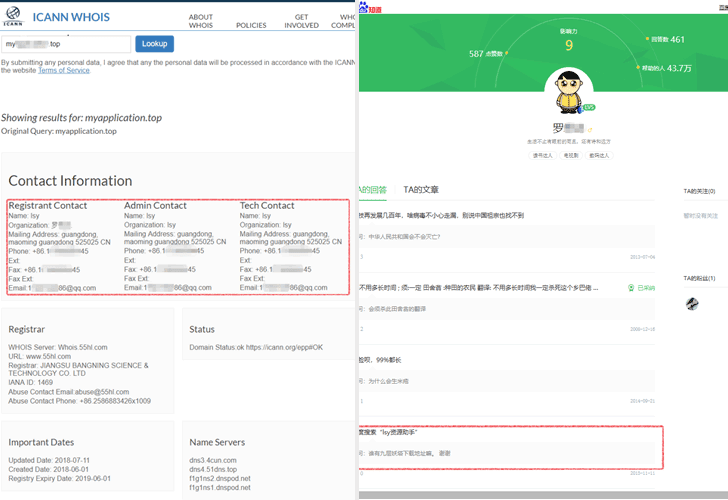
match with the information researchers collected via following
attacker’s WeChat account.
Moreover, after being notified of the threat, WeChat has also
suspended the attackers account on its service used to receive the
ransom payments.
Velvet researchers have also notified Chinese law enforcement
agencies with the available information for further
investigation.
References
- ^
WannaCry
(thehackernews.com) - ^
NotPetya
(thehackernews.com) - ^
Velvet Security
(www.huorong.cn) - ^
free ransomware decryption tool
(www.huorong.cn)
Read more http://feedproxy.google.com/~r/TheHackersNews/~3/L_Ndy0Ifbdc/china-ransomware-wechat.html