Mar 27, 2023Ravie Lakshmanan
A new information-stealing malware has set its sights on Apple’s
macOS operating system to siphon sensitive information from
compromised devices.
Dubbed MacStealer, it’s the latest example of a
threat that uses Telegram as a command-and-control (C2) platform to
exfiltrate data. It primarily affects devices running macOS
versions Catalina and later running on M1 and M2 CPUs.
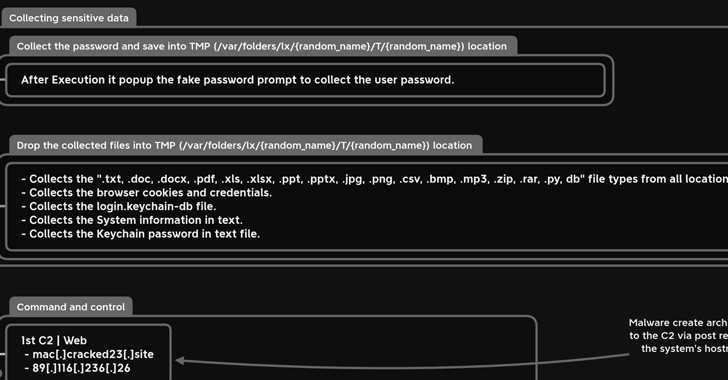
“MacStealer has the ability to steal documents, cookies from the
victim’s browser, and login information,” Uptycs researchers
Shilpesh Trivedi and Pratik Jeware said[1]
in a new report.
First advertised on online hacking forums at the start of the
month, it is still a work in progress, with the malware authors
planning to add features to capture data from Apple’s Safari
browser and the Notes app.
In its current form, MacStealer is designed to extract iCloud
Keychain data, passwords and credit card information from browsers
like Google Chrome, Mozilla Firefox, and Brave. It also features
support for harvesting Microsoft Office files, images, archives,
and Python scripts.
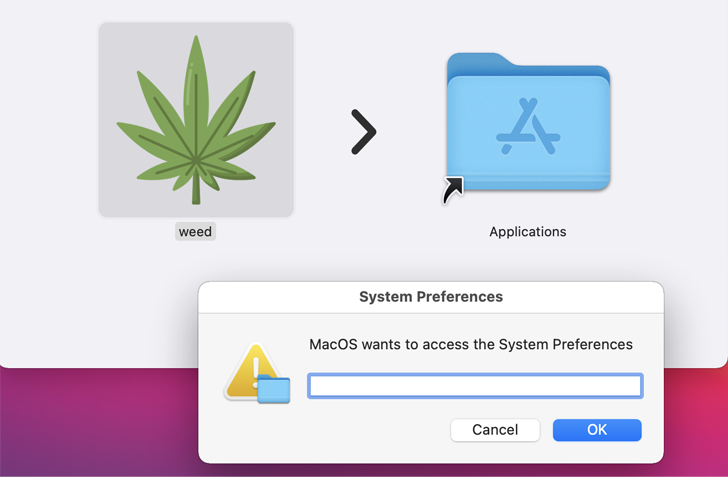
The exact method used to deliver the malware is not known, but
it is propagated as a DMG file (weed.dmg[2]) that, when executed,
opens a fake password prompt to harvest the passwords under the
guise of seeking access to the System Settings app.
MacStealer is one of several[3]
info-stealers[4]
that have surfaced just over the past few months and adds to an
already large number of similar tools currently in the wild.
This also includes another piece of new C#-based malware called
HookSpoofer[5]
that’s inspired[6]
by StormKitty[7]
and comes with keylogging and clipper abilities and transmits the
stolen data to a Telegram bot.
Another browser cookie-stealing malware of note is Ducktail[8], which also uses a
Telegram bot to exfiltrate data[9] and re-emerged in
mid-February 2023 with improved tactics to sidestep detection.
This involves “changing the initial infection from an archive
containing a malicious executable to an archive containing a
malicious LNK file that would start the infection chain,” Deep
Instinct researcher Simon Kenin said[10] earlier this month.
WEBINAR
Discover the Hidden Dangers of Third-Party SaaS Apps
Are you aware of the risks associated with third-party app
access to your company’s SaaS apps? Join our webinar to learn about
the types of permissions being granted and how to minimize
risk.
Stealer malware is typically spread through different channels,
including email attachments, bogus software downloads, and other
social engineering techniques.
To mitigate such threats, it’s recommended that users keep their
operating system and security software up to date and avoid
downloading files or clicking links from unknown sources.
“As Macs have become increasingly popular in the enterprise
among leadership and development teams, the more important the data
stored on them is to attackers,” SentinelOne researcher Phil Stokes
said[12] last week.
Found this article interesting? Follow us on Twitter [13] and LinkedIn[14] to read more exclusive
content we post.
References
- ^
said
(www.uptycs.com) - ^
weed.dmg
(www.virustotal.com) - ^
several
(www.uptycs.com) - ^
info-stealers
(thehackernews.com) - ^
HookSpoofer
(www.uptycs.com) - ^
inspired
(github.com) - ^
StormKitty
(github.com) - ^
Ducktail
(thehackernews.com) - ^
Telegram
bot to exfiltrate data (thehackernews.com) - ^
said
(www.deepinstinct.com) - ^
RESERVE YOUR SEAT
(thn.news) - ^
said
(www.sentinelone.com) - ^
Twitter
(twitter.com) - ^
LinkedIn
(www.linkedin.com)
Read more https://thehackernews.com/2023/03/new-macstealer-macos-malware-steals.html