Mar 27, 2023Ravie Lakshmanan
Microsoft has released an out-of-band update to address a
privacy-defeating flaw in its screenshot editing tool for Windows
10 and Windows 11.
The issue[1], dubbed
aCropalypse, could enable malicious actors to
recover edited portions of screenshots, potentially revealing
sensitive information that may have been cropped out.
Tracked as CVE-2023-28303, the vulnerability is
rated 3.3 on the CVSS scoring system. It affects both the Snip &
Sketch app on Windows 10 and the Snipping Tool on Windows 11.
“The severity of this vulnerability is Low because successful
exploitation requires uncommon user interaction and several factors
outside of an attacker’s control,” Microsoft said[2]
in an advisory released on March 24, 2023.
Successful exploitation requires that the following two
prerequisites are met –
- The user must take a screenshot, save it to a file, modify the
file (for example, crop it), and then save the modified file to the
same location. - The user must open an image in Snipping Tool, modify the file
(for example, crop it), and then save the modified file to the same
location.
However, it does not impact scenarios where an image is copied
from the Snipping Tool or modified before saving it.
“If you take a screenshot of your bank statement, save it to
your desktop, and crop out your account number before saving it to
the same location, the cropped image could still contain your
account number in a hidden format that could be recovered by
someone who has access to the complete image file,” Microsoft
explains.
“However, if you copy the cropped image from Snipping Tool and
paste it into an email or a document, the hidden data will not be
copied, and your account number will be safe.”
The vulnerability has been addressed in-app version
10.2008.3001.0 of Snip and Sketch installed on Windows 10 and
version 11.2302.20.0 of Snipping Tool installed on Windows 11.
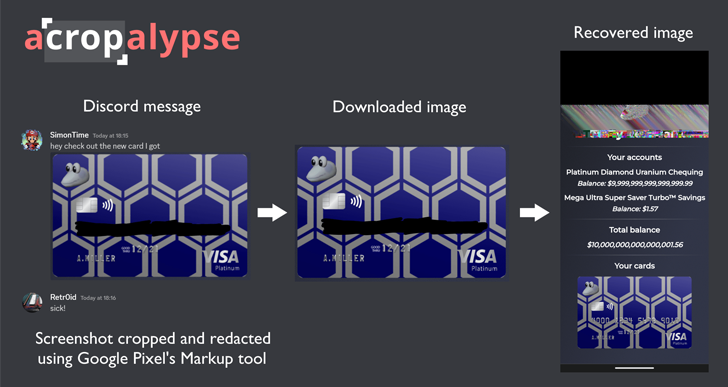
aCropalypse first came to light on March 18, 2022, when it was
found[3]
that a bug in Google Pixel’s Markup tool made it possible to
retroactively reverse the changes introduced to screenshots,
thereby recovering personal information from redacted screenshots
and images, including those that have been cropped or had their
contents masked.
Credited with discovering the problem are reverse engineers
Simon Aarons and David Buchanan.
WEBINAR
Discover the Hidden Dangers of Third-Party SaaS Apps
Are you aware of the risks associated with third-party app
access to your company’s SaaS apps? Join our webinar to learn about
the types of permissions being granted and how to minimize
risk.
The Pixel-related high-severity flaw, tracked as CVE-2023-21036,
was reported to Google on January 2, 2023, and was fixed[5]
via an update released on March 6, 2023 for Pixel 4A, 5A, 7, and 7
Pro devices.
The shortcoming[6]
has existed since the release of the Markup utility with Android 9
Pie in 2018, and images already shared over the past five years are
vulnerable to the Acropalypse attack, raising possible privacy
concerns.
“You can patch it, but you can’t easily un-share all the
vulnerable images you may have sent,” Buchanan said[7]
in a tweet, describing it as a “bad one.”
A similar issue with reversible cropping was recently disclosed[8]
in Google Docs as well, allowing users with view-only access to
recover original versions of cropped images in shared documents
without having the edit permissions to do so.
Found this article interesting? Follow us on Twitter [9]
and LinkedIn[10] to read more exclusive
content we post.
References
Read more https://thehackernews.com/2023/03/microsoft-issues-patch-for-acropalypse.html