Cybersecurity researchers have disclosed a novel attack that
could allow criminals to trick a point of sale terminal into
transacting with a victim’s Mastercard contactless card while
believing it to be a Visa card.
The research, published by a group of academics from the ETH
Zurich, builds on a study detailed last September[1]
that delved into a PIN bypass attack, permitting bad actors to
leverage a victim’s stolen or lost Visa EMV-enabled credit card for
making high-value purchases without knowledge of the card’s PIN,
and even fool the terminal into accepting unauthentic offline card
transactions.
“This is not just a mere card brand mixup but it has critical
consequences,” researchers David Basin, Ralf Sasse, and Jorge Toro
said. “For example, criminals can use it in combination with the
previous attack on Visa to also bypass the PIN for Mastercard
cards. The cards of this brand were previously presumed protected
by PIN.”
Following responsible disclosure, ETH Zurich researchers
said[2] Mastercard implemented
defense mechanisms at the network level to thwart such attacks. The
findings will be presented at the 30th USENIX Security Symposium in
August later this year.
A Card Brand Mixup Attack
Just like the previous attack involving Visa cards, the latest
research too exploits “serious” vulnerabilities in the widely used
EMV contactless protocol, only this time the target is a Mastercard
card.
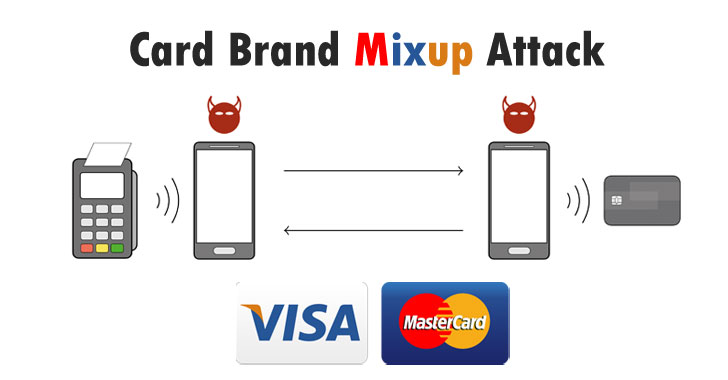
At a high level, this was achieved using an Android application
that implements a man-in-the-middle (MitM) attack atop a relay
attack architecture, thereby allowing the app to not only initiate
messages between the two ends — terminal and the card — but also to
intercept and manipulate the NFC (or Wi-Fi) communications to
maliciously introduce a mismatch between the card brand and the
payment network.
Put differently, if the card issued is Visa or Mastercard
branded, then the authorization request needed for facilitating EMV
transactions is routed to the respective payment network. The
payment terminal recognizes the brand using a combination of the
primary account number (PAN, also known as the card number) and an
application identifier (AID[3]) that uniquely
identifies the type of card (e.g., Mastercard Maestro or Visa
Electron), and subsequently makes use of the latter to activate a
specific kernel for the transaction.
An EMV Kernel is a set of functions that provides all the
necessary processing logic and data that is required to perform an
EMV contact or contactless transaction.
The attack, dubbed “card brand mixup[4],” takes advantage of the
fact that these AIDs are not authenticated to the payment terminal,
thus making it possible to deceive a terminal into activating a
flawed kernel, and by extension, the bank that processes payments
on behalf of the merchant, into accepting contactless transactions
with a PAN and an AID that indicate different card brands.
“The attacker then simultaneously performs a Visa transaction
with the terminal and a Mastercard transaction with the card,” the
researchers outlined.
The attack, however, necessitates that it meets a number of
prerequisites in order to be successful. Notably, the criminals
must have access to the victim’s card, besides being able to modify
the terminal’s commands and the card’s responses before delivering
them to the corresponding recipient. What it doesn’t require is the
need to have root privileges or exploit flaws in Android so as to
use the proof-of-concept (PoC) application.
But the researchers note a second shortcoming in the EMV
contactless protocol could let an attacker “build all necessary
responses specified by the Visa protocol from the ones obtained
from a non-Visa card, including the cryptographic proofs needed for
the card issuer to authorize the transaction.”
Mastercard Adds Countermeasures
Using the PoC Android app, ETH Zurich researchers said they were
able to bypass PIN verification for transactions with Mastercard
credit and debit cards, including two Maestro debit and two
Mastercard credit cards, all issued by different banks with one of
the transactions exceeding $400.
In response to the findings, Mastercard has added a number of
countermeasures, including mandating financial institutions to
include the AID in the authorization data, allowing card issuers to
check the AID against the PAN.
Additionally, the payment network has rolled out checks for
other data points present in the authorization request that could
be used to identify an attack of this kind, thereby declining a
fraudulent transaction right at the outset.
References
- ^
detailed
last September (thehackernews.com) - ^
researchers said
(emvrace.github.io) - ^
AID
(en.wikipedia.org) - ^
card
brand mixup (jorgetp.github.io)
Read more http://feedproxy.google.com/~r/TheHackersNews/~3/2EndDI02n68/new-hack-lets-attackers-bypass.html