
vulnerabilities that impacts all major operating systems, including
Microsoft Windows, Apple macOS, Linux, and FreeBSD, allowing
attackers to bypass protection mechanisms introduced to defend
against DMA attacks.
Known for years, Direct memory access (DMA)-based attacks
let an attacker compromise a targeted computer in a matter of
seconds by plugging-in a malicious hot plug device—such as an
external network card, mouse, keyboard, printer, storage, and
graphics card—into Thunderbolt 3 port or the latest USB-C
port.
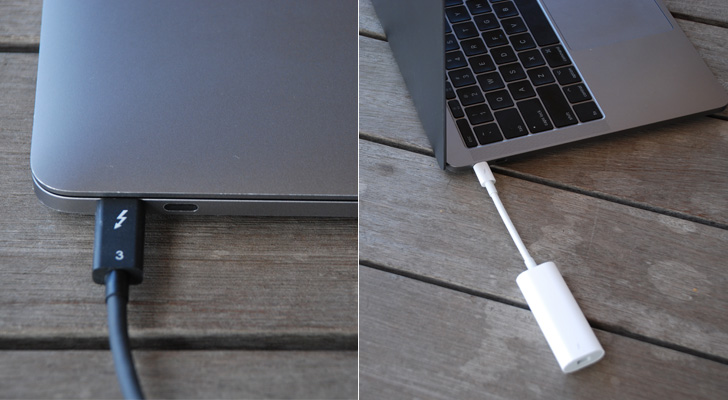
The DMA-based attacks are possible because Thunderbolt port
allows connected peripherals to bypass operating system security
policies and directly read/write system memory that contains
sensitive information including your passwords, banking logins,
private files, and browser activity.
That means, simply plugging in an infected device, created using
tools like Interception[1], can manipulate the
contents of the memory and execute arbitrary code with much higher
privileges than regular universal serial bus peripherals, allowing
attackers to bypass the lock screen or control PCs remotely.
To block DMA-based attacks, most operating systems and devices
leverage Input/Output Memory Management Unit (IOMMU) protection
technique to control which peripheral device (usually legitimate)
can access memory and which region of the memory.
ThunderClap Flaws Bypass IOMMU to Re-Enable DMA Attacks
Now, a team of cybersecurity researchers from the University of
Cambridge, Rice University, and SRI International has unveiled a
set of new vulnerabilities in various major operating systems that
could allow attackers to bypass IOMMU
protection[2].
By mimicking the functionality of a legitimate peripheral
device, an attacker can trick targeted operating systems into
granting it access to sensitive regions of memory.
In a paper [PDF[3]] published earlier this
week, researchers detailed technical information of all new
vulnerabilities that they claimed to have discovered using a
hardware/software stack, called Thunderclap[4], which they build
and also released in the open-source.

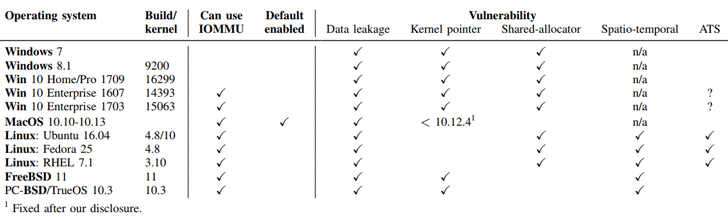
“Our work leverages vulnerabilities in operating system IOMMU usage
to compromise a target system via DMA, even in the presence of an
IOMMU that is enabled and configured to defend against DMA
attacks,” the researchers said.
not come enabled by default on most operating systems and since
modern devices have USB-C, the attack surface of DMA attack has
significantly increased which was earlier primarily limited to
Apple devices with Thunderbolt 3 ports.
“The rise of hardware interconnects like Thunderbolt 3 over USB-C
that combine power input, video output, and peripheral device DMA
over the same port greatly increases the real-world applicability
of Thunderclap vulnerabilities.”
“In particular, all Apple laptops and desktops produced since 2011
are vulnerable, with the exception of the 12-inch MacBook. Many
laptops, and some desktops, designed to run Windows or Linux
produced since 2016 are also affected – check whether your laptop
supports Thunderbolt.”
How to Protect Against Thunderclap Vulnerabilities
Researchers have reported their findings to all major hardware and
operating system vendors, and most of them have already shipped
substantial mitigation to address the Thunderclap vulnerabilities.
“In macOS 10.12.4 and later, Apple addressed the specific network
card vulnerability we used to achieve a root shell,” researchers
said. “Recently, Intel has contributed patches to version 5.0 of
the Linux kernel.”
“The FreeBSD Project indicated that malicious peripheral devices
are not currently within their threat model for security response.”
users are still advised to install available security updates to
reduce the attack surface. According to the researchers, the best
way to fully protect yourself is to disable the Thunderbolt ports
on your machine, if applicable.
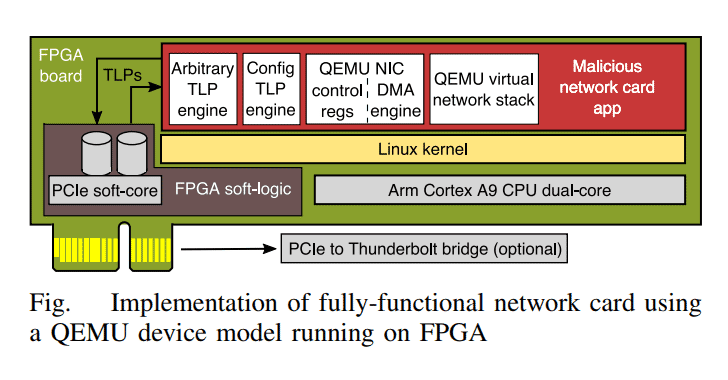
attacking hardware that can execute the ThunderClap vulnerabilities
on targeted systems, but they chose not to release it in public at
this time.
References
- ^
Interception
(github.com) - ^
IOMMU protection
(docs.microsoft.com) - ^
PDF
(www.ndss-symposium.org) - ^
Thunderclap
(github.com)
Read more http://feedproxy.google.com/~r/TheHackersNews/~3/qsvp92rxj5I/thunderbolt-peripheral-dma-attacks.html