vulnerability that is being exploited by
in the wild cybercriminals to attack vulnerable websites
that have not yet applied patches already available by its
developers, but hackers are also exploiting a critical WinRAR
vulnerability that was also revealed last week.
A few days ago, The Hacker News reported about a 19-year-old remote
code execution vulnerability[3]
disclosed by Check Point in the UNACEV2.dll library of WinRAR that
could allow a maliciously-crafted ACE archive file to execute
arbitrary code on a targeted system.
WinRAR is a popular Windows file compression application with
500 million users worldwide, but a critical “Absolute Path
Traversal” bug (CVE-2018-20250) in its old third-party library,
called UNACEV2.DLL, could allow attackers to extract a compressed
executable file from the ACE archive to one of the Windows Startup
folders, where the file would automatically run on the next
reboot.
To successfully exploit the vulnerability and take full control
over the targeted computers, all an attacker needs to do is just
convincing users into opening a maliciously-crafted compressed
archive file using WinRAR.
Just a day after the Check Point’s blog post and a proof of concept
video[4] (that showcased how an
ACE archive can extract a malicious file into the Windows Startup
folder) went public, a Proof-of-concept (PoC) exploit code[5]
for the newly discovered WinRAR vulnerability was published to
Github.
What’s worse?
Security researchers at the 360 Threat Intelligence Center
(360TIC) just yesterday detected an in-the-wild malspam email
campaign that’s distributing a malicious RAR archive file that
exploits the latest WinRAR vulnerability to install malware on
computers running the vulnerable version of the software.
“Possibly the first malware delivered through the mail to exploit
WinRAR vulnerability. The backdoor is generated by MSF [Microsoft
Solutions Framework] and written to the global startup folder by
WinRAR if UAC is turned off,” the researchers tweeted[6].
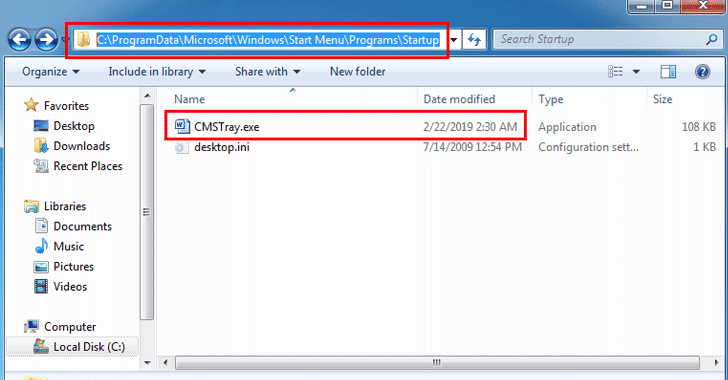
using WinRAR—software running with administrator privileges or on a
targeted system with UAC (User Account Control) disabled—the
malware drops a malicious exe file (CMSTray.exe) to the Windows
Startup folder, designed to infect the targeted computer with a
backdoor.
Since UAC puts some limitations on permissions, attempting to
extract the archive with UAC enabled fails to place the malicious
exe file in the C:\ProgramData folder, thus failing to infect the
computer.
The best way to protect yourself from these attacks is to update
your software by installing the latest version of WinRAR as soon as
possible and avoid opening files received from unknown sources.
Since the WinRAR team had lost the access to the source code for
the vulnerable UNACEV2.DLL library in 2005, instead of fixing the
issue, it released WINRar version 5.70 beta 1 that doesn’t support
the DLL and ACE format. This fix addressed the bug, but at the same
time also removes all ACE support from WinRAR.
References
- ^
critical Drupal vulnerability
(thehackernews.com) - ^
being exploited by in the wild
(thehackernews.com) - ^
19-year-old remote code execution
vulnerability (thehackernews.com) - ^
proof of concept video
(thehackernews.com) - ^
exploit code
(github.com) - ^
tweeted
(twitter.com)
Read more http://feedproxy.google.com/~r/TheHackersNews/~3/Wa2j4xkSDOQ/winrar-hacking-exploit.html