A short-lived phishing campaign has been observed taking
advantage of a novel exploit that bypassed a patch put in place by
Microsoft to fix a remote code execution vulnerability affecting
the MSHTML component with the goal of delivering Formbook
malware.
“The attachments represent an escalation of the attacker’s abuse
of the CVE-2021-40444 bug and demonstrate that even a patch can’t
always mitigate the actions of a motivated and sufficiently skilled
attacker,” SophosLabs researchers Andrew Brandt and Stephen Ormandy
said[1]
in a new report published Tuesday.
CVE-2021-40444[2]
(CVSS score: 8.8) relates to a remote code execution flaw in MSHTML
that could be exploited using specially crafted Microsoft Office
documents. Although Microsoft addressed the security weakness as
part of its September 2021 Patch Tuesday updates[3], it has been put to use
in multiple attacks[4]
ever since details pertaining to the flaw became public.
That same month, the technology giant uncovered[5]
a targeted phishing campaign that leveraged the vulnerability to
deploy Cobalt Strike Beacons on compromised Windows systems. Then
in November, SafeBreach Labs reported[6]
details of an Iranian threat actor operation that targeted
Farsi-speaking victims with a new PowerShell-based information
stealer designed to gather sensitive information.
The new campaign discovered by Sophos aims to get around the
patch’s protection by morphing a publicly available proof-of-concept Office exploit[7] and weaponizing it to
distribute Formbook malware. The cybersecurity firm said the
success of the attack can, in part, be attributed to a
“too-narrowly focused patch.”
“In the initial versions of CVE-2021-40444 exploits, [the]
malicious Office document retrieved a malware payload packaged into
a Microsoft Cabinet (or .CAB) file,” the researchers explained.
“When Microsoft’s patch closed that loophole, attackers discovered
they could use a different attack chain altogether by enclosing the
maldoc in a specially crafted RAR archive.”
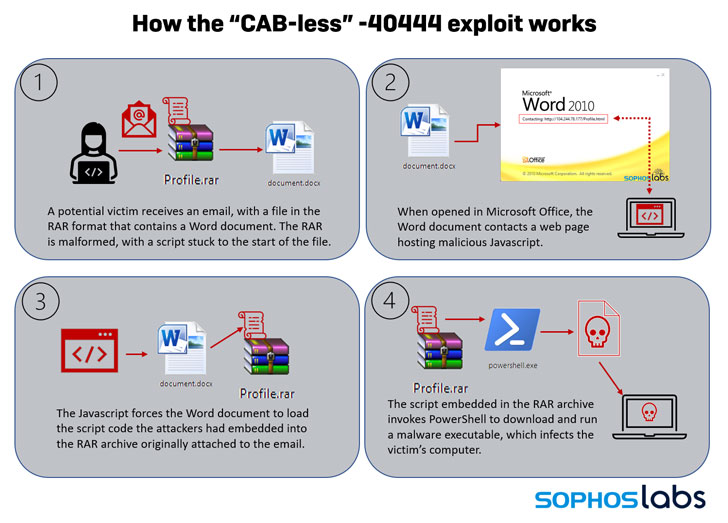
CAB-less 40444, as the modified exploit is
called, lasted for 36 hours between October 24 and 25, during which
spam emails containing a malformed RAR archive file were sent to
potential victims. The RAR file, in turn, included a script written
in Windows Script Host (WSH[8]) and a Word Document
that, upon opening, contacted a remote server hosting malicious
JavaScript.
Consequently, the JavaScript code utilized the Word Document as
a conduit to launch the WSH script and execute an embedded
PowerShell command in the RAR file to retrieve the Formbook[9]
malware payload from an attacker-controlled website.
As for why the exploit disappeared a little over a day in use,
clues lie in the fact that the modified RAR archive files wouldn’t
work with older versions of the WinRAR utility. “So, unexpectedly,
in this case, users of the much older, outdated version of WinRAR
would have been better protected than users of the latest release,”
the researchers said.
“This research is a reminder that patching alone cannot protect
against all vulnerabilities in all cases,” SophosLabs Principal
Researcher Andrew Brandt said. “Setting restrictions that prevent a
user from accidentally triggering a malicious document helps, but
people can still be lured into clicking the ‘enable content’
button.”
“It is therefore vitally important to educate employees and
remind them to be suspicious of emailed documents, especially when
they arrive in unusual or unfamiliar compressed file formats from
people or companies they don’t know,” Brandt added.
References
- ^
said
(news.sophos.com) - ^
CVE-2021-40444
(msrc.microsoft.com) - ^
Patch
Tuesday updates (thehackernews.com) - ^
multiple
attacks (thehackernews.com) - ^
uncovered
(thehackernews.com) - ^
reported
(thehackernews.com) - ^
proof-of-concept Office exploit
(github.com) - ^
WSH
(en.wikipedia.org) - ^
Formbook
(malpedia.caad.fkie.fraunhofer.de)
Read more https://thehackernews.com/2021/12/new-exploit-lets-malware-attackers.html