
Microsoft is urging customers to patch two security
vulnerabilities in Active Directory domain controllers that it
addressed in November[1]
following the availability of a proof-of-concept (PoC) tool on
December 12.
The two vulnerabilities — tracked as CVE-2021-42278[2]
and CVE-2021-42287[3]
— have a severity rating of 7.5 out of a maximum of 10 and concern
a privilege escalation flaw affecting the Active Directory Domain
Services (AD DS) component. Credited with discovering and reporting
both the bugs is Andrew Bartlett of Catalyst IT.
Active Directory is a directory service[4]
that runs on Microsoft Windows Server and is used for identity and
access management. Although the tech giant marked the shortcomings
as “exploitation Less Likely[5]” in its assessment, the
public disclosure of the PoC has prompted renewed calls for
applying the fixes to mitigate any potential exploitation by threat
actors.
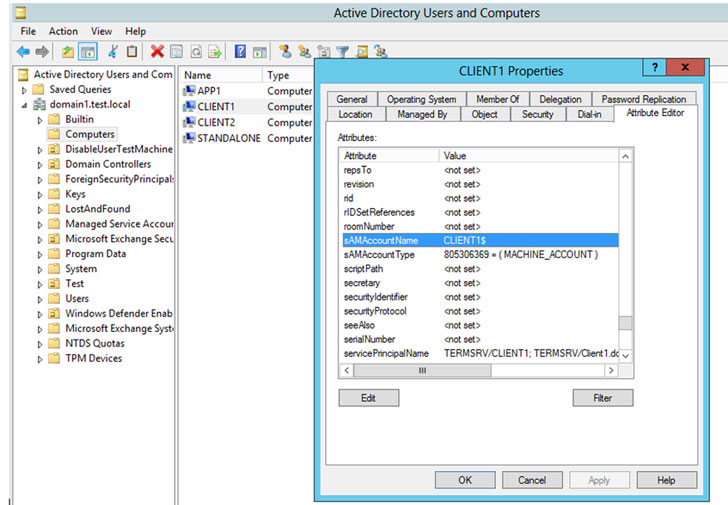
While CVE-2021-42278 enables an attacker to tamper with the
SAM-Account-Name attribute — which is used to log a user into
systems in the Active Directory domain, CVE-2021-42287 makes it
possible to impersonate the domain controllers. This effectively
grants a bad actor with domain user credentials to gain access as a
domain admin[6]
user.
“When combining these two vulnerabilities, an attacker can
create a straightforward path to a Domain Admin user in an Active
Directory environment that hasn’t applied these new updates,”
Microsoft’s senior product manager Daniel Naim said[7]. “This escalation attack
allows attackers to easily elevate their privilege to that of a
Domain Admin once they compromise a regular user in the
domain.”
The Redmond-based company has also provided a step-by-step guide
to help users ascertain if the vulnerabilities might have been
exploited in their environments. “As always, we strongly advise
deploying the latest patches on the domain controllers as soon as
possible,” Microsoft said.
References
- ^
addressed in November
(thehackernews.com) - ^
CVE-2021-42278
(msrc.microsoft.com) - ^
CVE-2021-42287
(msrc.microsoft.com) - ^
directory service
(en.wikipedia.org) - ^
exploitation Less Likely
(www.microsoft.com) - ^
domain
admin (docs.microsoft.com) - ^
said
(techcommunity.microsoft.com)
Read more https://thehackernews.com/2021/12/active-directory-bugs-could-let-hackers.html