disclosed a security vulnerability in Bluetooth that could
potentially allow an attacker to spoof a remotely paired device,
exposing over a billion of modern devices to hackers.
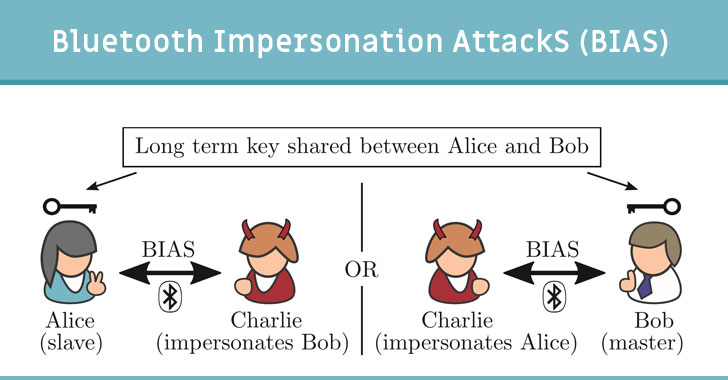
The attacks, dubbed Bluetooth Impersonation AttackS[2] or BIAS, concerns
Bluetooth Classic, which supports Basic Rate (BR) and Enhanced Data
Rate (EDR) for wireless data transfer between devices.
“The Bluetooth specification contains vulnerabilities enabling
to perform impersonation attacks during secure connection
establishment,” the researchers outlined[3] in the paper. “Such
vulnerabilities include the lack of mandatory mutual
authentication, overly permissive role switching, and an
authentication procedure downgrade.”
Given the widespread impact of the vulnerability, the
researchers said they responsibly disclosed the findings to the
Bluetooth Special Interest Group (SIG), the organization that
oversees the development of Bluetooth standards in December
2019.
The Bluetooth SIG
acknowledged the flaw, adding it has made changes to resolve
the vulnerability. “These changes will be introduced into a future
specification revision,” the SIG said.
The BIAS Attack
For BIAS to be successful, an attacking device would need to be
within the wireless range of a vulnerable Bluetooth device that has
previously established a BR/EDR connection with another Bluetooth
device whose address is known to the attacker.
The flaw stems from how two previously paired devices handle the
long term key, also known as link key, that’s used to mutually
authenticate the devices and activate a secure connection between
them.
The link key also ensures that users don’t have to pair their
devices every time a data transfer occurs between, say, a wireless
headset and a phone, or between two laptops.
The attacker, then, can exploit the bug to request a connection
to a vulnerable device by forging the other end’s Bluetooth
address, and vice versa, thus spoofing the identity and gaining
full access to another device without actually possessing the long
term pairing key that was used to establish a connection.
Put differently, the attack allows a bad actor to impersonate
the address of a device previously paired with the target
device.
What’s more, BIAS can be combined with other attacks, including the
KNOB (Key Negotiation of
Bluetooth) attack, which occurs when a third party forces two
or more victims to agree on an encryption key with reduced entropy,
thus allowing the attacker to brute-force the encryption key and use
it to decrypt communications.
Devices Not Updated Since December 2019 Affected
With most standard-compliant Bluetooth devices impacted by the
vulnerability, the researchers said they tested the attack against
as many as 30 devices, including smartphones, tablets, laptops,
headphones, and single-board computers such as Raspberry Pi. All
the devices were found to be vulnerable to BIAS attacks.
The Bluetooth SIG said it’s updating the Bluetooth Core
Specification to “avoid a downgrade of secure connections to legacy
encryption,” which lets the attacker initiate “a master-slave role
switch to place itself into the master role and become the
authentication initiator.”
In addition to urging companies to apply the necessary patches,
the organization is recommending Bluetooth users to install the
latest updates from the device and operating system
manufacturers.
“The BIAS attacks are the first uncovering issues related to
Bluetooth’s secure connection establishment authentication
procedures, adversarial role switches, and Secure Connections
downgrades,” the research team concluded. “The BIAS attacks are
stealthy, as Bluetooth secure connection establishment does not
require user interaction.”
References
- ^
vulnerability in Bluetooth
(www.kb.cert.org) - ^
Bluetooth Impersonation AttackS
(francozappa.github.io) - ^
outlined
(francozappa.github.io) - ^
Bluetooth SIG acknowledged
(www.bluetooth.com) - ^
Key Negotiation of Bluetooth
(thehackernews.com) - ^
brute-force the encryption key
(kb.cert.org)
Read more http://feedproxy.google.com/~r/TheHackersNews/~3/jbyug0Ugy9A/hacking-bluetooth-vulnerability.html