discovered in the wild that uses HTTP status codes to control
compromised systems targeted in a recent campaign against
diplomatic entities in Europe.
The cyberespionage malware—traced to Turla APT with
“medium-to-low level of confidence” based on the history of
compromised victims—spread via an initial dropper that masks itself
as a visa application, the Global Research and Analysis Team at
Kaspersky[1]
discovered.
The Turla APT, a Russian-based threat group,
has a long history of
carrying out espionage and watering hole attacks spanning various
sectors, including governments, embassies, military, education,
research, and pharmaceutical companies.
[2][3]
First documented by G-Data in 2014,
COMpfun received a significant upgrade last year (called
“Reductor”) after Kaspersky found that the malware was used to spy
on a victim’s browser activity by staging man-in-the-middle
(MitM) attacks on
encrypted web traffic via a tweak in the browser’s random numbers
generator (PRNG).
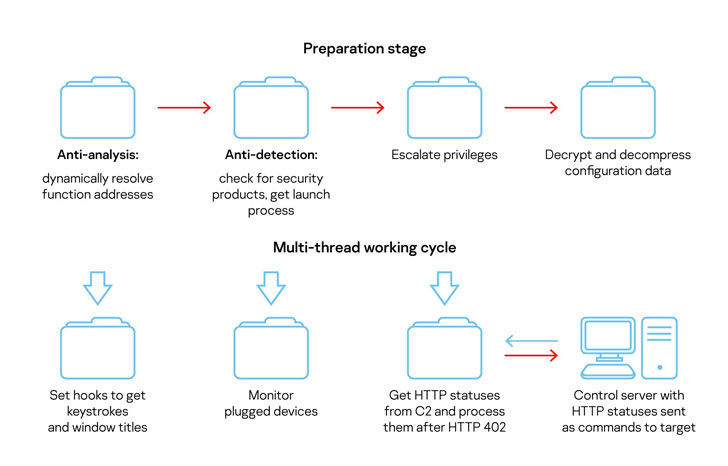
capturing keystrokes, screenshots, and exfiltrating sensitive data,
this new variant of COMpfun monitors for any removable USB devices
plugged to the infected systems to spread further and receives
commands from an attacker-controlled server in the form of HTTP
status codes.
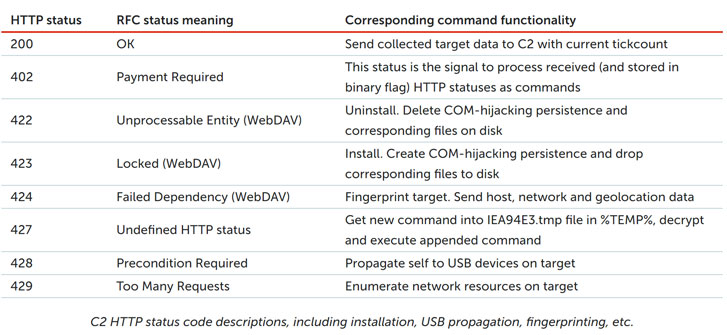
“We observed an interesting C2 communication protocol utilizing
rare HTTP/HTTPS status codes (check IETF RFC 7231, 6585, 4918),”
the researchers said. “Several HTTP status codes (422-429) from the
Client Error class let the Trojan know what the operators want to
do. After the control server sends the status ‘Payment Required’
(402), all these previously received commands are
executed.”
HTTP status codes
are standardized responses issued by a server in response to a
client’s request made to the server. By issuing remote commands in
the form of status codes, the idea is to obfuscate any detection of
malicious activity while scanning internet traffic.
encrypted configuration data. Created for web content caching
reasons, this marker could also be used to filter unwanted requests
to the C2, e.g., those that are from network scanners rather than
targets.”
“To exfiltrate the target’s data to the C2 over HTTP/HTTPS, the
malware uses RSA encryption. To hide data locally, the Trojan
implements LZNT1 compression and one-byte XOR encryption.”
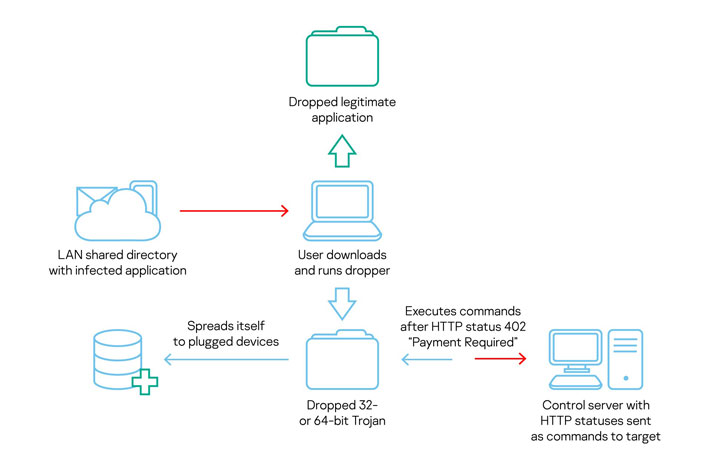
application is delivered to a target remains unclear, the initial
dropper, upon download, runs the next stage of malware, which
communicates with the command-and-control (C2) server using an HTTP
status-based module.
“The malware operators retained their focus on diplomatic
entities, and the choice of a visa-related application — stored on
a directory shared within the local network — as the initial
infection vector worked in their favor,” Kaspersky researchers
concluded.
“The combination of a tailored approach to their targets and the
ability to generate and execute their ideas certainly makes the
developers behind COMpfun a strong offensive team.
References
Read more http://feedproxy.google.com/~r/TheHackersNews/~3/P0g3H2YLRTs/malware-http-codes.html