research revealing how over 1300 Android
apps are collecting sensitive data even when users have
explicitly denied the required permissions.
The research was primarily focused on how app developers abuse
multiple ways around to collect location data, phone identifiers,
and MAC addresses of their users by exploiting both covert and side
channels.
Now, a separate team of cybersecurity researchers has
successfully demonstrated a new side-channel attack that could
allow malicious apps to eavesdrop on the voice coming out of your
smartphone’s loudspeakers without requiring any device
permission.
Abusing Android Accelerometer to Capture Loudspeaker Data
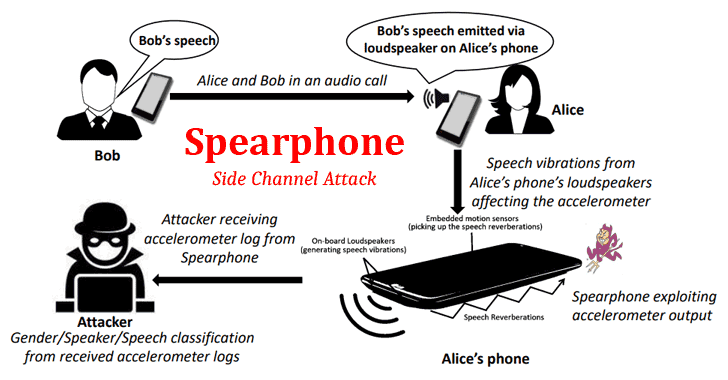
Dubbed Spearphone, the newly demonstrated attack takes
advantage of a hardware-based motion sensor, called an
accelerometer, which comes built into most Android devices and can
be unrestrictedly accessed by any app installed on a device even
with zero permissions.
An accelerometer is a motion sensor that lets apps monitor the
movement of a device, such as tilt, shake, rotation, or swing, by
measuring the time rate of change of velocity with respect to
magnitude or direction.
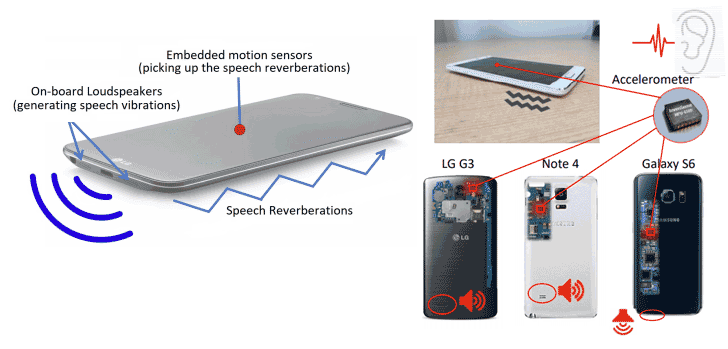
the same surface as the embedded motion sensors, it produces
surface-borne and aerial speech reverberations in the body of the
smartphone when loudspeaker mode is enabled.
Discovered by a team of security researchers—Abhishek Anand,
Chen Wang, Jian Liu, Nitesh Saxena, Yingying Chen—the attack can be
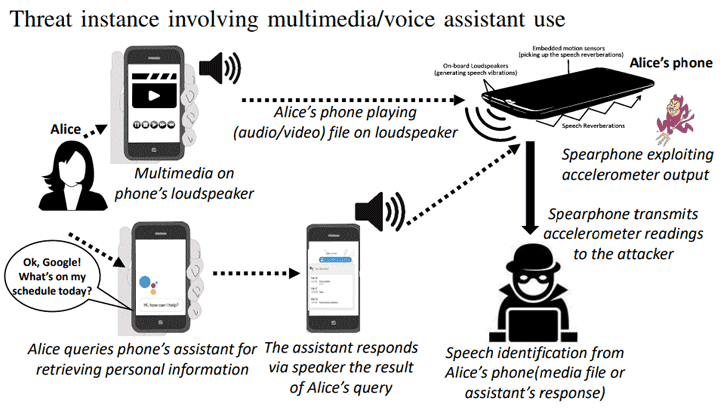
triggered when the victim either places a phone or video call on
the speaker mode, or attempts to listen to a media file, or
interacts with the smartphone assistant.
As a proof-of-concept, researchers created an Android app, which
mimics the behavior of a malicious attacker, designed to record
speech reverberations using the accelerometer and send captured
data back to an attacker-controlled server.
Researchers say the remote attacker could then examine the captured
readings, in an offline manner, using signal processing along with
“off-the-shelf” machine learning techniques to reconstruct spoken
words and extract relevant information about the intended victim.
Spearphone Attack: Spy On Calls, Voice Notes, and
Multimedia
According to the researchers, the Spearphone attack can be used to
learn about the contents of the audio played by the victim—selected
from the device gallery over the Internet, or voice notes received
over the instant messaging applications like WhatsApp.
“The proposed attack can eavesdrop on voice calls to compromise the
speech privacy of a remote end-user in the call,” the researchers
explain.
“Personal information such as social security number, birthday,
age, credit card details, banking account details, etc. consist
mostly of numerical digits. So, we believe that the limitation of
our dataset size should not downplay the perceived threat level of
our attack.”
assistants, including Google Assistant and Samsung Bixby, and
successfully captured response (output results) to a user query
over the phone’s loudspeaker.
tools, their Spearphone attack has “significant value as it can be
created by low-profile attackers.”
Besides this, Spearphone attack can also be used to simply
determine some other user’s speech characteristics, including
gender classification, with over 90% accuracy, and speaker
identification, with over 80% accuracy.
“For example, an attacker can learn if a particular individual (a
person of interest under surveillance by law enforcement) was in
contact with the phone owner at a given time,” the researchers say.
confirmed The Hacker News that the attack can not be used to
capture targeted users’ voice or their surroundings because “that
is not strong enough to affect the phone’s motion sensors,
especially given the low sampling rates imposed by the OS,” and
thus also doesn’t interfere with the accelerometer readings.
For more details, we encourage our readers to head onto the
full research
paper[3] [PDF], titled
“Spearphone: A Speech Privacy Exploit via Accelerometer-Sensed
Reverberations from Smartphone Loudspeakers.”
The paper also discussed some possible mitigation techniques
that may help prevent such attacks, as well as a few limitations,
including low sampling rate and variation in maximum volume and
voice quality of different phone that could negatively impact the
accelerometer readings.
In a previous report, we also explained how malware apps were
found using motion-sensors of infected Android devices to avoid detection by
monitoring[4] if the device is running
in a run emulator or belongs to a legitimate user with
movements.
References
- ^
over 1300 Android apps
(thehackernews.com) - ^
Nitesh Saxena
(twitter.com) - ^
full research paper
(arxiv.org) - ^
avoid detection by monitoring
(thehackernews.com)
Read more http://feedproxy.google.com/~r/TheHackersNews/~3/RqA6x7PoJpA/android-side-channel-attacks.html