
spyware that’s currently fully undetected across all major
antivirus security software products, and includes rarely seen
functionalities with regards to most Linux malware, The Hacker News
learned.
It’s a known fact that there are a very few strains of Linux
malware exist in the wild as compared to Windows viruses because of
its core architecture and also due to its low market share, and
also many of them don’t even have a wide range of
functionalities.
In recent years, even after the disclosure of severe critical
vulnerabilities in various flavors of Linux operating systems and
software, cybercriminals failed to leverage most of them in their
attacks.
Instead, a large number of malware targeting Linux ecosystem is
primarily focused on cryptocurrency mining
attacks[1] for financial gain and
creating DDoS
botnets[2] by hijacking vulnerable
servers.
However, researchers at security firm Intezer Labs recently
discovered a new Linux backdoor implant that appears to be under
development and testing phase but already includes several
malicious modules to spy on Linux desktop users.
EvilGnome: New Linux Spyware
Dubbed EvilGnome, the malware has been designed to take
desktop screenshots, steal files, capture audio recording from the
user’s microphone as well as download and execute further
second-stage malicious modules.
According to a new report Intezer Labs shared
with The Hacker News prior to its release, the sample of
EvilGnome it discovered on VirusTotal also contains an unfinished
keylogger functionality, which indicates that it was uploaded
online mistakenly by its developer.
[3]
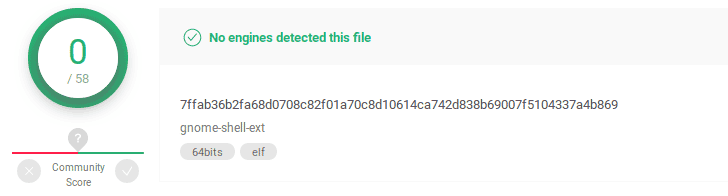
extension, a program that lets Linux users extend the functionality
of their desktops.
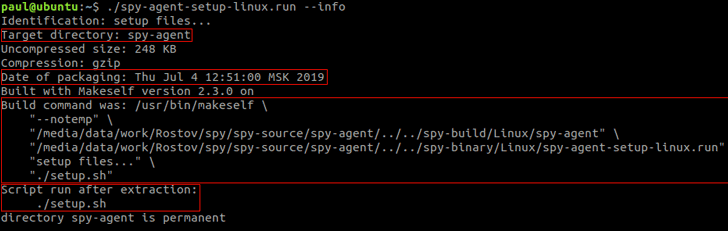
According to the researchers, the implant is delivered in the
form of a self-extracting archive shell script created with
‘makeself,’ a small shell script that generates a self-extractable
compressed tar archive from a directory.
The Linux implant also gains persistence on a targeted system using
crontab, similar to windows task scheduler, and sends stolen user
data to a remote attacker-controlled server.
“Persistence is achieved by registering gnome-shell-ext.sh to
run every minute in crontab. Finally, the script executes
gnome-shell-ext.sh, which in turn launches the main executable
gnome-shell-ext,” the researchers said.
EvilGnome’s Spyware Modules
The Spy Agent of EvilGnome contains five malicious modules called
“Shooters,” as explained below:
- ShooterSound — this module uses PulseAudio to capture
audio from the user’s microphone and uploads the data to the
operator’s command-and-control server. - ShooterImage — this module uses the Cairo open source
library to captures screenshots and uploads them to the C&C
server. It does so by opening a connection to the XOrg Display
Server, which is the backend to the Gnome desktop. - ShooterFile — this module uses a filter list to scan the
file system for newly created files and uploads them to the C&C
server. - ShooterPing — the module receives new commands from the
C&C server, like download and execute new files, set new
filters for file scanning, download and set new runtime
configuration, exfiltrate stored output to the C&C server, and
stop any shooter module from running. - ShooterKey — this module is unimplemented and unused,
which most likely is an unfinished keylogging module.
Notably, all the above modules encrypt their output data and
decrypt commands received from the C&C server with RC5 key
“sdg62_AS.sa$die3,” using a modified version of a Russian open
source library.
Possible Connection b/w EvilGnome and Gamaredon Hacking
Group
Furthermore, the researchers also found connections between
EvilGnome and Gamaredon Group, an alleged Russian threat group that
has been active since at
least 2013[4] and has targeted
individuals working with the Ukrainian government.
Here below, I have briefed some of the similarities between
EvilGnome and Gamaredon Group:
- EvilGnome uses a hosting provider that has been used by
Gamaredon Group for years and continues to be used by it. - EvilGnome also found to be operating on an IP address that was
controlled by the Gamaredon group two months ago. - EvilGnome attackers are also using ‘.space’ TTLD for their
domains, just as the Gamaredon Group. - EvilGnome employs techniques and modules—like the use of SFX,
persistence with task scheduler, and the deployment of
information-stealing tools—that remind of Gamaredon Group’s Windows
tools.
How to Detect EvilGnome Malware?
To check if your Linux system is infected with the EvilGnome
spyware, you can look for the “gnome-shell-ext” executable in the
“~/.cache/gnome-software/gnome-shell-extensions” directory.
“We believe this is a premature test version. We anticipate newer
versions to be discovered and reviewed in the future, which could
potentially shed more light into the group’s operations,”
researchers conclude.
detect the EvilGnome malware, researchers recommend concerned Linux
administrators to block the Command & Control IP addresses listed
in the IOC section of Intezer’s blog post.
References
- ^
cryptocurrency mining attacks
(thehackernews.com) - ^
DDoS botnets
(thehackernews.com) - ^
Intezer Labs shared with The Hacker
News (www.intezer.com) - ^
active since at least 2013
(unit42.paloaltonetworks.com)
Read more http://feedproxy.google.com/~r/TheHackersNews/~3/ZgnzKRnkdkE/linux-gnome-spyware.html