Google on Monday disclosed details about an ongoing campaign
carried out by a government-backed threat actor from North Korea
that has targeted security researchers working on vulnerability
research and development.
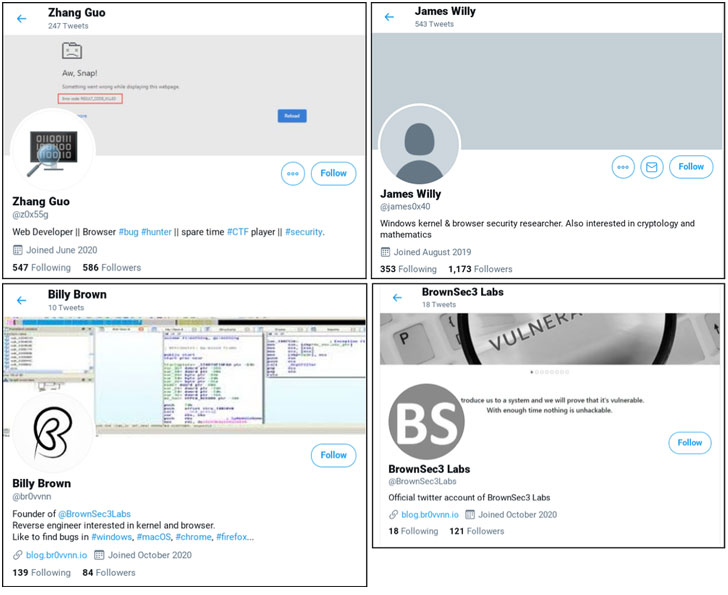
The internet giant’s Threat Analysis Group (TAG) said the
adversary created a research blog and multiple profiles on various
social media platforms such as Twitter, Twitter, LinkedIn,
Telegram, Discord, and Keybase in a bid to communicate with the
researchers and build trust.
The goal, it appears, is to steal exploits developed by the
researchers for possibly undisclosed vulnerabilities, thereby
allowing them to stage further attacks on vulnerable targets of
their choice.
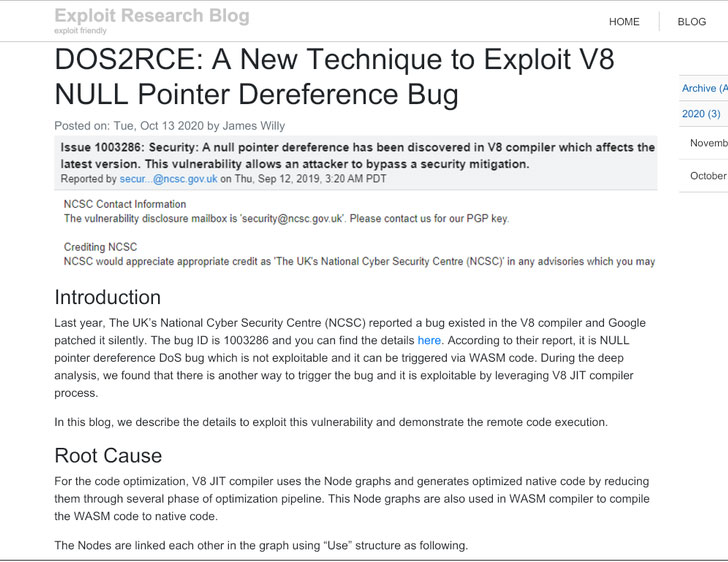
“Their blog contains write-ups and analysis of vulnerabilities
that have been publicly disclosed, including ‘guest’ posts from
unwitting legitimate security researchers, likely in an attempt to
build additional credibility with other security researchers,”
said[1]
TAG researcher Adam Weidemann.
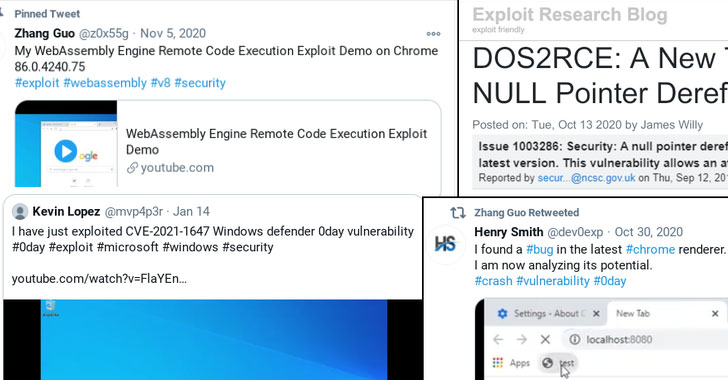
In one instance, the actor used Twitter to share a YouTube video
of what it claimed to be an exploit for a recently patched Windows
Defender flaw (CVE-2021-1647[2]), when in reality, the
exploit turned out to be fake.
The North Korean hackers are also said to have used a “novel
social engineering method” to hit security researchers by asking
them if they would like to collaborate on vulnerability research
together and then provide the targeted individual with a Visual
Studio Project.
This Visual Studio Project, besides containing the source code
for exploiting the vulnerability, included a custom malware that
establishes communication with a remote command-and-control (C2)
server to execute arbitrary commands on the compromised system.
What’s more, TAG said it observed several cases where
researchers were infected after visiting the research blog,
following which a malicious service was installed on the machine,
and an in-memory backdoor would begin beaconing to a C2 server.
With the victim systems running fully patched and up-to-date
versions of Windows 10 and Chrome web browser, the exact mechanism
of compromise remains unknown. But it’s suspected that the threat
actor likely leveraged zero-day vulnerabilities in Windows 10 and
Chrome to deploy the malware.
“If you are concerned that you are being targeted, we recommend
that you compartmentalize your research activities using separate
physical or virtual machines for general web browsing, interacting
with others in the research community, accepting files from third
parties and your own security research,” Weidemann said.
References
- ^
said
(blog.google) - ^
CVE-2021-1647
(thehackernews.com)