In 1982, when SMTP was first specified, it did not contain any
mechanism for providing security at the transport level to secure
communications between mail transfer agents.
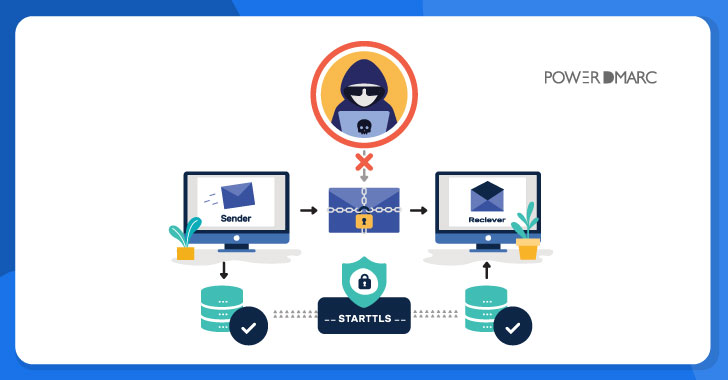
Later, in 1999, the STARTTLS command was added to SMTP that in
turn supported the encryption of emails in between the servers,
providing the ability to convert a non-secure connection into a
secure one that is encrypted using TLS protocol.
However, encryption is optional in SMTP, which implies that
emails can be sent in plaintext. Mail Transfer Agent-Strict
Transport Security (MTA-STS) is a relatively new standard
that enables mail service providers the ability to enforce
Transport Layer Security (TLS) to secure SMTP connections and to
specify whether the sending SMTP servers should refuse to deliver
emails to MX hosts that that does not offer TLS with a reliable
server certificate. It has been proven to successfully mitigate TLS
downgrade attacks and Man-in-the-Middle (MitM) attacks.
SMTP TLS Reporting (TLS-RPT) is a standard that
enables reporting issues in TLS connectivity experienced by
applications that send emails and detect misconfigurations. It
enables the reporting of email delivery issues that take place when
an email isn’t encrypted with TLS. In September 2018, the standard
was first documented in RFC 8460.
Why Do Your Emails Require Encryption in Transit?
The primary goal is to improve transport-level security during
SMTP communication, ensuring the privacy of email traffic.
Moreover, encryption of inbound messages addressed to your domain
enhances information security, using cryptography to safeguard
electronic information.
Furthermore, cryptographic attacks such as Man-in-the-Middle
(MitM) SMTP Downgrade attacks, as well as DNS spoofing attacks,
have been gaining popularity in recent times and have become a
common practice among cybercriminals, which can be evaded by
enforcing TLS encryption and extending support to secure
protocols.
How Is a MITM Attack Launched?
Since encryption had to be retrofitted into SMTP protocol, the
upgrade for encrypted delivery has to rely on a STARTTLS command. A
MITM attacker can easily exploit this feature by performing an
SMTP downgrade attack on the SMTP connection by
tampering with the upgrade command by replacing or deleting it,
forcing the client to fall back to sending the email in
plaintext.
After intercepting the communication, a MITM attacker can easily
steal the decrypted information and access the email’s content.
This is because SMTP is the industry standard for mail transfer. It
uses opportunistic encryption, which implies that encryption is
optional and emails can still be delivered in cleartext.
MITM attacks can also be launched in the form of a DNS
Spoofing Attack:
As DNS is an unencrypted system, a cybercriminal can replace the
MX records in the DNS query response with a mail server that they
have access to and are in control of, thereby easily diverting the
DNS traffic flowing through the network.
The mail transfer agent, in that case, delivers the email to the
server of the attacker, enabling him to access and tamper with the
email content. The email can be subsequently forwarded to the
intended recipient’s server without being detected.
When you deploy MTA-STS, the MX addresses are fetched over DNS
and compared to those found in the MTA-STS policy file, which is
served over an HTTPS secured connection, thereby mitigating DNS
spoofing attacks.
Apart from enhancing information security and mitigating
pervasive monitoring attacks, encrypting messages in transit also
solves multiple SMTP security problems.
Achieving Enforced TLS Encryption of Emails with MTA-STS
If you fail to transport your emails over a secure connection,
your data could be compromised or even modified and tampered with
by a cyber attacker.
Here is where MTA-STS steps in and fixes this issue, enabling
safe transit for your emails as well as successfully mitigating
cryptographic attacks and enhancing information security by
enforcing TLS encryption.
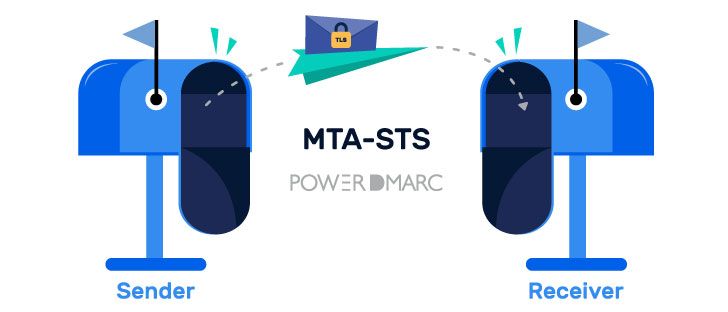
Simply put,MTA-STS enforces the transfer of emails over a TLS
encrypted pathway. In case an encrypted connection cannot be
established, the email is not delivered at all, instead of being
delivered in cleartext.
Furthermore, MTAs fetch and store MTA-STS policy files, which
securely serve the MX addresses making it more difficult for
attackers to launch a DNS spoofing attack.
MTA-STS offers protection against :
- Downgrade attacks
- Man-In-The-Middle (MITM) attacks
- It solves multiple SMTP security problems, including expired
TLS certificates and lack of support for secure protocols. - DNS Spoofing attacks
Major mail service providers, such as Microsoft, Oath, and
Google, support MTA-STS. Google, being the largest industry player,
attains center-stage when adopting any protocol, and the adoption
of MTA-STS by google indicates the extension of support towards
secure protocols and highlights the importance of email encryption
in transit.
Troubleshooting Issues in Email Delivery with TLS-RPT
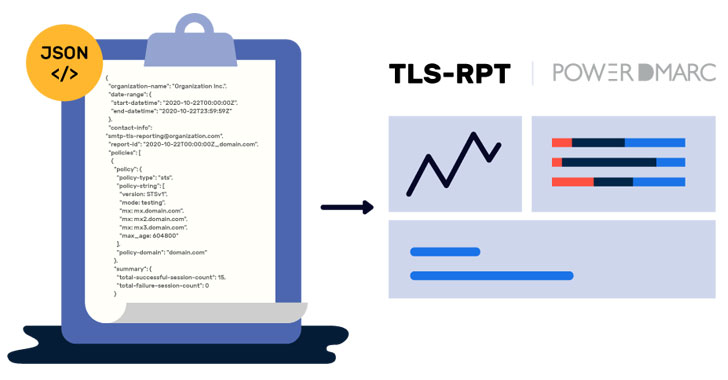
SMTP TLS Reporting provides domain owners with diagnostic
reports (in JSON file format) with elaborate details on emails
addressed to your domain and face delivery issues or couldn’t be
delivered due to a downgrade attack or other issues so that you can
fix the problem proactively.
As soon as you enable TLS-RPT, acquiescent Mail Transfer Agents
will begin sending diagnostic reports regarding email delivery
issues between communicating servers to the designated email
domain.
The reports are typically sent once a day, covering and
conveying the MTA-STS policies observed by senders, traffic
statistics as well as information on failure or issues in email
delivery.
The need for deploying TLS-RPT :
- In case an email fails to be sent to your domain due to any
issue in delivery, you will get notified.
- TLS-RPT provides enhanced visibility on all your email channels
so that you gain better insight on all that is going on in your
domain, including messages that are failing to be delivered.
- TLS-RPT provides in-depth diagnostic reports that enable you to
identify and get to the root of the email delivery issue and fix it
without any delay.
Adopting MTA-STS and TLS-RPT Made Easy and Speedy by
PowerDMARC
MTA-STS requires an HTTPS-enabled web server with a valid
certificate, DNS records, and constant maintenance. PowerDMARC
makes your life a whole lot easier by handling all of that for you,
completely in the background- from generating certificates
and MTA-STS policy files to policy enforcement, we help you evade
the complexities involved in adopting the protocol. Once
we help you set it up with just a few clicks, you never even have
to think about it again.
With the help of PowerDMARC’s Email Authentication Services[1], you can deploy Hosted
MTA-STS[2] at your organization
without the hassle and at a very speedy pace, with the help of
which you can enforce emails to be sent to your domain over a TLS
encrypted connection, thereby making your connection secure and
keeping MITM attacks at bay.
PowerDMARC makes your life easier by making the process of
implementation of TLS-RPT[3]
easy and speedy, at your fingertips! As soon as you sign up with
PowerDMARC and enable SMTP TLS Reporting for your domain,
we take the pain of converting the complicated JSON files
containing your reports of email delivery issues, into simple,
readable documents (per result and per sending source), that you
can go through and understand with ease! PowerDMARC’s
platform automatically detects and subsequently conveys the issues
you are facing in email delivery, so that you can promptly address
and resolve them in no time!
PowerDMARC is a single email authentication SaaS platform that
combines all email authentication best practices such as DMARC[4], SPF, DKIM, BIMI,
MTA-STS and TLS-RPT, under the same roof. So sign up to get your
free DMARC
Analyzer[5] today!
References
- ^
Email Authentication Services
(powerdmarc.com) - ^
MTA-STS
(powerdmarc.com) - ^
TLS-RPT
(powerdmarc.com) - ^
DMARC
(powerdmarc.com) - ^
free DMARC Analyzer
(powerdmarc.com)