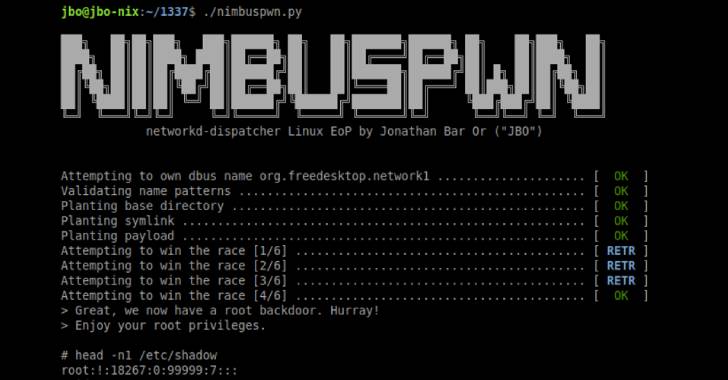
Microsoft on Tuesday disclosed a set of two privilege escalation
vulnerabilities in the Linux operating system that could
potentially allow threat actors to carry out an array of nefarious
activities.
Collectively called “Nimbuspwn,” the flaws “can be
chained together to gain root privileges on Linux systems, allowing
attackers to deploy payloads, like a root backdoor, and perform
other malicious actions via arbitrary root code execution,”
Jonathan Bar Or of the Microsoft 365 Defender Research Team
said[1]
in a report.
On top of that, the defects — tracked as CVE-2022-29799 and
CVE-2022-29800 — could also be weaponized as a vector for root
access to deploy more sophisticated threats such as ransomware.
The vulnerabilities are rooted in a systemd[2] component called
networkd-dispatcher[3], a daemon program[4]
for the network manager system service that’s designed to dispatch
network status changes.
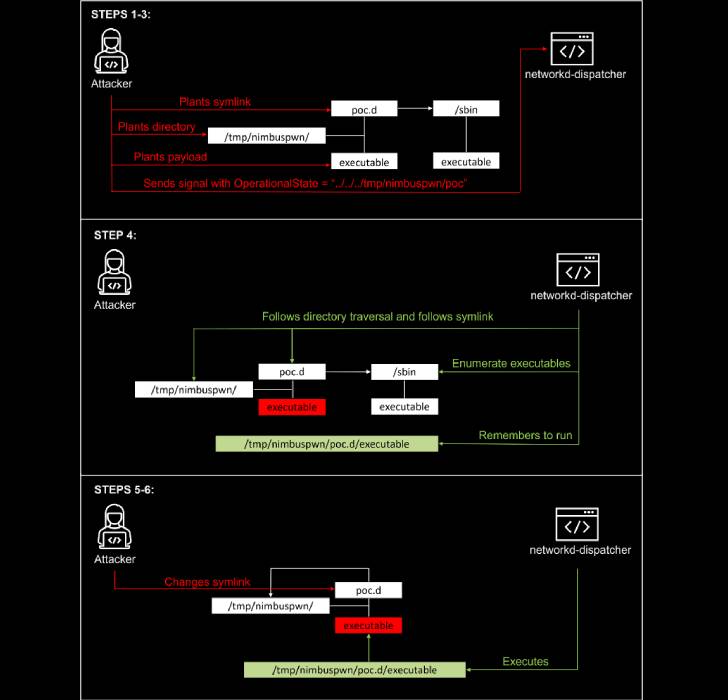
Specifically, they relate to a combination of directory traversal[5]
(CVE-2022-29799), symbolic link (aka symlink) race[6], and time-of-check to time-of-use[7] (CVE-2022-29800) flaws,
leading to a scenario where an adversary in control of a rogue
D-Bus[8]
service[9]
can plant and execute malicious backdoors on the compromised
endpoints.
Users of networkd-dispatcher are highly recommended to update
their instances to the latest version to mitigate potential arising
out of exploiting the flaws.
“The growing number of vulnerabilities on Linux environments
emphasize the need for strong monitoring of the platform’s
operating system and its components,” Bar Or said.
“This constant bombardment of attacks spanning a wide range of
platforms, devices, and other domains emphasizes the need for a
comprehensive and proactive vulnerability management approach that
can further identify and mitigate even previously unknown exploits
and issues.”
References
- ^
said
(www.microsoft.com) - ^
systemd
(en.wikipedia.org) - ^
networkd-dispatcher
(manpages.ubuntu.com) - ^
daemon
program (gitlab.com) - ^
directory traversal
(en.wikipedia.org) - ^
symbolic
link (aka symlink) race (en.wikipedia.org) - ^
time-of-check to time-of-use
(en.wikipedia.org) - ^
D-Bus
(en.wikipedia.org) - ^
service
(unit42.paloaltonetworks.com)
Read more https://thehackernews.com/2022/04/microsoft-discovers-new-privilege.html