A malware campaign targeting South Korean entities that came to
light earlier this year has been attributed to a North Korean
nation-state hacking group called Andariel, once again indicating
that Lazarus[1]
attackers are following the trends and their arsenal[2]
is in constant development[3].
“The way Windows commands and their options were used in this
campaign is almost identical to previous Andariel activity,”
Russian cybersecurity firm Kaspersky said[4]
in a deep-dive published Tuesday. Victims of the attack are in the
manufacturing, home network service, media, and construction
sectors.
Designated as part of the Lazarus constellation, Andariel is
known for unleashing attacks on South Korean organizations and
businesses using specifically tailored methods created for maximum
effectivity. In September 2019, the sub-group, along with Lazarus
and Bluenoroff, was sanctioned by the U.S. Treasury
Department[5] for their malicious
cyber activity on critical infrastructure.
Andariel is believed to have been active since at least May
2016.
North Korea has been behind an increasingly orchestrated effort[6] aimed at infiltrating
computers of financial institutions in South Korea and around the
world as well as staging cryptocurrency heists[7]
to fund the cash-strapped country in an attempt to circumvent the
stranglehold of economic sanctions[8]
imposed to stop the development of its nuclear weapons program.
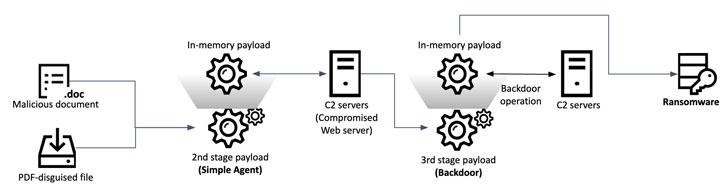
The findings from Kaspersky build upon a previous report from Malwarebytes[9] in April 2021, which
documented a novel infection chain that distributed phishing emails
weaponized with a macro embedded in a Word file that’s executed
upon opening in order to deploy malicious code concealed in the
form of a bitmap (.BMP) image file to drop a remote access trojan
(RAT) on targeted systems.
According to the latest analysis, the threat actor, besides
installing a backdoor, is also said to have delivered
file-encrypting ransomware to one of its victims, implying a
financial motive to the attacks. It’s worth noting that Andariel
has a track record of attempting to steal bank card information by
hacking into ATMs to withdraw cash or sell customer information on
the black market.
“This ransomware sample is custom made and specifically
developed by the threat actor behind this attack,” Kaspersky Senior
Security Researcher Seongsu Park said. “This ransomware is
controlled by command line parameters and can either retrieve an
encryption key from the C2 [server] or, alternatively, as an
argument at launch time.”
The ransomware is designed to encrypt all files in the machine
with the exception of system-critical “.exe,” “.dll,” “.sys,”
“.msiins,” and “.drv” extensions in return for paying a bitcoin
ransom to gain access to a decrypt tool and unique key to unlock
the scrambled files.
Kaspersky’s attribution to Andariel stems from overlaps in the
XOR-based decryption routine that have been incorporated into the
group’s tactics as early as 2018 and in the post-exploitation
commands executed on victim machines.
“The Andariel group has continued to focus on targets in South
Korea, but their tools and techniques have evolved considerably,”
Park said. “The Andariel group intended to spread ransomware
through this attack and, by doing so, they have underlined their
place as a financially motivated state-sponsored actor.”
References
- ^
Lazarus
(malpedia.caad.fkie.fraunhofer.de) - ^
arsenal
(thehackernews.com) - ^
constant
development (thehackernews.com) - ^
said
(securelist.com) - ^
sanctioned by the U.S. Treasury
Department (thenextweb.com) - ^
increasingly orchestrated effort
(blog.lexfo.fr) - ^
cryptocurrency heists
(thehackernews.com) - ^
economic
sanctions (en.wikipedia.org) - ^
previous
report from Malwarebytes
(thehackernews.com)