
down a portion of a malware botnet comprising at least 35,000
compromised Windows systems that attackers were secretly using to
mine Monero cryptocurrency.
The botnet, named “VictoryGate,” has been active since May 2019,
with infections mainly reported in Latin America, particularly Peru
accounting for 90% of the compromised devices.
“The main activity of the botnet is mining Monero
cryptocurrency,” ESET said. “The
victims include organizations in both public and private sectors,
including financial institutions.”
[1]
ESET said it worked with dynamic DNS provider No-IP to take down
the malicious command-and-control (C2) servers and that it set up
fake domains (aka sinkholes) to monitor the botnet’s activity.
The sinkhole data shows that between 2,000 and 3,500 infected
computers connected to the C2 servers on a daily basis during
February and March this year.
According to ESET researchers, VictoryGate propagates via
removable devices such as USB drives, which, when connected to the
victim machine, installs a malicious payload into the system.
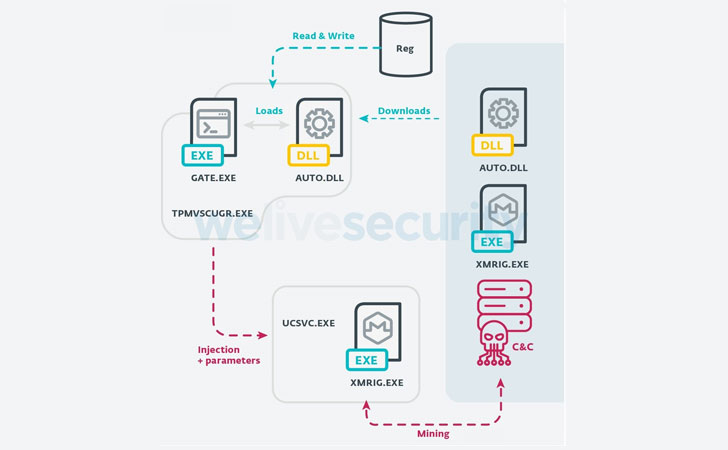
receive a secondary payload that injects arbitrary code into
legitimate Windows processes, such as introducing XMRig mining
software into the ucsvc.exe process (or Boot File Servicing
Utility), thus facilitating Monero mining.
“From the data collected during our sinkholing activities, we
can determine that there are, on average, 2,000 devices mining
throughout the day,” the researchers said. “If we estimate an
average hash rate of 150H/s, we could say that the authors of this
campaign have collected at least 80 Monero (approximately $6000)
from this botnet alone.”
With USB drives being used as a propagation vector, ESET warned of
new infections that could occur in the future. But with a
significant chunk of C2 infrastructure sinkholed, the bots will no
longer receive secondary payloads. However, those that were
compromised before the C2 servers were taken down would still
continue to mine Monero.
“One of the interesting characteristics about VictoryGate is
that it shows a greater effort to avoid detection than previous,
similar campaigns in the region,” the research team concluded.
“And, given the fact that the botmaster can update functionality
of the payloads that are downloaded and executed on the infected
devices from crypto mining to any other malicious activities at any
given time, this poses a considerable risk.”
Read more http://feedproxy.google.com/~r/TheHackersNews/~3/5uPgjiH-t0A/usb-drive-botnet-malware.html