
trick three British private equity firms into wire-transferring a
total of $1.3 million to the bank accounts fraudsters have access
to — while the victimized executives thought they closed an
investment deal with some startups.
According to the cybersecurity firm Check Point, who shared its
latest investigation with The Hacker News, nearly $700,000 of the
total wire transferred amount has permanently lost to the
attackers, with the rest of the amount recovered after researchers
alerted the targeted firms in time.
Dubbed ‘The Florentine Banker,’ the sophisticated
cybercrime gang behind this attack, “seems to have honed their
techniques over multiple attacks, from at least several years of
activity and has proven to be a resourceful adversary, quickly
adapting new situations,” the researchers said.
‘The techniques they use, especially the lookalike domains
technique, present a severe threat — not only to the originally
attacked organization but also to the third-parties with whom they
communicated using the lookalike domain.’
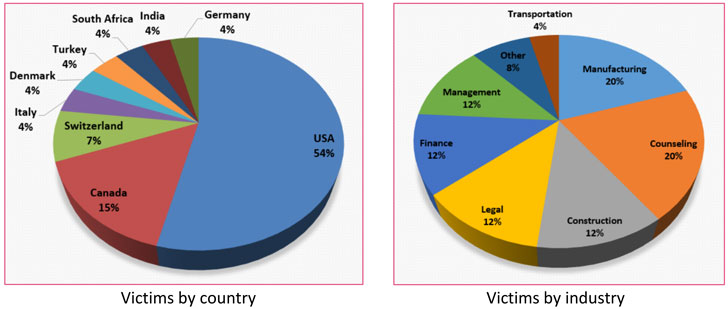
The security firm said previous spear-phishing campaigns
launched by the same group of hackers mainly targeted the
manufacturing, construction, legal, and finance sectors located in
the US, Canada, Switzerland, Italy, Germany, and India, among
others.
How did hackers do it?
The investigation follows Check Point’s previous report published
last December, which described a similar BEC (business email
compromise) incident that resulted in the theft of $1
million from a Chinese venture capital firm.
The amount, which was seed funding intended for an Israeli
startup, was instead routed to a bank account under the attacker’s
control via a carefully-planned man-in-the-middle (MITM)
attack.
The fraud scheme, which has since caught three UK and Israeli
based finance firms in the net, works by sending phishing emails to
high profile individuals in the target organization to gain control
of the account and carry out extensive reconnaissance to understand
the nature of business and the key roles inside the company.
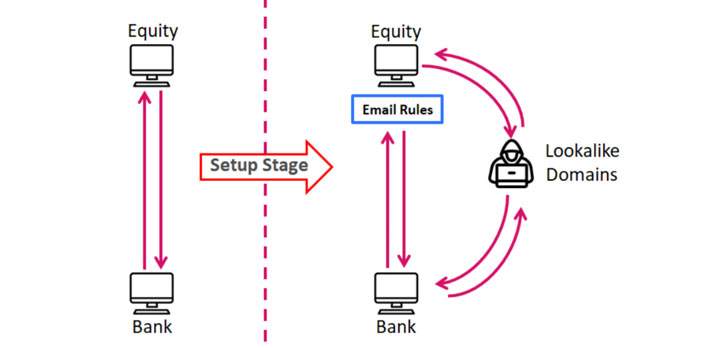
mailbox by creating new rules that would divert relevant email to a
different folder, such as the RSS Feeds folder, that’s not commonly
used by the individual in question.
Aside from infiltrating the high-level corporate email account
and monitoring messages, the hackers register separate lookalike
domains that mimic the legitimate domains of the entities involved
in the email correspondences they want to intercept, thus allowing
them to perpetrate a MITM attack by sending emails from the
fraudulent domains on behalf of the two parties.
‘For example, if there was a correspondence between
‘finance-firm.com’ and ‘banking-service.com,’ the attackers could
register similar domains like ‘finance-firms.com’ and
‘banking-services.com,’ the team said.
Put differently, the Florentine Banker group sent one mail each
from the spoofed domains to the counterparty, thus inserting itself
into the conversation and deceiving the recipient into thinking
that the source of the email is legitimate.
‘Every email sent by each side was in reality sent to the
attacker, who then reviewed the email, decided if any content
needed to be edited, and then forwarded the email from the relevant
lookalike domain to its original destination,’ Check Point
researchers said in a separate blog post on BEC scams.
[2]
Armed with this set-up, the attackers then begin injecting
fraudulent bank account information (associated with accounts
located in Hong Kong and the UK) in the emails to intercept money
transfers and initiate new wire requests.
FBI Sounds Warning Against BEC Attacks
Business email compromise (BEC) attacks have surged in recent years
as organized cybercrime groups try to profit off email scams
directed against big businesses.
Last month, Palo Alto Networks’ Unit 42 threat intelligence team
examined BEC operations working out of Nigeria, uncovering that the
group — dubbed ‘SilverTerrier[3]‘ — carried out an
average of 92,739 attacks a month in 2019.
According to the Federal Bureau of Investigation’s 2019 Internet Crime
Report[4], BEC-related scams alone
accounted for 23,775 complaints amounting to losses of over $1.7
billion.
month, the agency warned of cybercriminals conducting BEC attacks
through cloud-based email services, adding the scams cost US
businesses more than $2.1 billion between 2014 and 2019.
‘Cybercriminals analyze the content of compromised email
accounts for evidence of financial transactions,’ the FBI warned.
‘Often, the actors configure mailbox rules of a compromised account
to delete key messages. They may also enable automatic forwarding
to an outside email account.’
The bureau also issued a separate
warning[6] highlighting how crooks
are updating the profitable scam technique to capitalize on the
ongoing coronavirus
pandemic[7] and perform fraudulent
wire transfers.
In the face of such ongoing threats, it’s recommended that users
turn on two-factor authentication to secure their accounts and
ensure fund transfer and payment requests are verified through
phone calls confirming the transaction.
For more guidance on how to mitigate the risk, head to the
FBI’s alert
here[8].
References
- ^
theft of $1 million
(research.checkpoint.com) - ^
BEC scams
(research.checkpoint.com) - ^
SilverTerrier
(unit42.paloaltonetworks.com) - ^
Internet Crime Report
(pdf.ic3.gov) - ^
advisory
(www.ic3.gov) - ^
issued a separate warning
(www.fbi.gov) - ^
ongoing coronavirus pandemic
(thehackernews.com) - ^
FBI’s alert here
(www.ic3.gov)
Read more http://feedproxy.google.com/~r/TheHackersNews/~3/aQNnf4tJ4U8/bec-scam-wire-transfer-money.html