Dec 06, 2022Ravie Lakshmanan
Hackers with ties to the Iranian government have been linked to
an ongoing social engineering and credential phishing campaign
directed against human rights activists, journalists, researchers,
academics, diplomats, and politicians working in the Middle
East.
At least 20 individuals are believed to have been targeted,
Human Rights Watch (HRW) said in a report published Monday,
attributing the malicious activity to an adversarial collective
tracked as APT42[1], which is known to share
overlaps with Charming Kitten[2]
(aka APT35 or Phosphorus[3]).
The campaign resulted in the compromise of email and other
sensitive data belonging to three of the targets. This included a
correspondent for a major U.S. newspaper, a women’s rights defender
based in the Gulf region, and Nicholas Noe, a Lebanon-based
advocacy consultant for Refugees International.
The digital break-in entailed gaining access to their emails,
cloud storage, calendars, and contacts, as well as exfiltrating the
entire data associated with their Google accounts in the form of
archive files through Google Takeout[4].
“Iran’s state-backed hackers are aggressively using
sophisticated social engineering and credential harvesting tactics
to access sensitive information and contacts held by Middle
East-focused researchers and civil society groups,” Abir Ghattas,
information security director at Human Rights Watch, said[5].
The infection chain commences with the targets receiving
suspicious messages on WhatsApp under the pretext of inviting them
to a conference and luring the victims into clicking a rogue URL
that captured their Microsoft, Google, and Yahoo! login
credentials.
These phishing pages are also capable of orchestrating
adversary-in-the-middle (AiTM[6]) attacks, thereby making
it possible to breach accounts that are secured by two-factor
authentication (2FA) other than a hardware security key.
15 of the targeted high-profile individuals are confirmed to
have received the same WhatsApp messages between September 15 and
November 25, 2022, the international non-governmental organization
said.
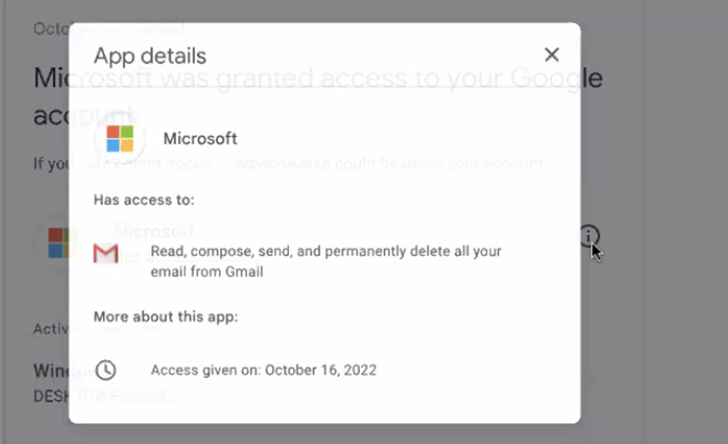
HRW further pointed out inadequacies in Google’s security protections[7], as the victims of the
phishing attack “did not realize their Gmail accounts had been
compromised or a Google Takeout had been initiated, in part because
the security warnings under Google’s account activity do not push
or display any permanent notification in a user’s inbox or send a
push message to the Gmail app on their phone.”
The option to request data from Google Takeout lines up with a
.NET-based program called HYPERSCRAPE[8]
that was first documented by Google’s Threat Analysis Group (TAG)
earlier this August, although HRW said it could not confirm if the
tool was indeed employed in this specific incident.
The attribution to APT42 is based on overlaps in the source code
of the phishing page with that of another spoofed registration page
that, in turn, was associated to a credential theft attack mounted
by an Iran-nexus actor (aka TAG-56) against an unnamed U.S. think
tank.
“The threat activity is highly likely indicative of a broader
campaign that makes use of URL shorteners to direct victims to
malicious pages where credentials are stolen,” Recorded Future
disclosed[9]
late last month. “This tradecraft is common among Iran-nexus
advanced persistent threat (APT) groups like APT42 and
Phosphorus.”
What’s more, the same code has been connected to another domain
utilized as part of a social engineering attack attributed to the
Charming Kitten group and disrupted by Google TAG[10] in October 2021.
It’s worth pointing out that despite APT35 and APT42’s links to
Iran’s Islamic Revolutionary Guard Corps (IRGC), the latter is
geared more towards individuals and entities for “domestic
politics, foreign policy, and regime stability purposes,” per
Mandiant.
“In a Middle East region rife with surveillance threats for
activists, it’s essential for digital security researchers to not
only publish and promote findings, but also prioritize the
protection of the region’s embattled activists, journalists, and
civil society leaders,” Ghattas said.
Found this article interesting? Follow us on Twitter [11] and LinkedIn[12] to read more exclusive
content we post.
References
- ^
APT42
(thehackernews.com) - ^
Charming
Kitten (thehackernews.com) - ^
Phosphorus
(research.checkpoint.com) - ^
Google
Takeout (support.google.com) - ^
said
(www.hrw.org) - ^
AiTM
(thehackernews.com) - ^
security
protections (landing.google.com) - ^
HYPERSCRAPE
(thehackernews.com) - ^
disclosed
(www.recordedfuture.com) - ^
disrupted by Google TAG
(thehackernews.com) - ^
Twitter
(twitter.com) - ^
LinkedIn
(www.linkedin.com)
Read more https://thehackernews.com/2022/12/iranian-state-hackers-targeting-key.html