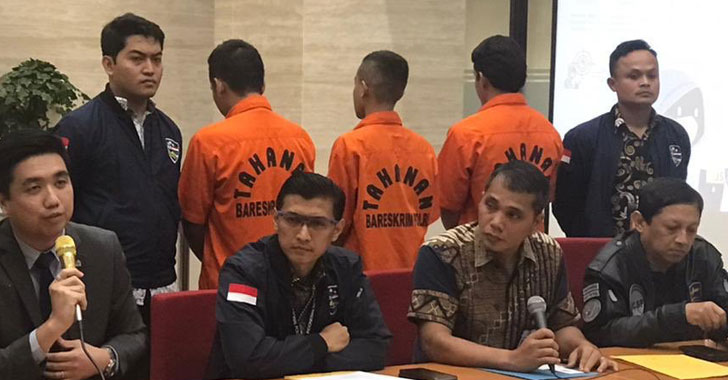
conference[1] with Interpol earlier
today announced the arrest of three Magecart-style Indonesian
hackers who had compromised hundreds of international e-commerce
websites and stolen payment card details of their online shoppers.
Dubbed ‘Operation Night Fury,’ the investigation was led
by Interpol’s ASEAN Cyber Capability Desk, a joint initiative by
law enforcement agencies of Southeast Asian countries to combat
cybercrime.
According to the press conference, all three accused (23, 26, and
35 years old) were arrested last year in December from Jakarta and
Yogyakarta and charged with criminal laws related to the data
theft, fraud, and unauthorized access.
Just like most of the other widespread Magecart
attacks[2], the modus operandi
behind this series of attacks also involved exploiting unpatched
vulnerabilities in e-commerce websites powered by Magento and
WordPress[3] content management
platforms.

code—also known as web skimming or JS
sniffers[4]—on those compromised
websites to intercept users’ inputs in real-time and steal their
payment card numbers, names, addresses and login details as well.
Though Indonesian police claim these hackers had compromised 12
e-commerce websites, experts at cybersecurity firm Sanguine
Security believe the same group is behind the credit card theft
at more than 571 online stores.
[5]
“These hacks could be attributed because of an odd message that was
left in all of the skimming code,” Sanguine Security said.
“‘Success gan’ translates to ‘Success bro’ in Indonesian and has
been present for years on all of their skimming
infrastructures.’
The police revealed[6] that the suspects used
stolen credit cards to buy electronic goods and other luxury items,
and then also attempted to resell some of them at a relatively low
price through local e-commerce websites in Indonesia.

hacking[7] e-commerce websites and
injecting web skimmers since 2017.
Moreover, experts also observed similar cyberattacks linked to
the same online infrastructure even after the arrest of three
people, and thus believes that there are more members of this
hacking group who are still at large.
References
- ^
press conference
(twitter.com) - ^
Magecart attacks
(thehackernews.com) - ^
Magento and WordPress
(thehackernews.com) - ^
JS sniffers
(thehackernews.com) - ^
Sanguine Security
(sansec.io) - ^
revealed
(humas.polri.go.id) - ^
admitted to hacking
(www.metrotvnews.com)
Read more http://feedproxy.google.com/~r/TheHackersNews/~3/Vk7H4sRNfNU/indonesian-magecart-hackers.html