Threat actors are exploiting improperly-secured Google Cloud
Platform (GCP) instances to download cryptocurrency mining software
to the compromised systems as well as abusing its infrastructure to
install ransomware, stage phishing campaigns, and even generate
traffic to YouTube videos for view count manipulation.
“While cloud customers continue to face a variety of threats
across applications and infrastructure, many successful attacks are
due to poor hygiene and a lack of basic control implementation,”
Google’s Cybersecurity Action Team (CAT) outlined[1]
as part of its recent Threat Horizons report published last
week.
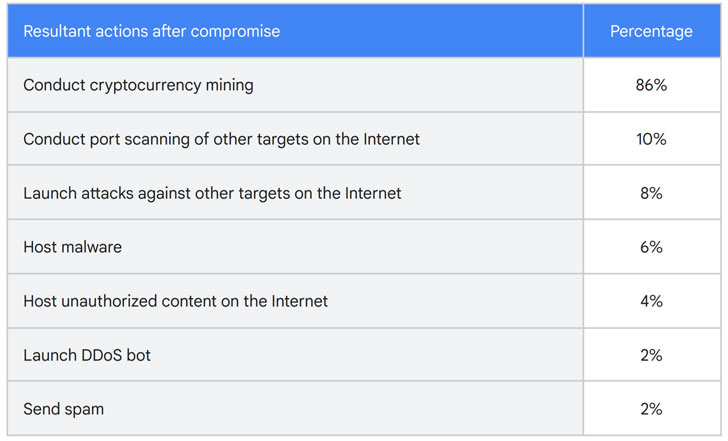
Of the 50 recently compromised GCP instances, 86% of them were
used to conduct cryptocurrency mining, in some cases within 22
seconds of successful breach, while 10% of the instances were
exploited to perform scans of other publicly accessible hosts on
the Internet to identify vulnerable systems, and 8% of the
instances were used to strike other entities. About 6% of the GCP
instances were used to host malware.
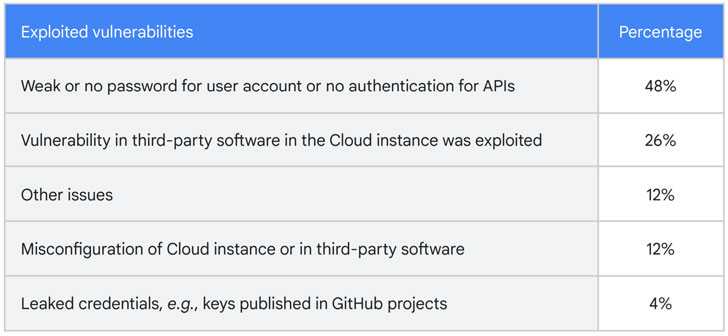
In most cases, the unauthorized access was attributed to the use
of weak or no passwords for user accounts or API connections (48%),
vulnerabilities in third-party software installed on the cloud
instances (26%), and leakage of credentials in GitHub projects
(4%).
Another attack of note was a Gmail phishing campaign[2]
launched by APT28 (aka Fancy Bear) towards the end of September
2021 that involved[3]
sending an email blast to over 12,000 account holders primarily in
the U.S., U.K., India, Canada, Russia, Brazil, and the E.U. nations
with the goal of stealing their credentials.
Furthermore, Google CAT said it observed adversaries abusing
free Cloud credits by using trial projects and posing as fake
startups to engage in traffic pumping to YouTube. In a separate
incident, a North Korean government-backed attacker group
masqueraded as Samsung recruiters to send fake job opportunities to
employees at several South Korean information security companies
that sell anti-malware solutions.
“The emails included a PDF allegedly claiming to be of a job
description for a role at Samsung; however, the PDFs were malformed
and did not open in a standard PDF reader,” the researchers said.
“When targets replied that they could not open the job description,
attackers responded with a malicious link to malware purporting to
be a ‘Secure PDF Reader’ stored in Google Drive which has now been
blocked.”
Google connected the attacks to the same threat actor that
previously set its sights on security
professionals[4]
working on vulnerability research and development earlier this year
to steal exploits and stage further attacks on vulnerable targets
of their choice.
“Cloud-hosted resources have the benefit of high availability
and ‘anywhere, anytime’ access,” Google CAT said. “While
cloud-hosted resources streamline workforce operations, bad actors
can try to take advantage of the ubiquitous nature of the cloud to
compromise cloud resources. Despite growing public attention to
cybersecurity, spear-phishing and social engineering tactics are
frequently successful.”
References
- ^
outlined
(cloud.google.com) - ^
Gmail
phishing campaign (twitter.com) - ^
involved
(www.vice.com) - ^
set its
sights on security professionals
(thehackernews.com)
Read more https://thehackernews.com/2021/11/hackers-using-compromised-google-cloud.html