
Cybersecurity researchers on Thursday disclosed a new attack
wherein threat actors are leveraging Xcode as an attack vector to
compromise Apple platform developers with a backdoor, adding to a
growing trend that involves targeting developers and researchers
with malicious attacks.
Dubbed “XcodeSpy,” the trojanized Xcode project is a tainted
version of a legitimate, open-source project available on GitHub
called TabBarInteraction that’s used by developers to animate iOS
tab bars based on user interaction.
“XcodeSpy is a malicious Xcode project that installs a custom
variant of the EggShell backdoor on the developer’s macOS computer
along with a persistence mechanism,” SentinelOne researchers
said[1].
Xcode is Apple’s integrated development environment (IDE) for
macOS, used to develop software for macOS, iOS, iPadOS, watchOS,
and tvOS.
Earlier this year, Google’s Threat Analysis group uncovered[2]
a North Korean campaign aimed at security researchers and exploit
developers, which entailed the sharing of a Visual Studio project
designed to load a malicious DLL on Windows systems.
The doctored Xcode project does something similar, only this
time the attacks have singled out Apple developers.
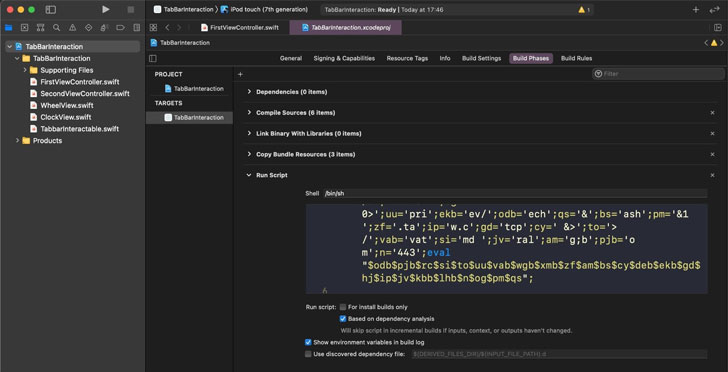
Besides including the original code, XcodeSpy also contains an
obfuscated Run Script that’s executed when the developer’s build
target is launched. The script then contacts an attacker-controlled
server to retrieve a custom variant of the EggShell backdoor on the
development machine, which comes with capabilities to record
information from the victim’s microphone, camera, and keyboard.
SentinelOne said it identified two variants of the EggShell
payload, with the samples uploaded to VirusTotal from Japan on
August 5 and October 13 last year. Additional clues point to one
unnamed U.S. organization that’s said to have been targeted using
this campaign between July and October 2020, with other developers
in Asia likely to be targeted as well.
Adversaries have previously resorted to tainted Xcode
executables (aka XCodeGhost[3]) to inject malicious
code into iOS apps compiled with the infected Xcode without the
developers’ knowledge, and subsequently use the infected apps to
collect information from the devices once they are downloaded and
installed from the App Store.
Then in August 2020, researchers from Trend Micro unearth a
similar threat that spread via modified Xcode projects, which, upon
building, were configured to install a malware called XCSSET[4]
to steal credentials, capture screenshots, sensitive data from
messaging and note taking apps, and even encrypt files for a
ransom.
But XcodeSpy, in contrast, takes an easier route, since the goal
appears to be to strike the developers themselves.
“Targeting software developers is the first step in a successful
supply chain attack. One way to do so is to abuse the very
development tools necessary to carry out this work,” the
researchers said.
“It is entirely possible that XcodeSpy may have been targeted at
a particular developer or group of developers, but there are other
potential scenarios with such high-value victims. Attackers could
simply be trawling for interesting targets and gathering data for
future campaigns, or they could be attempting to gather AppleID
credentials for use in other campaigns that use malware with valid
Apple Developer code signatures.”