
exposed to a critical security vulnerability discovered in online
flight ticket booking system that allowed remote hackers to access
and modify their travel details and even claim their frequent flyer
miles.
Israeli network security researcher Noam Rotem discovered the
vulnerability when he booked a flight on the Israeli airline ELAL,
successful exploitation of which just required victim’s PNR
(Passenger Name Record) number.
The vulnerability resided in the widely used online flight
booking system developed by Amadeus, which is currently being used
by nearly 141 international airlines, including United Airlines,
Lufthansa and Air Canada.
After booking a flight with ELAL, the traveler receives a PNR
number and a unique link that allows customers to check their
booking status and related information associated with that PNR.
Rotem found that merely by changing the value of the
“RULE_SOURCE_1_ID” parameter on that link to someone else’s PNR
number would display personal and booking-related information from
the account associated with that customer.
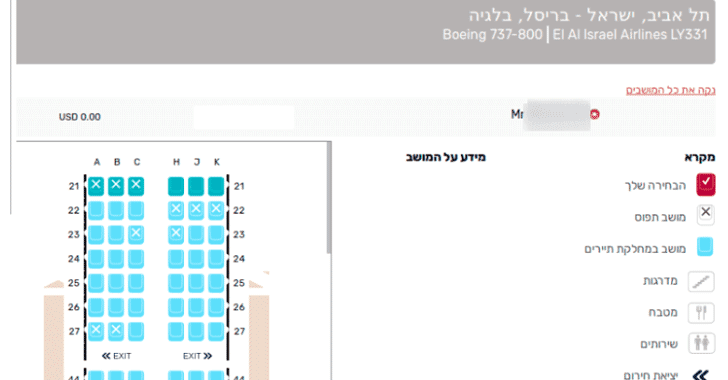
the customer, an attacker can simply access the victim’s account on
ELAL’s customer
portal and “make changes, claim frequent flyer miles to a
personal account, assign seats and meals, and update the customer’s
email and phone number, which could then be used to cancel/change
flight reservation via customer service.”
“Though the security breach requires knowledge of the PNR code,
ELAL sends these codes via unencrypted email, and many people even
share them on Facebook or Instagram. But that’s just the tip of the
iceberg,” the researcher said in his blog
post[2].
Rotem also figured out that the Amadeus portal was not using any
brute-force protection that eventually allowed attackers to attempt
every alphanumeric uppercase complications using a script, as
shown, to find all active PNR numbers of customers of any
Amadeus-linked airline website.
“After running a small and non-threatening script to check for any
brute-force protections, none of which were found, we were able to
find PNRs of random customers, which included all of their personal
information,” Rotem added.
to know how a simple script devised by him guessed the PNR numbers
and was able to find active numbers in Amadeus.
Since the Amadeus booking system is being used by at least 141
airlines, the vulnerability could have affected hundreds of
millions of travelers.
After discovering the vulnerability, Rotem immediately contacted
ELAL to point out the threat and suggested the airline to introduce
captchas, passwords and a bot protection mechanism in order to
prevent brute-force attempts.
Amadeus has now fixed the issue, and the Rotem’s script can no
longer identify active PNRs as demonstrated in the above video.
Upon contacting Amadeus, the company replied, “At Amadeus, we
give security the highest priority and are constantly monitoring
and updating our systems. Our technical teams took immediate
action, and we can now confirm that the issue is solved.”
Amadeus also added that the company has also added a Recovery
PTR to strengthen security further and “prevent a malicious user
from accessing travelers’ personal information.”
References
- ^
ELAL’s customer portal
(booking.elal.co.il) - ^
blog post
(www.safetydetective.com)
Read more http://feedproxy.google.com/~r/TheHackersNews/~3/xAuy0KWFIao/airlines-flight-hacking.html