Cybersecurity researchers on Thursday disclosed details of a
previously undiscovered in-memory Windows backdoor developed by a
hacker-for-hire operation that can execute remotely malicious code
and steal sensitive information from its targets in Asia, Europe,
and the US.
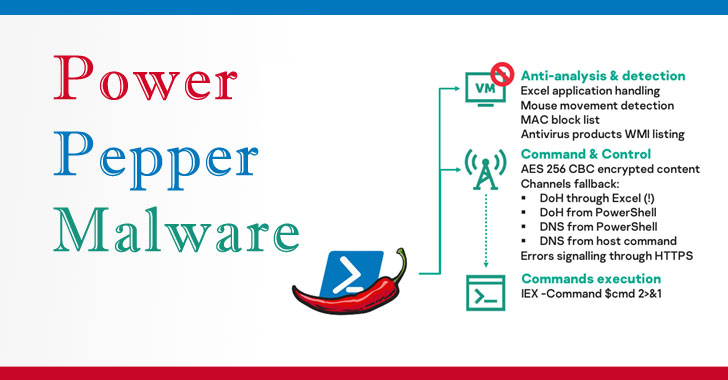
Dubbed “PowerPepper[1]” by Kaspersky
researchers, the malware has been attributed to the DeathStalker[2]
group (formerly called Deceptikons), a threat actor that has been
found to hit law firms and companies in the financial sector
located in Europe and the Middle East at least since 2012.
The hacking tool is so-called because of its reliance on
steganographic trickery to deliver the backdoor payload in the form
of an image of ferns or peppers.
The espionage group first came to light earlier this July[3], with most of their
attacks starting with a spear-phishing email containing a malicious
modified LNK (shortcut) file that, when clicked, downloads and runs
a PowerShell-based implant named Powersing.
While their objectives don’t appear to be financially motivated,
their continued interest in collecting crucial business information
led Kaspersky to the conclusion that “DeathStalker is a group of
mercenaries offering hacking-for-hire services, or acting as some
sort of information broker in financial circles.”
PowerPepper now joins the group’s list of expanding and evolving
toolsets.
Spotted in the wild in mid-July 2020, this new strain of malware
gets dropped from a decoy Word document and leverages DNS over
HTTPS (DoH) as a communications channel to transmit encrypted
malicious shell commands from an attacker-controlled server.
The spear-phishing emails come with themes as varied as carbon
emission regulations, travel booking, and the ongoing coronavirus
pandemic, with the Word documents having social engineering banners
urging users to enable macros in a bid to lure an unsuspecting user
into downloading the backdoor.
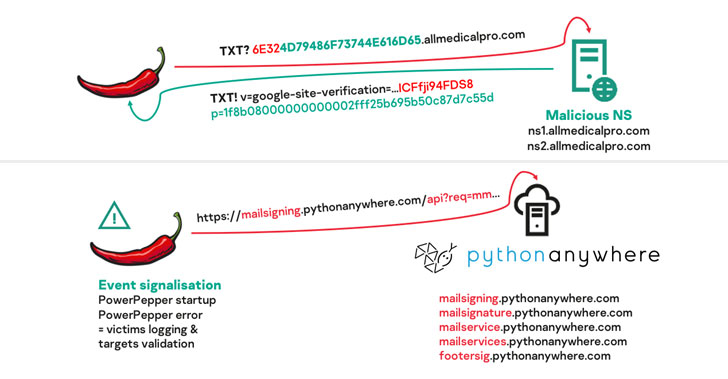
To achieve its goals, the implant sends DNS requests to name
servers — servers that store the DNS records — associated with a
malicious C2 domain, which then sends back the command to be run in
the form of an embedded response. Upon execution, the results are
beamed to the server through a batch of DNS requests.
Besides leveraging macro-based and LNK-based delivery chains to
deploy the malware, DeathStalker employed “obfuscation, execution
and masquerading tricks to hinder detection, or deceive targets
that are curious about what is happening on their computers,”
Kaspersky’s Pierre Delcher noted.
Chief among them are the capabilities to hide malicious
execution workflow in Word embedded shape and object properties and
use Windows Compiled HTML Help (CHM) files as archives for
malicious files.
Multiple mercenary groups have been seen in the wild before,
including BellTroX[4]
(aka Dark Basin), Bahamut[5], and CostaRicto[6], all of whom have
deployed custom malware to breach systems belonging to financial
institutions and government officials.
“It only seems fair to write that DeathStalker tried hard to
develop evasive, creative and intricate tools with this PowerPepper
implant and associated delivery chains,” Delcher concluded.
“There is nothing particularly sophisticated about the
techniques and tricks that are leveraged, yet the whole toolset has
proved to be effective, is pretty well put together, and shows
determined efforts to compromise various targets around the
world.”
To safeguard against PowerPepper delivery and execution, it is
recommended that businesses and users update their CMS backends as
well as associated plugins, restrict PowerShell use on end-user
computers with enforced execution policies, and refrain from
opening Windows shortcuts attached to emails, or click links in
emails from unknown senders.
References
- ^
PowerPepper
(securelist.com) - ^
DeathStalker
(securelist.com) - ^
earlier
this July (securelist.com) - ^
BellTroX
(citizenlab.ca) - ^
Bahamut
(www.blackberry.com) - ^
CostaRicto
(thehackernews.com)