Feb 20, 2023Ravie Lakshmanan
Russia’s cyber attacks against Ukraine surged by 250% in 2022
when compared to two years ago, Google’s Threat Analysis Group
(TAG) and Mandiant disclosed in a new joint report.
The targeting, which coincided[1]
and has since persisted[2]
following the country’s military invasion of Ukraine in February
2022, focused heavily on the Ukrainian government and military
entities, alongside critical infrastructure, utilities, public
services, and media sectors.
Mandiant said[3]
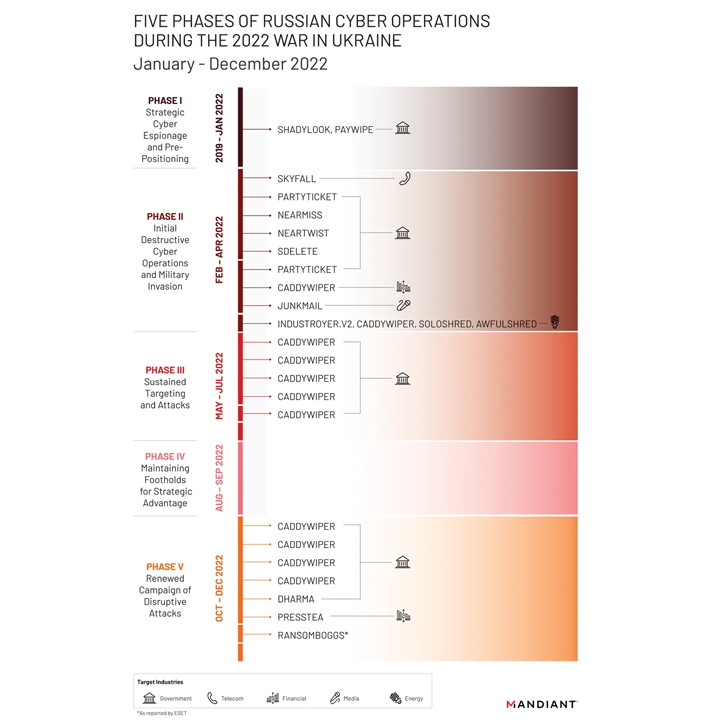
it observed, “more destructive cyber attacks in Ukraine during the
first four months of 2022 than in the previous eight years with
attacks peaking around the start of the invasion.”
As many as six unique wiper strains – including WhisperGate,
HermeticWiper, IsaacWiper, CaddyWiper, Industroyer2, and SDelete –
have been deployed against Ukrainian networks, suggesting a
willingness on the part of Russian threat actors to forgo
persistent access.
Phishing attacks aimed at NATO countries witnessed a 300% spike
over the course of the same period. These efforts were driven by a
Belarusian government-backed group dubbed PUSHCHA[4]
(aka Ghostwriter or UNC1151) that’s aligned with Russia.
“Russian government-backed attackers have engaged in an
aggressive, multi-pronged effort to gain a decisive wartime
advantage in cyberspace, often with mixed results,” TAG’s Shane
Huntley noted.
Some of the key actors involved in the efforts include FROZENBARENTS[5]
(aka Sandworm or Voodoo Bear), FROZENLAKE[6]
(aka APT28 or Fancy Bear), COLDRIVER[7]
(aka Callisto Group), FROZENVISTA[8]
(aka DEV-0586 or UNC2589), and SUMMIT[9]
(aka Turla or Venomous Bear).

The uptick in the intensity and frequency of the operations
aside, the invasion has also been accompanied by the Kremlin
engaging in covert and overt information operations designed to
shape public perception with the goal of undermining the Ukrainian
government, fracturing international support for Ukraine, and
maintain domestic support for Russia.
“GRU-sponsored actors have used their access to steal sensitive
information and release it to the public to further a narrative, or
use that same access to conduct destructive cyber attacks or
information operations campaigns,” the tech giant said.
With the war splintering hacking groups[10] over political
allegiances, and in some cases, even causing them to close shop,
the development further points to a “notable shift in the Eastern
European cybercriminal ecosystem” in a manner that blurs the lines
between financially motivated actors and state-sponsored
attackers.
This is evidenced by the fact that UAC-0098[11], a threat actor that
has historically delivered the IcedID malware[12], was observed
repurposing its techniques to assault Ukraine as part of a set of
ransomware attacks.
Some members of UAC-0098 are assessed to be former members of
the now-defunct Conti cybercrime group. TrickBot, which was
absorbed into the Conti operation last year prior to the latter’s shutdown[13], has also resorted to
systematically targeting Ukraine[14].
It’s not just Russia, as the ongoing conflict has led Chinese
government-backed attackers such as CURIOUS GORGE[15] (aka UNC3742) and
BASIN[16] (aka Mustang Panda) to
shift their focus towards Ukrainian and Western European targets
for intelligence gathering.
“It is clear cyber will continue to play an integral role in
future armed conflict, supplementing traditional forms of warfare,”
Huntley said.
The disclosure comes as the Computer Emergency Response Team of
Ukraine (CERT-UA) warned[17] of phishing emails
targeting organizations and institutions that purport to be
critical security updates but actually contain executables that
lead to the deployment of remote desktop control software on the
infected systems.
CERT-UA attributed the operation to a threat actor it tracks
under the moniker UAC-0096[18], which was previously
detected adopting the same modus operandi back in late January 2022
in the weeks leading to the war.
“A year after Russia launched its full-scale invasion of
Ukraine, Russia remains unsuccessful in bringing Ukraine under its
control as it struggles to overcome months of compounding strategic
and tactical failures,” cybersecurity firm Recorded Future said[19] in a report published
this month.
“Despite Russia’s conventional military setbacks and its failure
to substantively advance its agenda through cyber operations,
Russia maintains its intent to bring Ukraine under Russian
control,” it added, while also highlighting its “burgeoning
military cooperation with Iran and North Korea.”
Found this article interesting? Follow us on Twitter [20] and LinkedIn[21] to read more exclusive
content we post.
References
- ^
coincided
(thehackernews.com) - ^
since
persisted (thehackernews.com) - ^
said
(blog.google) - ^
PUSHCHA
(thehackernews.com) - ^
FROZENBARENTS
(thehackernews.com) - ^
FROZENLAKE
(thehackernews.com) - ^
COLDRIVER
(thehackernews.com) - ^
FROZENVISTA
(thehackernews.com) - ^
SUMMIT
(thehackernews.com) - ^
splintering hacking groups
(thehackernews.com) - ^
UAC-0098
(thehackernews.com) - ^
IcedID
malware (thehackernews.com) - ^
latter’s shutdown
(thehackernews.com) - ^
systematically targeting Ukraine
(thehackernews.com) - ^
CURIOUS GORGE
(thehackernews.com) - ^
BASIN
(thehackernews.com) - ^
warned
(cert.gov.ua) - ^
UAC-0096
(cert.gov.ua) - ^
said
(www.recordedfuture.com) - ^
Twitter
(twitter.com) - ^
LinkedIn
(www.linkedin.com)
Read more https://thehackernews.com/2023/02/google-reveals-alarming-surge-in.html