
A recent wave of spear-phishing campaigns leveraged weaponized
Windows 11 Alpha-themed Word documents with Visual Basic macros to
drop malicious payloads, including a JavaScript implant, against a
point-of-sale (PoS) service provider located in the U.S.
The attacks, which are believed to have taken place between late
June to late July 2021, have been attributed with “moderate
confidence” to a financially motivated threat actor dubbed FIN7,
according to researchers from cybersecurity firm Anomali.
“The specified targeting of the Clearmind domain fits well with
FIN7’s preferred modus operandi,” Anomali Threat Research said[1]
in a technical analysis published on September 2. “The group’s goal
appears to have been to deliver a variation of a JavaScript
backdoor used by FIN7 since at least 2018.”
An Eastern European group active since at least mid-2015, FIN7
has a checkered history of targeting restaurant, gambling, and
hospitality industries in the U.S. to plunder financial information
such as credit and debit card numbers that were then used or sold
for profit on underground marketplaces.
Although multiple members of the collective have been imprisoned for their roles[2] in different campaigns
since the start of the year, FIN7’s activities have also been tied
to another group called Carbanak, given its similar TTPs, with the
main distinction being that while FIN7 focuses on hospitality and
retail sectors, Carbanak has singled out banking institutions.
In the latest attack observed by Anomali, the infection
commences with a Microsoft Word maldoc containing a decoy image
that’s purported to have been “made on Windows 11 Alpha,” urging
the recipient to enable macros to trigger the next stage of
activity, which involves executing a heavily-obfuscated VBA macro
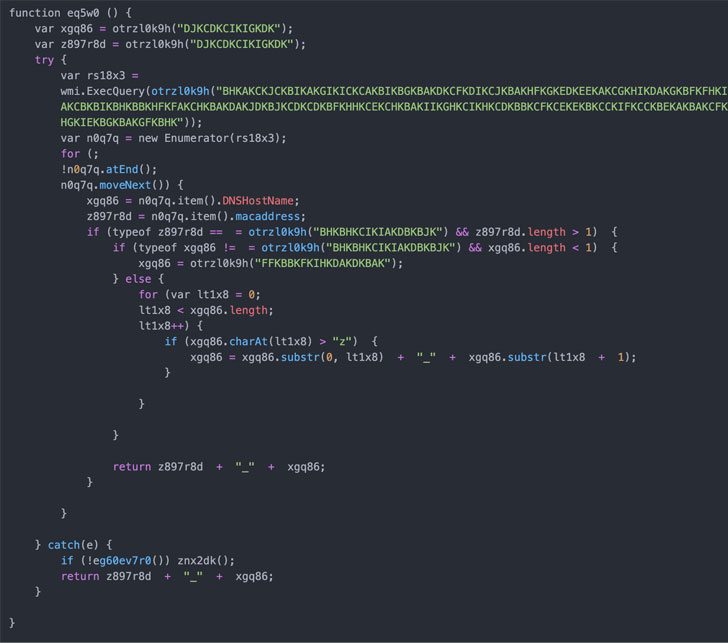
to retrieve a JavaScript payload, which has been found to share
similar functionality[3]
with other backdoors used by FIN7.
Besides taking several steps to try to impede analysis by
populating the code with junk data, the VB script also checks if it
is running under a virtualized environment such as VirtualBox and
VMWare, and if so, terminates itself, in addition to stopping the
infection chain upon detecting Russian, Ukrainian, or several other
Eastern European languages.
The backdoor’s attribution to FIN7 stems from overlaps in the
victimology and techniques adopted by the threat actor, including
the use of a JavaScript-based payload to plunder valuable
information.
“FIN7 is one of the most notorious financially motivated groups
due to the large amounts of sensitive data they have stolen through
numerous techniques and attack surfaces,” the researchers said.
“Things have been turbulent for the threat group over the past few
years as with success and notoriety comes the ever-watchful eye of
the authorities. Despite high-profile arrests and sentencing,
including alleged higher-ranking members, the group continues to be
as active as ever.”
References
- ^
said
(www.anomali.com) - ^
imprisoned for their roles
(thehackernews.com) - ^
similar
functionality (labs.sentinelone.com)