Cisco has patched a critical security vulnerability impacting
its Enterprise Network Function Virtualization Infrastructure
Software (NFVIS) that could be exploited by an attacker to take
control of an affected system.
Tracked as CVE-2021-34746, the weakness has
been rated 9.8 out of a maximum of 10 on the Common Vulnerability
Scoring System (CVSS) and could allow a remote attacker to
circumvent authentication and log in to a vulnerable device as an
administrator.
The network equipment maker said it’s aware of a publicly
available proof-of-concept (PoC) exploit code targeting the
vulnerability, but added it’s not detected any successful
weaponization attempts in the wild.
The issue is caused due to incomplete validation of
user-supplied input that’s passed to an authentication script
during the sign-in process, enabling an attacker to inject
parameters into an authentication request. “A successful exploit
could allow the attacker to bypass authentication and log in as an
administrator to the affected device,” the company said[1]
in an advisory.
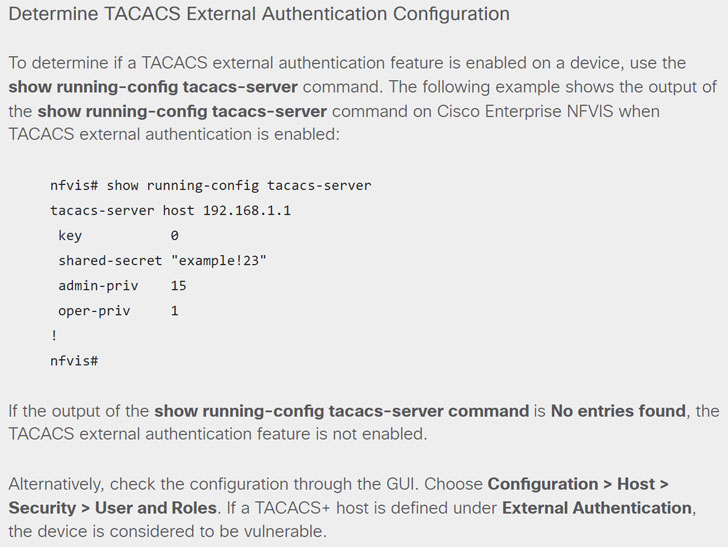
It’s worth pointing out that enterprise NFVIS deployments are
impacted by this vulnerability only if TACACS external
authentication method is configured on a targeted device, which can
be determined by running the “show running-config tacacs-server”
command. “If the output of the show running-config tacacs-server
command is No entries found, the TACACS external authentication
feature is not enabled,” the company noted.
The patches come a little over a week after Cisco rolled out
updates to address a critical security vulnerability (CVE-2021-1577[2]) affecting the
Application Policy Infrastructure Controller (APIC) interface used
in its Nexus 9000 Series Switches that could be potentially abused
to read or write arbitrary files on a vulnerable system.
The company is also in the process of readying fixes for a
zero-day bug (CVE-2021-1585[3]) in its Adaptive
Security Device Manager (ADSM) Launcher that could allow an
unauthenticated, remote attacker to execute arbitrary code on a
user’s operating system.
References
- ^
said
(tools.cisco.com) - ^
CVE-2021-1577
(thehackernews.com) - ^
CVE-2021-1585
(tools.cisco.com)
Read more http://feedproxy.google.com/~r/TheHackersNews/~3/62_Sa5DBHuY/cisco-issues-patch-for-critical.html