
Cybersecurity researchers have shed more light on a malicious
loader that runs as a server and executes received modules in
memory, laying bare the structure of an “advanced multi-layered
virtual machine” used by the malware to fly under the radar.
Wslink, as the malicious loader is called, was first documented[1]
by Slovak cybersecurity company ESET in October 2021, with very few
telemetry hits detected in the past two years spanning Central
Europe, North America, and the Middle East.
Analysis of the malware samples have yielded little to no clues
about the initial compromise vector used and no code, functionality
or operational similarities have been uncovered to suggest that
this is a tool from a previously identified threat actor.
Packed with a file compression utility named NsPack, Wslink
makes use of what’s called a process virtual machine[2]
(VM), a mechanism to run an application in a platform-independent
manner that abstracts the underlying hardware or operating system,
as an obfuscation method but with a crucial difference.
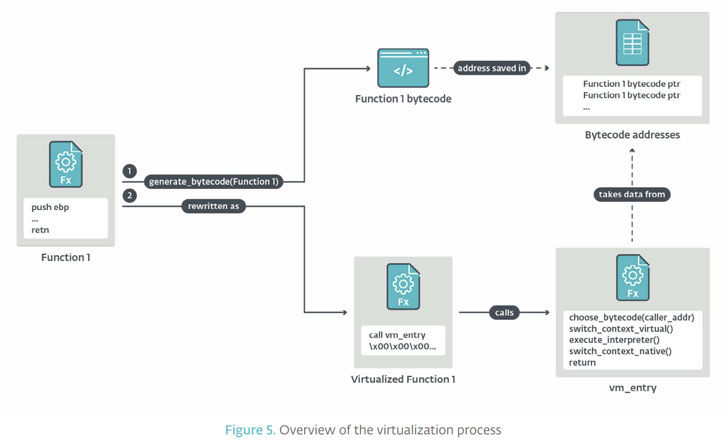
“Virtual machines used as obfuscation engines […] are not
intended to run cross-platform applications and they usually take
machine code compiled or assembled for a known ISA[3]
[instruction set architecture], disassemble it, and translate that
to their own virtual ISA,” ESET malware analyst Vladislav Hrčka
said[4].
“The strength of this obfuscation technique resides in the fact
that the ISA of the VM is unknown to any prospective reverse
engineer – a thorough analysis of the VM, which can be very
time-consuming, is required to understand the meaning of the
virtual instructions and other structures of the VM.”
What’s more, the virtualized Wslink malware package comes with a
diverse arsenal of tactics to hamper reverse engineering, including
junk code, encoding of virtual operands, merging of virtual
instructions, and the use of a nested virtual machine.
“Obfuscation techniques are a kind of software protection
intended to make code hard to understand and hence conceal its
objectives; obfuscating virtual machine techniques have become
widely misused for illicit purposes such as obfuscation of malware
samples, since they hinder both analysis and detection,” Hrčka
said.
References
- ^
documented
(thehackernews.com) - ^
process
virtual machine (en.wikipedia.org) - ^
ISA
(en.wikipedia.org) - ^
said
(www.welivesecurity.com)
Read more https://thehackernews.com/2022/03/experts-detail-virtual-machine-used-by.html