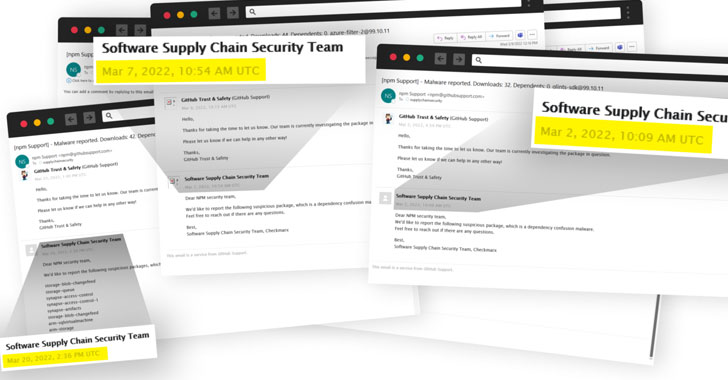
A threat actor dubbed “RED-LILI” has been
linked to an ongoing large-scale supply chain attack campaign
targeting the NPM package repository by publishing nearly 800
malicious modules.
“Customarily, attackers use an anonymous disposable NPM account
from which they launch their attacks,” Israeli security company
Checkmarx said[1]. “As it seems this time,
the attacker has fully-automated the process of NPM account
creation and has opened dedicated accounts, one per package, making
his new malicious packages batch harder to spot.”
The findings build on recent reports from JFrog[2]
and Sonatype[3], both of which detailed
hundreds of NPM packages leveraging techniques like dependency confusion[4]
and typosquatting to target Azure, Uber, and Airbnb developers.
According to a detailed analysis of RED-LILI’s modus operandi,
earliest evidence of anomalous activity is said to have occurred on
February 23, 2022, with the cluster of malicious packages published
in “bursts” over a span of a week.
Specifically, the automation process for uploading the rogue
libraries to NPM, which Checkmarx described as a “factory,”
involves using a combination of custom Python code and web testing
tools like Selenium to simulate user actions required for
replicating the user creation process in the registry.
To get past the one-time password (OTP) verification barrier put
in place by NPM, the attacker leverages an open-source tool called
Interactsh[5]
to extract the OTP sent by NPM servers to the email address
provided during sign-up, effectively allowing the account creation
request to succeed.
Armed with this brand new NPM user account, the threat actor
then proceeds to create and publish a malicious package, only one
per account, in an automated fashion, but not before generating an
access token[6]
so as to publish the package without requiring an email OTP
challenge.
“As supply chain attackers improve their skills and make life
harder for their defenders, this attack marks another milestone in
their progress,” the researchers said. “By distributing the
packages across multiple usernames, the attacker makes it harder
for defenders to correlate [and] take them all down with ‘one
stroke.’ By that, of course, making the chances of infection
higher.”
References
- ^
said
(checkmarx.com) - ^
JFrog
(thehackernews.com) - ^
Sonatype
(blog.sonatype.com) - ^
dependency confusion
(thehackernews.com) - ^
Interactsh
(github.com) - ^
access
token (docs.npmjs.com)
Read more https://thehackernews.com/2022/03/a-threat-actor-dubbed-red-lili-has-been.html