Law enforcement agencies from as many as eight countries
dismantled the infrastructure of Emotet, a notorious
email-based Windows malware behind several botnet-driven spam
campaigns and ransomware attacks over the past decade.
The coordinated takedown of the botnet on Tuesday — dubbed
“Operation Ladybird” — is the result of a joint effort
between authorities in the Netherlands, Germany, the U.S., the
U.K., France, Lithuania, Canada, and Ukraine to take control of
servers used to run and control the malware network.
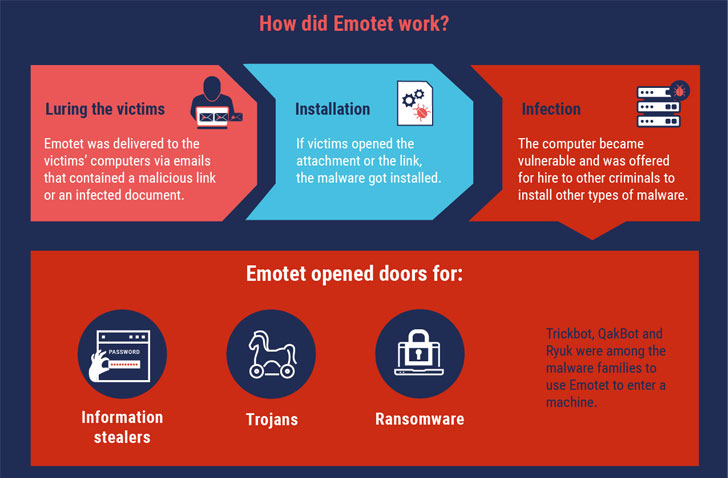
“The Emotet infrastructure essentially acted as a primary door
opener for computer systems on a global scale,” Europol said[1]. “What made Emotet so
dangerous is that the malware was offered for hire to other
cybercriminals to install other types of malware, such as banking
Trojans or ransomware, onto a victim’s computer.”
More Than a Malware
Since its first identification in 2014, Emotet[2]
has evolved from its initial roots as a credential stealer and
banking Trojan to a powerful “Swiss Army knife” that can serve as a
downloader, information stealer, and spambot depending on how it’s
deployed.
Known for being constantly under development, cybercrime service
updates itself regularly to improve stealthiness, persistence, and
add new spying capabilities through a wide range of modules,
including a Wi-Fi spreader[3]
to identify and compromise fresh victims connected to nearby Wi-Fi
networks.
Last year, the malware was linked to several botnet-driven spam
campaigns and even capable of delivering more dangerous payloads
such as TrickBot and Ryuk ransomware by renting its botnet of
compromised machines to other malware groups.
“The Emotet group managed to take e-mail as an attack vector to
a next level,” Europol said.
700 Emotet Servers Seized
The U.K.’s National Crime Agency (NCA) said the operation took
nearly two years to map the infrastructure of Emotet, with multiple
properties in the Ukrainian city of Kharkiv raided to confiscate
computer equipment used by the hackers.
The Ukrainian[4]
Cyberpolice Department[5]
also arrested two individuals allegedly involved in the botnet’s
infrastructure maintenance, both of whom are facing 12 years in
prison if found guilty.
“Analysis of accounts used by the group behind Emotet showed
$10.5 million being moved over a two-year period on just one
Virtual Currency platform,” the NCA said[6], adding “almost $500,000
had been spent by the group over the same period to maintain its
criminal infrastructure.”
Globally, Emotet-linked damages are said to have cost about $2.5
billion, Ukrainian authorities said.
With at least 700 servers operated by Emotet across the world
now having been taken down from the inside, machines infected by
the malware are now directed to this law
enforcement-infrastructure, thus preventing further
exploitation.
In addition, the Dutch National Police has released a tool[7]
to check for potential compromise, based on a dataset containing
600,000 e-mail addresses, usernames, and passwords that were
identified during the operation.
Emotet to Be Wiped En Masse on March 25, 2021
The Dutch police, which seized two central servers located in
the country, said it has deployed a software update[8] to neutralize the threat
posed by Emotet effectively.
“All infected computer systems will automatically retrieve the
update there, after which the Emotet infection will be
quarantined,” the agency said. According to a tweet from a security
researcher who goes by the Twitter handle milkream[9], Emotet is expected to
be wiped on April 25, 2021, at 12:00 local time from all
compromised machines.
Given the nature of the takedown operation, it remains to be
seen if Emotet can stage a comeback. If it does, it wouldn’t be the
first time a botnet survived[10] major disruption
efforts.
As of writing, Abuse.ch’s Feodo Tracker[11] shows at least 20
Emotet servers are still online.
“A combination of both updated cybersecurity tools (antivirus
and operating systems) and cybersecurity awareness is essential to
avoid falling victim to sophisticated botnets like Emotet,” Europol
cautioned.
“Users should carefully check their e-mail and avoid opening
messages and especially attachments from unknown senders. If a
message seems too good to be true, it likely is and e-mails that
implore a sense of urgency should be avoided at all costs.”
References
- ^
said
(www.europol.europa.eu) - ^
Emotet
(thehackernews.com) - ^
Wi-Fi
spreader (thehackernews.com) - ^
Ukrainian
(www.cyberpolice.gov.ua) - ^
Cyberpolice Department
(www.npu.gov.ua) - ^
said
(www.nationalcrimeagency.gov.uk) - ^
tool
(www.politie.nl) - ^
deployed
a software update (www.politie.nl) - ^
milkream
(twitter.com) - ^
botnet
survived (thehackernews.com) - ^
Feodo
Tracker (feodotracker.abuse.ch)