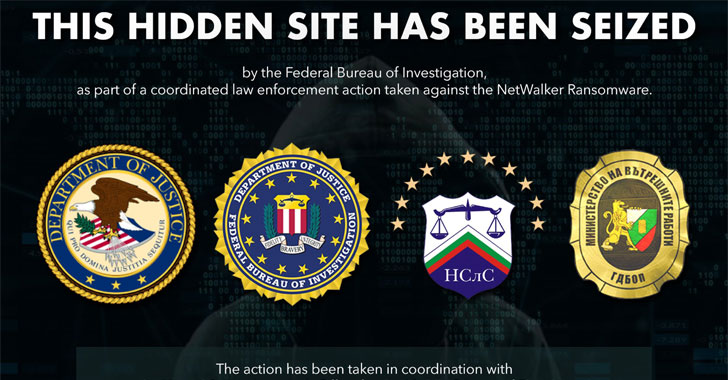
U.S. and Bulgarian authorities this week took control of the
dark web site used by the NetWalker ransomware cybercrime group to
publish data stolen from its victims.
“We are striking back against the growing threat of ransomware
by not only bringing criminal charges against the responsible
actors, but also disrupting criminal online infrastructure and,
wherever possible, recovering ransom payments extorted from
victims,” said[1]
Acting Assistant Attorney General Nicholas L. McQuaid of the
Justice Department’s Criminal Division.
“Ransomware victims should know that coming forward to law
enforcement as soon as possible after an attack can lead to
significant results like those achieved in today’s multi-faceted
operation.”
In connection with the takedown, a Canadian national named
Sebastien Vachon-Desjardins from the city of Gatineau was charged
in the U.S. state of Florida for extorting $27.6 million in
cryptocurrency from ransom payments.
Separately, the Bulgarian National Investigation Service and
General Directorate Combating Organized Crime seized a dark web
hidden resource used by NetWalker ransomware affiliates — i.e.,
cybercrime groups responsible for identifying and attacking
high-value victims using the ransomware — to provide payment
instructions and communicate with victims.
Visitors to the website will now be greeted by a seizure banner
notifying them that it has been taken over by law enforcement
authorities.
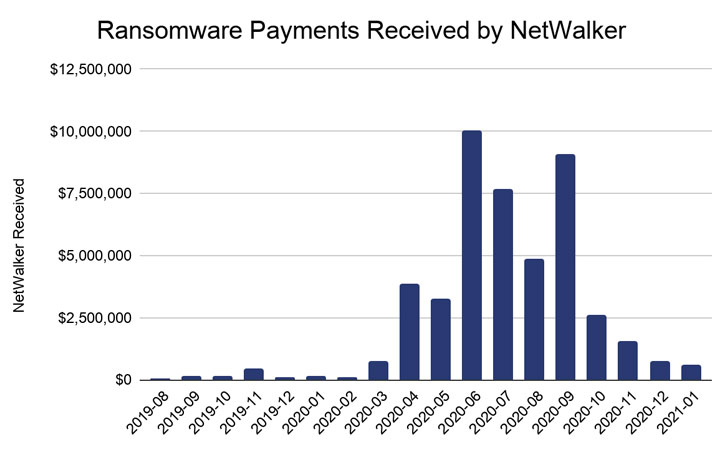
Chainalysis, which aided in the investigation, said[2]
it has “traced more than $46 million worth of funds in NetWalker
ransoms since it first came on the scene in August 2019,” adding
“it picked up steam in mid-2020, growing the average ransom to
$65,000 last year, up from $18,800 in 2019.”
In recent months, Netwalker emerged as a popular choice of
ransomware strain besides Ryuk, Maze, Doppelpaymer, and Sodinokibi,
with numerous companies, municipalities, hospitals, schools, and
universities targeted by the cybercriminals to extort victims.
Before the takedown, the NetWalker administrator, who goes by
the moniker “Bugatti” on darknet forums, is said to have posted an
advertisement in May 2020 looking for additional Russian-speaking
affiliates as part of a transition to a ransomware-as-a-service
(RaaS) model, using the partners to compromise targets and steal
data before encrypting the files.
The NetWalker operators have also been part of a growing
ransomware trend called double extortion, where the attackers hold
the stolen data hostage and threaten to publish the information
should the target refuse to pay the ransom.

“After a victim pays, developers and affiliates split the
ransom,” the U.S. Department of Justice (DoJ) said.
Chainalysis researchers suspect that besides involving in at
least 91 attacks using NetWalker since April 2020,
Vachon-Desjardins worked as an affiliate for other RaaS operators
such as Sodinokibi, Suncrypt, and Ragnarlocker.
The NetWalker disruption comes on the same day that European
authorities announced a coordinated takedown targeting the Emotet[3]
crimeware-as-a-service network. The botnet has been used by several
cybercrime groups to deploy second-stage malware — most notably
Ryuk and TrickBot.