Microsoft on Tuesday addressed a quartet of security flaws as
part of its Patch Tuesday updates[1]
that could be abused by adversaries to target Azure cloud customers
and elevate privileges as well as allow for remote takeover of
vulnerable systems.
The list of flaws, collectively called OMIGOD by
researchers from Wiz, affect a little-known software agent called
Open Management Infrastructure that’s automatically deployed in
many Azure services –
- CVE-2021-38647[2] (CVSS score: 9.8) – Open
Management Infrastructure Remote Code Execution Vulnerability - CVE-2021-38648[3] (CVSS score: 7.8) – Open
Management Infrastructure Elevation of Privilege Vulnerability - CVE-2021-38645[4] (CVSS score: 7.8) – Open
Management Infrastructure Elevation of Privilege Vulnerability - CVE-2021-38649[5] (CVSS score: 7.0) – Open
Management Infrastructure Elevation of Privilege Vulnerability
Open Management Infrastructure (OMI[6]) is an open-source
analogous equivalent[7]
of Windows Management Infrastructure (WMI) but designed for Linux
and UNIX systems such as CentOS, Debian, Oracle Linux, Red Hat
Enterprise Linux Server, SUSE Linux, and Ubuntu that allows for
monitoring, inventory management, and syncing configurations across
IT environments.
Azure customers on Linux machines, including users of Azure
Automation, Azure Automatic Update, Azure Operations Management
Suite (OMS), Azure Log Analytics, Azure Configuration Management,
and Azure Diagnostics, are at risk of potential exploitation.
“When users enable any of these popular services, OMI is
silently installed on their virtual machine, running at the highest
privileges possible,” Wiz security researcher Nir Ohfeld said[8]. “This happens without
customers’ explicit consent or knowledge. Users simply click agree
to log collection during set-up and they have unknowingly opted
in.”
“In addition to Azure cloud customers, other Microsoft customers
are affected since OMI can be independently installed on any Linux
machine and is frequently used on-premise,” Ohfeld added.
Since the OMI agent runs as root with the highest privileges,
the aforementioned vulnerabilities could be abused by external
actors or low-privileged users to remotely execute code on target
machines and escalate privileges, thereby enabling the threat
actors to take advantage of the elevated permissions to mount
sophisticated attacks.
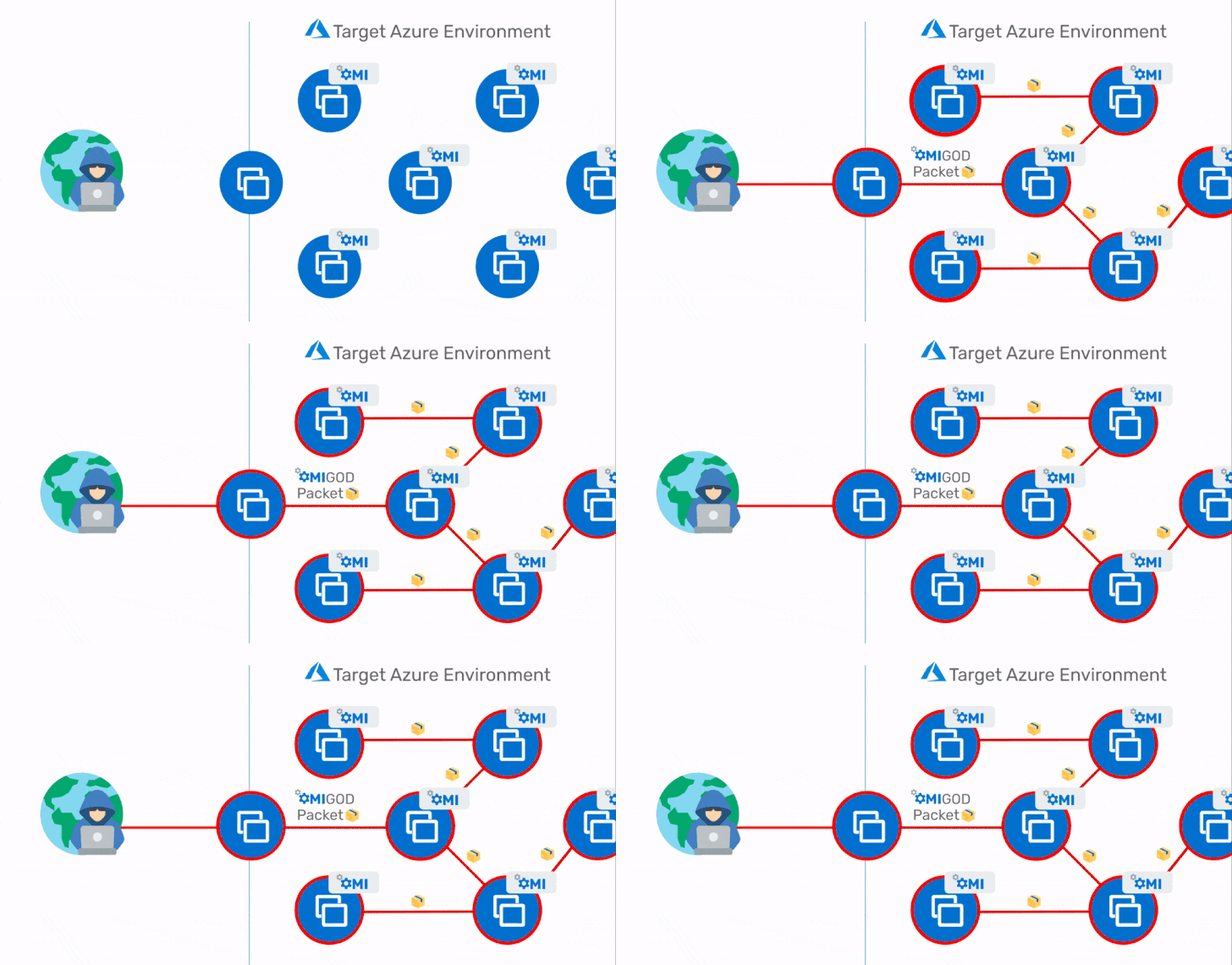
The most critical of the four flaws is a remote code execution
flaw arising out of an internet-exposed HTTPS port like 5986, 5985,
or 1270, allowing attackers to obtain initial access to a target
Azure environment and subsequently move laterally within the
network.
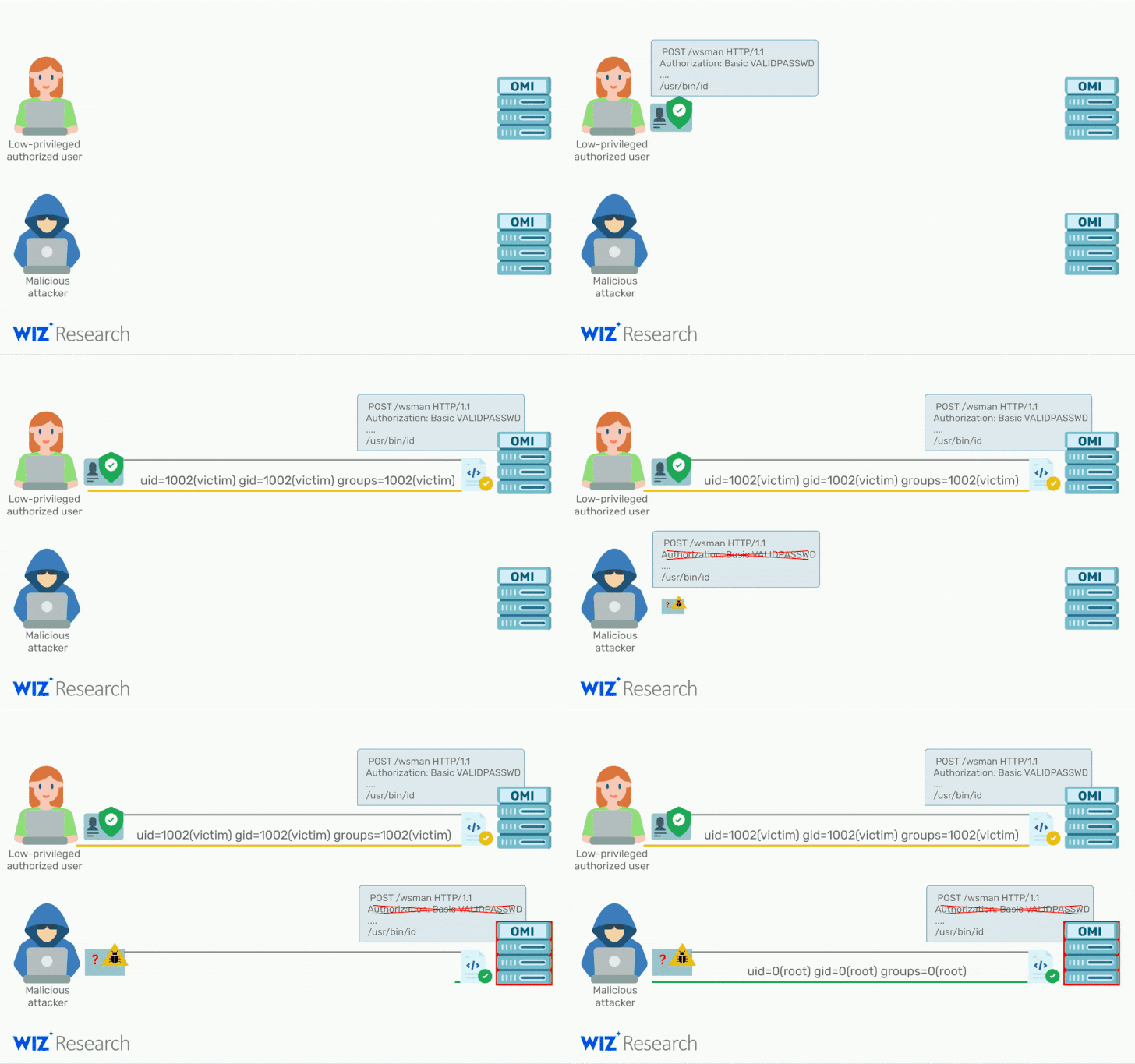
“This is a textbook RCE vulnerability that you would expect to
see in the 90’s – it’s highly unusual to have one crop up in 2021
that can expose millions of endpoints,” Ohfeld said. “With a single
packet, an attacker can become root on a remote machine by simply
removing the authentication header. It’s that simple.”
“OMI is just one example of a ‘secret’ software agent that’s
pre-installed and silently deployed in cloud environments. It’s
important to note that these agents exist not just in Azure but in
[Amazon Web Services] and [Google Cloud Platform] as well.”
References
- ^
Patch
Tuesday updates (thehackernews.com) - ^
CVE-2021-38647
(msrc.microsoft.com) - ^
CVE-2021-38648
(msrc.microsoft.com) - ^
CVE-2021-38645
(msrc.microsoft.com) - ^
CVE-2021-38649
(msrc.microsoft.com) - ^
OMI
(github.com) - ^
analogous equivalent
(cloudblogs.microsoft.com) - ^
said
(www.wiz.io)