
Almost 10 days after application security company F5 Networks
released patches[1]
for critical vulnerabilities in its BIG-IP and BIG-IQ products,
adversaries have begun opportunistically mass scanning and
targeting exposed and unpatched networking devices to break into
enterprise networks.
News of in the wild exploitation development comes on the heels
of a proof-of-concept exploit code that surfaced online earlier
this week by reverse-engineering the Java software patch in BIG-IP.
The mass scans[2]
are said to have spiked since March 18.
The flaws affect BIG-IP versions 11.6 or 12.x and newer, with a
critical remote code execution (CVE-2021-22986) also impacting
BIG-IQ versions 6.x and 7.x. CVE-2021-22986[3]
(CVSS score: 9.8) is notable for the fact that it’s an
unauthenticated, remote command execution vulnerability affecting
the iControl REST interface, allowing an attacker to execute
arbitrary system commands, create or delete files, and disable
services without the need for any authentication.
Successful exploitation of these vulnerabilities could lead to a
full compromise of vulnerable systems, including the possibility of
remote code execution as well as trigger a buffer overflow, leading
to a denial of service (DoS) attack.
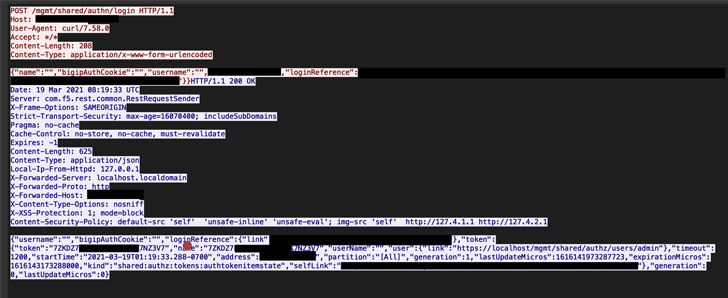
While F5 said it not aware of any public exploitation of these
issues on March 10, researchers from NCC Group said[4]
they have now found evidence of “full chain exploitation of F5
BIG-IP/BIG-IQ iControl REST API vulnerabilities CVE-2021-22986” in
the wake of multiple exploitation attempts against its honeypot
infrastructure.
Additionally, Palo Alto Networks’ Unit 42 threat intelligence
team said[5]
it found attempts to exploit CVE-2021-22986 to install a variant of
the Mirai botnet. But it’s not immediately clear if those attacks
were successful.
Given the popularity of BIG-IP/BIG-IQ in corporate and
government networks, it should come as no surprise that this is the
second time in a year F5 appliances have become a lucrative target
for exploitation.
Last July, the company addressed a similar critical flaw
(CVE-2020-5902[6]), following which it was
abused by Iranian and Chinese state-sponsored hacking[7] groups, prompting the
U.S. Cybersecurity and Infrastructure Security Agency (CISA) to
issue an alert cautioning of a “broad scanning activity for the
presence of this vulnerability across federal departments and
agencies.”
“The bottom line is that [the flaws] affect all BIG-IP and
BIG-IQ customers and instances — we urge all customers to update
their BIG-IP and BIG-IQ deployments to the fixed versions as soon
as possible,” F5 Senior Vice President Kara Sprague noted[8]
last week.
References
- ^
released
patches (thehackernews.com) - ^
mass
scans (twitter.com) - ^
CVE-2021-22986
(support.f5.com) - ^
said
(research.nccgroup.com) - ^
said
(twitter.com) - ^
CVE-2020-5902
(thehackernews.com) - ^
hacking
(geekprank.com) - ^
noted
(www.f5.com)
Read more http://feedproxy.google.com/~r/TheHackersNews/~3/hdV2DXTqVo0/latest-f5-big-ip-bug-under-active.html