
A Chinese cyberespionage group known for targeting Southeast
Asia leveraged flaws in the Microsoft Exchange Server that came to
light earlier this March to deploy a previously undocumented
variant of a remote access trojan (RAT) on compromised systems.
Attributing the intrusions to a threat actor named PKPLUG[1]
(aka Mustang Panda[2]
and HoneyMyte), Palo Alto Networks’ Unit 42 threat intelligence
team said it identified a version of the modular PlugX malware
called Thor that was delivered as a post-exploitation tool to one
of the compromised servers. Dating back to as early as 2008,
PlugX[3]
is a fully-featured second-stage implant with capabilities such as
file upload, download, and modification, keystroke logging, webcam
control, and access to a remote command shell.
“The variant observed […] is unique in that it contains a
change to its core source code: the replacement of its trademark
word ‘PLUG’ to ‘THOR,'” Unit 42 researchers Mike Harbison and Alex
Hinchliffe noted[4]
in a technical write-up published Tuesday. “The earliest THOR
sample uncovered was from August 2019, and it is the earliest known
instance of the rebranded code. New features were observed in this
variant, including enhanced payload-delivery mechanisms and abuse
of trusted binaries.”
After Microsoft disclosed on March 2 that China-based hackers —
codenamed Hafnium[5]
— were exploiting zero-day bugs in Exchange server collectively
known as ProxyLogon to steal sensitive data from select targets,
multiple threat actors[6], such as ransomware
groups (DearCry and Black Kingdom) and crypto-mining gangs
(LemonDuck), were also observed exploiting the flaws to hijack
Exchange servers and install a web shell that granted code
execution at the highest privilege level.
PKPLUG now joins the list, according to Unit 42, who found the
attackers bypassing antivirus detection mechanisms to target
Microsoft Exchange Server by leveraging legitimate executables such
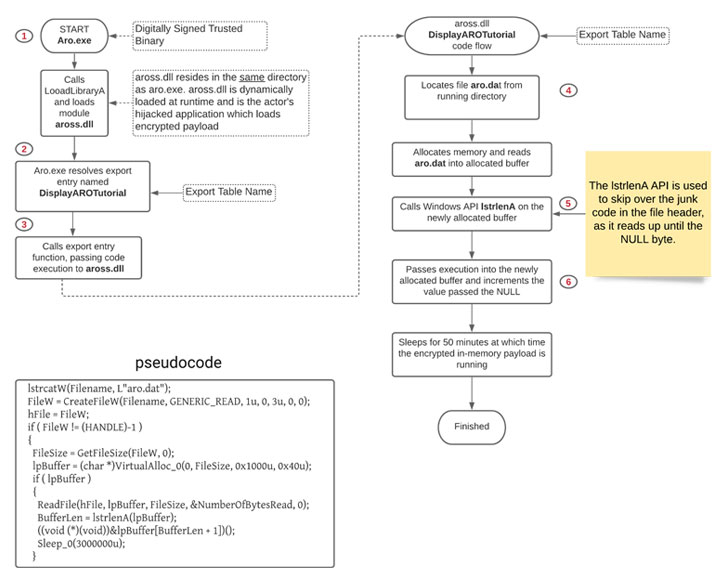
as BITSAdmin to retrieve a seemingly innocuous file (“Aro.dat”)
from an actor-controlled GitHub repository. The file, which houses
the encrypted and compressed PlugX payload, alludes to a freely
available[7] advanced repair and
optimization tool that’s designed to clean up and fix issues in the
Windows Registry.
The latest sample of PlugX comes equipped with a variety of
plug-ins that “provide attackers various capabilities to monitor,
update and interact with the compromised system to fulfil their
objectives,” the researchers said. THOR’s links to PKPLUG stem from
piecing together the command-and-control infrastructure as well as
overlaps in the malicious behaviors detected among other recently
discovered PlugX samples.
Additional indicators of compromise associated with the attack
can be accessed here[8]. Unit 42 has also made
available[9]
a Python script that can decrypt and unpack encrypted PlugX
payloads without having the associated PlugX loaders.
References
- ^
PKPLUG
(unit42.paloaltonetworks.com) - ^
Mustang
Panda (malpedia.caad.fkie.fraunhofer.de) - ^
PlugX
(logrhythm.com) - ^
noted
(unit42.paloaltonetworks.com) - ^
Hafnium
(thehackernews.com) - ^
multiple
threat actors (thehackernews.com) - ^
freely
available (www.file.net) - ^
here
(unit42.paloaltonetworks.com) - ^
available
(github.com)