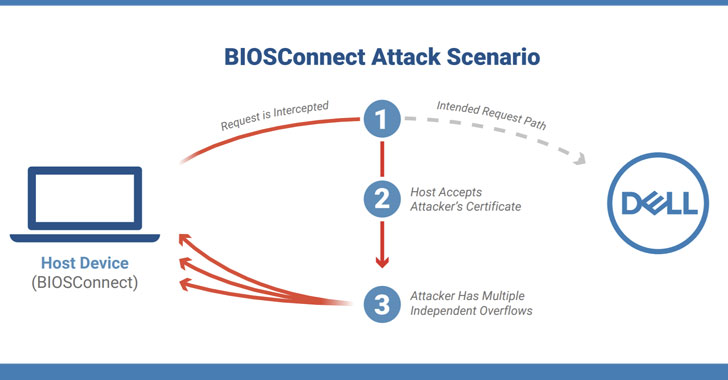
Cybersecurity researchers on Thursday disclosed a chain of
vulnerabilities affecting the BIOSConnect feature within Dell
Client BIOS that could be abused by a privileged network adversary
to gain arbitrary code execution at the BIOS/UEFI level of the
affected device.
“As the attacker has the ability to remotely execute code in the
pre-boot environment, this can be used to subvert the operating
system and undermine fundamental trust in the device,” researchers
from enterprise device security firm Eclypsium said[1]. “The virtually
unlimited control over a device that this attack can provide makes
the fruit of the labor well worth it for the attacker.”
In all, the flaws affect 128 Dell models spanning across
consumer and business laptops, desktops, and tablets, totalling an
estimated 30 million individual devices. Worse, the weaknesses also
impact computers that have Secure Boot[2]
enabled, a security feature designed to prevent rootkits from being installed[3] at boot time in
memory.
BIOSConnect[4]
offers network-based boot recovery, allowing the BIOS to connect to
Dell’s backend servers via HTTPS to download an operating system
image, thereby enabling users to recover their systems when the
local disk image is corrupted, replaced, or absent.
Successful exploitation of the flaws could mean loss of device
integrity, what with the attacker capable of remotely executing
malicious code in the pre-boot environment that could alter the
initial state of the operating system and break OS-level security
protections.
The list of four flaws uncovered by Eclypsium is as follows
—
- CVE-2021-21571 – Insecure TLS connection from
BIOS to Dell, allowing a bad actor to stage a impersonate Dell.com
and delivery malicious code back to the victim’s device - CVE-2021-21572, CVE-2021-21573, and
CVE-2021-21574 – Overflow vulnerabilities enabling
arbitrary code execution
The combination of remote exploitation as well the ability to
gain control over the most privileged code on the device could make
such vulnerabilities a lucrative target for attackers, the
researchers said.
The issues were reported to Dell by the Oregon-based company on
March 3, following which server-side updates were rolled out on May
28 to remediate CVE-2021-21573 and CVE-2021-21574. Dell has also
released client-side BIOS firmware
updates[5] to address the remaining
two flaws.
Additionally, the PC maker has released workarounds to disable
both the BIOSConnect and HTTPS Boot features for customers who are
unable to apply the patches immediately.
“Successfully compromising the BIOS of a device would give an
attacker a high degree of control over a device,” Eclypsium
researchers said. “The attacker could control the process of
loading the host operating system and disable protections in order
to remain undetected. This would allow an attacker to establish
ongoing persistence while controlling the highest privileges on the
device.”
References
- ^
said
(eclypsium.com) - ^
Secure
Boot (www.dell.com) - ^
rootkits
from being installed (thehackernews.com) - ^
BIOSConnect
(www.dell.com) - ^
released
client-side BIOS firmware updates
(www.dell.com)