
An advanced persistent threat (APT) actor has been tracked in a
new campaign deploying Android malware via the Syrian e-Government
Web Portal, indicating an upgraded arsenal designed to compromise
victims.
“To the best of our knowledge, this is the first time that the
group has been publicly observed using malicious Android
applications as part of its attacks,” Trend Micro researchers
Zhengyu Dong, Fyodor Yarochkin, and Steven Du said[1]
in a technical write-up published Wednesday.
StrongPity, also codenamed Promethium[2]
by Microsoft, is believed to have been active since 2002 and has
typically focused on targets across Turkey and Syria. In June 2020,
the espionage threat actor was connected[3]
to a wave of activities that banked on watering hole attacks and
tampered installers, which abuse the popularity of legitimate
applications, to infect targets with malware.
“Promethium has been resilient over the years,” Cisco Talos
disclosed[4]
last year. “Its campaigns have been exposed several times, but that
was not enough to make the actors behind it to make them stop. The
fact that the group does not refrain from launching new campaigns
even after being exposed shows their resolve to accomplish their
mission.”
The latest operation is no different in that it underscores the
threat actor’s propensity towards repackaging benign applications
into trojanized variants to facilitate the attacks.
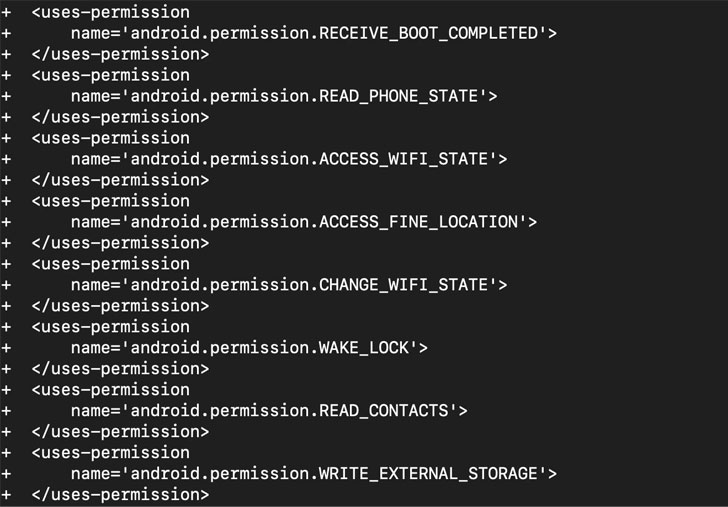
The malware, masquerading as the Syrian e-Gov Android
application, is said to have been created in May 2021, with the
app’s manifest file (“AndroidManifest.xml[5]“) modified to explicitly
request additional permissions on the phone, including the ability
to read contacts, write to external storage, keep the device awake,
access information about cellular and Wi-Fi networks, precise
location, and even allow the app to have itself started as soon as
the system has finished booting.
Additionally, the malicious app is designed to perform
long-running tasks in the background and trigger a request to a
remote command-and-control (C2) server, which responds back with an
encrypted payload containing a settings file that allows the
“malware to change its behavior according to the configuration” and
update its C2 server address.
Last but not least, the “highly modular” implant has the
capacity to hoover data stored on the infected device, such as
contacts, Word and Excel documents, PDFs, images, security keys,
and files saved using Dagesh Pro Word Processor (.DGS), among
others, all of which are exfiltrated back to the C2 server.
Despite no known public reports of StrongPity using malicious
Android applications in their attacks, Trend Micro’s attribution to
the adversary stems from the use of a C2 server that has previously
been used in intrusions linked to the hacking group, notably a
malware campaign[6]
documented by AT&T’s Alien Labs in July 2019 that leveraged
tainted versions of the WinBox router management software, WinRAR,
and other trusted utilities to breach targets.
“We believe that the threat actor is exploring multiple ways of
delivering the applications to potential victims, such as using
fake apps and using compromised websites as watering holes to trick
users into installing malicious applications,” the researchers
said.
“Typically, these websites would require its users to download
the applications directly onto their devices. In order to do so,
these users would be required to enable installation of the
applications from ‘unknown sources’ on their devices. This bypasses
the ‘trust-chain’ of the Android ecosystem and makes it easier for
an attacker to deliver additional malicious components,” they
added.
References
- ^
said
(www.trendmicro.com) - ^
Promethium
(malpedia.caad.fkie.fraunhofer.de) - ^
connected
(thehackernews.com) - ^
disclosed
(blog.talosintelligence.com) - ^
AndroidManifest.xml
(developer.android.com) - ^
malware
campaign (cybersecurity.att.com)