
Apple on Tuesday released updates for iOS, iPadOS, and tvOS with
fixes for three security vulnerabilities that it says may have been
actively exploited in the wild.
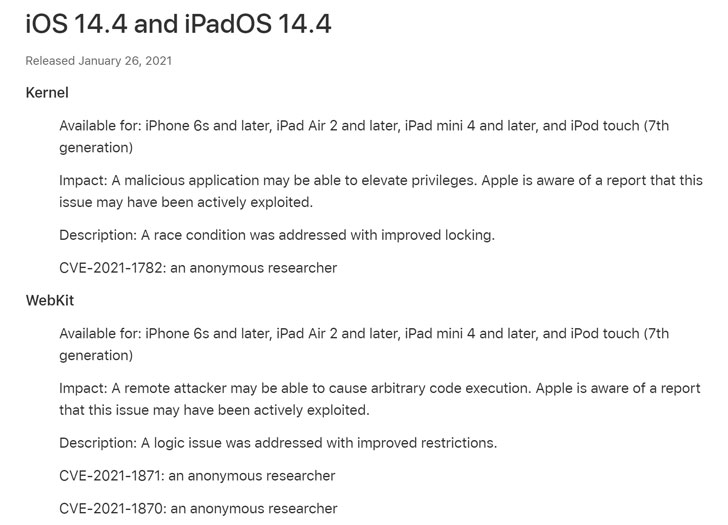
Reported by an anonymous researcher, the three zero-day[1] flaws[2] — CVE-2021-1782,
CVE-2021-1870, and CVE-2021-1871 — could have allowed an attacker
to elevate privileges and achieve remote code execution.
The iPhone maker did not disclose how widespread the attack was
or reveal the identities of the attackers actively exploiting
them.
While the privilege escalation bug in the kernel (CVE-2021-1782)
was noted as a race condition that could cause a malicious
application to elevate its privileges, the other two shortcomings —
dubbed a “logic issue” — were discovered in the WebKit browser
engine (CVE-2021-1870 and CVE-2021-1871), permitting an attacker to
achieve arbitrary code execution inside Safari.
Apple said the race condition and the WebKit flaws were
addressed with improved locking and restrictions, respectively.
While exact details of the exploit leveraging the flaws are
unlikely to be made public until the patches have been widely
applied, it wouldn’t be a surprise if they were chained together to
carry out watering hole attacks against potential targets.
Such an attack would involve delivering the malicious code
simply by visiting a compromised website that then takes advantage
of the aforementioned vulnerabilities to escalate its privileges
and run arbitrary commands to take control of the device.
The updates are now available for iPhone 6s and later, iPad Air
2 and later, iPad mini 4 and later, and iPod touch (7th
generation), as well as Apple TV 4K and Apple TV HD.
News of the latest zero-days comes after the company resolved
three actively exploited vulnerabilities in November 2020[3]
and a separate zero-day bug in iOS 13.5.1 that was disclosed as
used in a cyberespionage campaign[4]
targeting Al Jazeera journalists last year.
References
- ^
zero-day
(support.apple.com) - ^
flaws
(support.apple.com) - ^
November
2020 (thehackernews.com) - ^
cyberespionage campaign
(thehackernews.com)