ransomware targeting macOS users that spreads via pirated apps.
According to several independent reports from K7 Lab malware
researcher Dinesh
Devadoss[1], Patrick
Wardle[2], and Malwarebytes[3], the ransomware variant
— dubbed “EvilQuest” — is packaged along with legitimate
apps, which upon installation, disguises itself as Apple’s
CrashReporter or Google Software Update.
Besides encrypting the victim’s files, EvilQuest also comes with
capabilities to ensure persistence, log keystrokes, create a
reverse shell, and steal cryptocurrency wallet-related files.
With this development, EvilQuest joins a handful of ransomware
strains that have exclusively singled out macOS, including KeRanger and
Patcher.
[4][5]
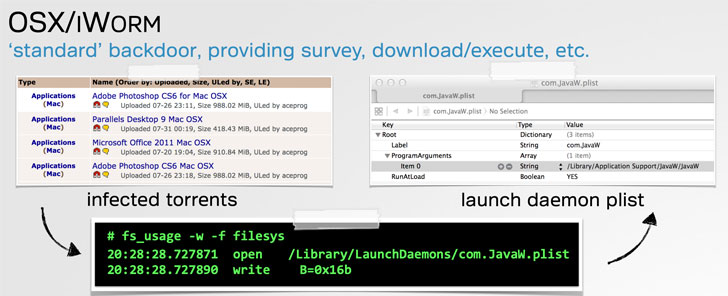
The source of the malware appears to be trojanized versions of
popular macOS software — such as Little Snitch, a DJ software
called Mixed In Key 8, and Ableton Live — that are distributed on
popular torrent sites.
“To start, the legitimate Little Snitch installer is
attractively and professionally packaged, with a well-made custom
installer that is properly code signed,” Thomas Reed, director of
Mac and mobile at Malwarebytes, said. “However, this installer was
a simple Apple installer package with a generic icon. Worse, the
installer package was pointlessly distributed inside a disk image
file.”
to detect
sleep-patching and comes equipped with anti-debugging logic to
ensure the malware program is not running under a debugger.
“It’s not unusual for malware to include delays,” Reed said.
“For example, the first-ever Mac ransomware, KeRanger, included a
three-day delay between when it infected the system and when it
began encrypting files. This helps to disguise the source of the
malware, as the malicious behavior may not be immediately
associated with a program installed three days before.”
Avast, DrWeb, McAfee, Bitdefender, and Bullguard) that may detect
or block such malicious behavior on the system, and sets up
persistence using launch agent and daemon property list files
(“com.apple.questd.plist”) to automatically restart the malware
each time the user logs in.
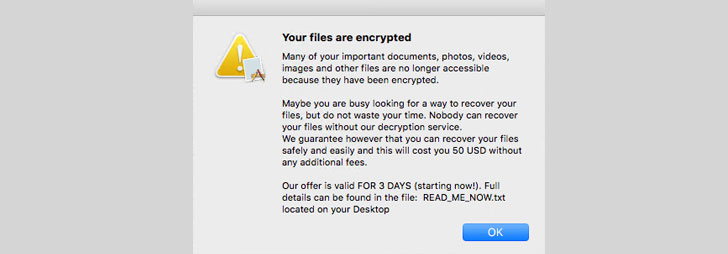
In the last stage, EvilQuest launches a copy of itself and
starts encrypting files — counting cryptocurrency wallet
(“wallet.pdf”) and keychain related files — before eventually
displaying ransom instructions to pay $50 within 72 hours or risk
leaving the files locked.
But EvilQuest’s features go beyond typical ransomware, including
the ability to communicate with a command-and-control server
(“andrewka6.pythonanywhere.com”) to remotely execute commands,
initiate keylogger, create a reverse shell, and even execute a
malicious payload directly out of memory.
“Armed with these capabilities, the attacker can maintain full
control over an infected host,” Wardle said.
While work is on to find a weakness in the encryption algorithm
to create a decryptor, it’s recommended that macOS users create
backups to avoid data loss and use a utility like RansomWhere[8]? to thwart such
attacks.
“The best way of avoiding the consequences of ransomware is to
maintain a good set of backups,” Reed concluded. “Keep at least two
backup copies of all important data, and at least one should not be
kept attached to your Mac at all times.”
References
- ^
Dinesh Devadoss
(twitter.com) - ^
Patrick Wardle
(objective-see.com) - ^
Malwarebytes
(blog.malwarebytes.com) - ^
KeRanger
(unit42.paloaltonetworks.com) - ^
Patcher
(www.welivesecurity.com) - ^
detect sleep-patchin
(www.isaca.org) - ^
property
list (en.wikipedia.org) - ^
RansomWhere
(objective-see.com)
Read more http://feedproxy.google.com/~r/TheHackersNews/~3/VtFVjAVAAtA/macos-ransomware-attack.html