Mar 13, 2023Ravie Lakshmanan

A widespread malicious cyber operation has hijacked thousands of
websites aimed at East Asian audiences to redirect visitors to
adult-themed content since early September 2022.
The ongoing campaign entails injecting malicious JavaScript code
to the hacked websites, often connecting to the target web server
using legitimate FTP credentials the threat actor previously
obtained via an unknown method.
“In many cases, these were highly secure auto-generated FTP
credentials which the attacker was somehow able to acquire and
leverage for website hijacking,” Wiz said[1]
in a report published this month.
The fact that the breached websites – owned by both small firms
and multinational corporations – utilize different tech stacks and
hosting service providers has made it difficult to trace a common
attack vector, the cloud security company noted.
That having said, one of the common denominators between the
websites is that a majority of them are either hosted in China or
hosted in a different country but are primed for Chinese users.
What’s more, the URLs hosting the rogue JavaScript code are
geofenced to limit its execution in certain East Asian
countries.
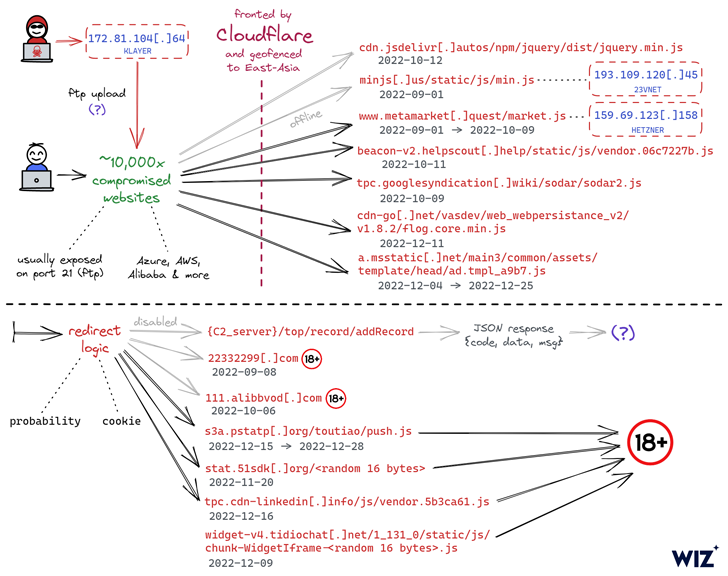
There are also indications that the campaign has set its sights
on Android as well, with the redirection script leading visitors to
gambling websites that urge them to install an app (APK package
name “com.tyc9n1999co.coandroid[2]“).
The identity of the threat actor is unknown as yet, and although
their precise motives are yet to be identified, it is suspected
that the goal is to carry out ad fraud and SEO manipulation, or
alternatively, drive inorganic traffic to these
websites[3].
WEBINAR
Discover the Hidden Dangers of Third-Party SaaS Apps
Are you aware of the risks associated with third-party app
access to your company’s SaaS apps? Join our webinar to learn about
the types of permissions being granted and how to minimize
risk.
Another notable aspect of the attacks is the absence of
phishing, web skimming, or malware infection.
“We remain unsure as to how the threat actor has been gaining
initial access to so many websites, and we have yet to identify any
significant commonalities between the impacted servers other than
their usage of FTP,” researchers Amitai Cohen and Barak Sharoni
said.
“Although it’s unlikely that the threat actor is using a 0-day
vulnerability given the apparently low sophistication of the
attack, we can’t rule this out as an option.”
Found this article interesting? Follow us on Twitter [5]
and LinkedIn[6]
to read more exclusive content we post.
References
- ^
said
(www.wiz.io) - ^
com.tyc9n1999co.coandroid
(www.virustotal.com) - ^
drive
inorganic traffic to these websites
(thehackernews.com) - ^
RESERVE YOUR SEAT
(thn.news) - ^
Twitter
(twitter.com) - ^
LinkedIn
(www.linkedin.com)
Read more https://thehackernews.com/2023/03/large-scale-cyber-attack-hijacks-east.html