Mar 14, 2023Ravie Lakshmanan

Government entities and large organizations have been targeted
by an unknown threat actor by exploiting a security flaw in
Fortinet FortiOS software to result in data loss and OS and file
corruption.
“The complexity of the exploit suggests an advanced actor and
that it is highly targeted at governmental or government-related
targets,” Fortinet researchers Guillaume Lovet and Alex Kong
said[1]
in an advisory last week.
The zero-day flaw in question is CVE-2022-41328[2] (CVSS score: 6.5), a
medium security path traversal bug in FortiOS that could lead to
arbitrary code execution.
“An improper limitation of a pathname to a restricted directory
vulnerability (‘path traversal’) [CWE-22] in FortiOS may allow a
privileged attacker to read and write arbitrary files via crafted
CLI commands,” the company noted.
The shortcoming impacts FortiOS versions 6.0, 6.2, 6.4.0 through
6.4.11, 7.0.0 through 7.0.9, and 7.2.0 through 7.2.3. Fixes are
available in versions 6.4.12, 7.0.10, and 7.2.4 respectively.
The disclosure comes days after Fortinet released
patches[3] to address 15 security
flaws, including CVE-2022-41328 and a critical heap-based buffer
underflow issue impacting FortiOS and FortiProxy (CVE-2023-25610,
CVSS score: 9.3).
According to the Sunnyvale-based company, multiple FortiGate
devices belonging to an unnamed customer suffered from a “sudden
system halt and subsequent boot failure,” indicating an integrity
breach.
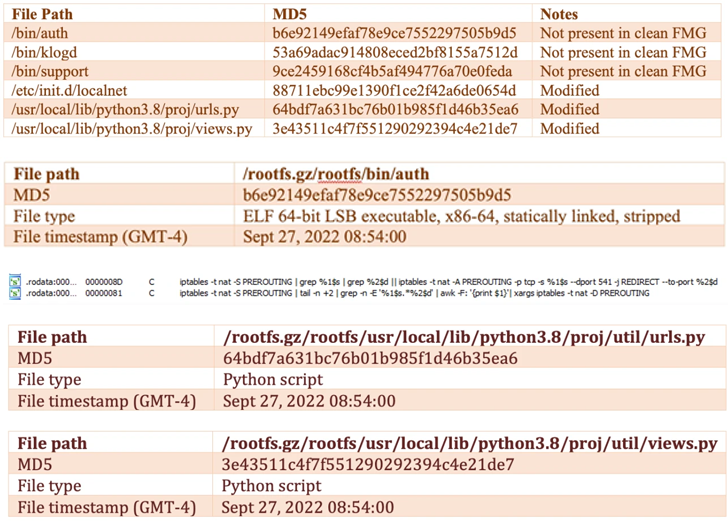
Further analysis of the incident revealed that the threat actors
modified the device’s firmware image to include a new payload
(“/bin/fgfm”) such that it’s always launched before the booting
process began.
The /bin/fgfm malware is designed to establish contact with a
remote server to download files, exfiltrate data from the
compromised host, and grant remote shell access.
Additional changes introduced to the firmware are said to have
provided the attacker with persistent access and control, not to
mention even disable firmware verification at startup.
WEBINAR
Discover the Hidden Dangers of Third-Party SaaS Apps
Are you aware of the risks associated with third-party app
access to your company’s SaaS apps? Join our webinar to learn about
the types of permissions being granted and how to minimize
risk.
Fortinet said the attack was highly targeted, with evidence
pointing to governmental or government-affiliated
organizations.
Given the complexity of the exploit, it’s suspected that the
attacker has a “deep understanding of FortiOS and the underlying
hardware” and possesses advanced capabilities to reverse engineer
different aspects of the FortiOS operating system.
It’s not immediately clear if the threat actor has any
connections to another intrusion set that was observed weaponizing a flaw[5]
in FortiOS SSL-VPN (CVE-2022-42475) earlier this January to deploy
a Linux implant.
Found this article interesting? Follow us on Twitter [6]
and LinkedIn[7]
to read more exclusive content we post.
References
- ^
said
(www.fortinet.com) - ^
CVE-2022-41328
(www.fortiguard.com) - ^
released patches
(thehackernews.com) - ^
RESERVE YOUR SEAT
(thn.news) - ^
weaponizing a flaw
(thehackernews.com) - ^
Twitter
(twitter.com) - ^
LinkedIn
(www.linkedin.com)
Read more https://thehackernews.com/2023/03/fortinet-fortios-flaw-exploited-in.html