Mar 09, 2023The Hacker News

Phishing, the theft of users’ credentials or sensitive data
using social engineering, has been a significant threat since the
early days of the internet – and continues to plague organizations
today, accounting for more than 30% of all known
breaches[1]. And with the mass
migration to remote working during the pandemic, hackers have
ramped up their efforts to steal login credentials as they take
advantage of the chaos and lack of in-person user verification.
This has led to the revival of the old-school technique of
vishing, which, like phishing online, involves using social
engineering over the phone to steal sensitive information. Vishing
attacks have been on the rise[2]
as a result, with 69% of companies experiencing them in 2021, up
from 54% in 2020. These attacks often take the form of job or tech
support scams and can be incredibly convincing. In August 2020, the
FBI along with the CISA[3]
issued a warning regarding remote users being targeted by attackers
spoofing organizations’ business numbers and impersonating the IT
service desk.
Vishing bypassing 2FA
One of the most concerning aspects of vishing is the attackers’
ability to bypass two-factor authentication (2FA) security
measures. 2FA is a popular form of multi-factor authentication that
requires users to provide two types of information: a password and
a one-time code sent via SMS.
Attackers achieve this by impersonating a support representative
and requesting the victim’s 2FA code over the phone. If the victim
provides the code, the attacker can gain full access to their
account, potentially leading to financial or personal information
being compromised.
Attackers impersonating as help desk support
A common instance is when individuals receive a pop-up alert
claiming that their device has been breached or infected with
malware and that professional phone support is required to fix the
problem. Alternatively, victims may receive a call from an alleged
tech support representative from a reputable software provider,
claiming that malware has been detected on their machine. The
attacker will try to convince the user to download remote access
software under the pretext of corporate IT help desk
representatives. This is the final phase of the scam, after which
it’s checkmate for the unsuspecting victims and a potential payday
for the attackers.
Attackers impersonating the help desk is clearly working: in
July 2020, Twitter[4]
experienced a major security breach when hackers used a vishing
scam to successfully access dozens of high-profile accounts,
including those of Barack Obama, Joe Biden, Jeff Bezos, and Elon
Musk. The attackers used these accounts to tweet a bitcoin scam,
resulting in the swift theft of over $100,000. Unlike traditional
scams, these attacks target carefully selected individuals by
gathering extensive information about them from social media and
other public sources. This information is then used to identify
employees who are most likely to cooperate and have access to the
desired resources, at which point attackers are primed and ready to
wreak havoc.
A twist as attackers call the help desk & impersonate
end-users
Social engineering attacks are carefully fabricated with
collected data and can be used to impersonate an end-user on a call
to the help desk. An experienced attacker can easily acquire
answers to security questions from various sources, especially
knowing end-users put too much personal information on social media
and the web.
Microsoft said that LAPSUS$[5], a known threat group,
calls on a targeted organization’s help desk and attempts to
convince support personnel to reset a privileged account’s
credentials. The group would use previously gathered information,
have an English-speaking caller speak with the help desk. They
would be able to answer common recovery prompts such as “first
street you lived on” or “mother’s maiden name” from data collected
to convince help desk personnel of authenticity.
In another attempt to reach the help desk, slack was used.
Electronic Arts[6]
had 780GB of source code downloaded by hackers presumed to also be
LAPSUS$[7]. The threat actors used
the authentication cookies to impersonate an already-logged-in
employee’s account and access EA’s Slack channel, then convinced an
IT support employee into granting them access to the company’s
internal network.
How can your Help Desk know who’s really calling
Verifying user identity in the vishing age is more important
than ever. With the rise of cyber-attacks and social engineering,
it’s crucial for organizations to have security measures in place
to safeguard their employees, protect their sensitive information,
and prevent unauthorized access.
One effective way to safeguard against these types of attacks is
to implement a secure service desk solution[8], which allows for the
verification of user accounts with existing data beyond just
knowledge-based authentication. This can be achieved by sending a
one-time code to the mobile number associated with the user’s
account or using existing authentication services to verify
callers.
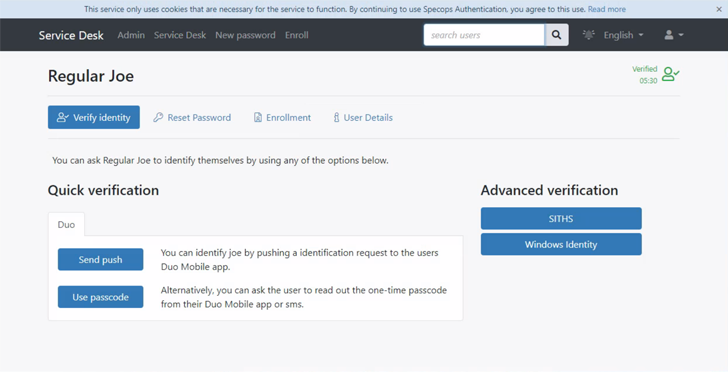
Enforcing user authentication is another key aspect of Specops Secure Service Desk[9]. This ensures that
information and password resets are only offered to authorized
users, which is essential for protecting high-security accounts and
adhering to regulatory requirements. With a Secure Service Desk,
you can remove the opportunity for user impersonation by requiring
verification with something the user has and not just relying on
something the user – or an attacker – may know.
In addition to verifying and enforcing user authentication, a
secure service desk also allows for the secure reset or unlocking
of user accounts. This is done only after the user has been
successfully verified and can be combined with a self-service
password reset tool to assist with account unlocks and the password
reset process.
With vishing scams showing no signs of slowing down, investing
in Specops Secure Service Desk solution could be a critical step
for organizations looking to protect their people from even the
subtlest of social engineering attempts. By instilling a
comprehensive and effective way to verify user identity, enforce
user authentication, and reset or unlock user accounts, would-be
victims can rest assured that they’ll always know who’s really calling[10].
Found this article interesting? Follow us on Twitter [11] and LinkedIn[12] to read more exclusive
content we post.
References
- ^
accounting for more than 30% of all
known breaches (enterprise.verizon.com) - ^
been on
the rise (www.kroll.com) - ^
FBI
along with the CISA
(www.infosecurity-magazine.com) - ^
Twitter
(www.tessian.com) - ^
Microsoft said that LAPSUS$
(krebsonsecurity.com) - ^
Electronic Arts
(therecord.media) - ^
LAPSUS$
(krebsonsecurity.com) - ^
secure
service desk solution (specopssoft.com) - ^
Specops
Secure Service Desk (specopssoft.com) - ^
know
who’s really calling (specopssoft.com) - ^
Twitter
(twitter.com) - ^
LinkedIn
(www.linkedin.com)
Read more https://thehackernews.com/2023/03/does-your-help-desk-know-whos-calling.html