Mar 09, 2023Ravie Lakshmanan
A previously known Windows-based ransomware strain known as
IceFire has expanded its focus to target Linux enterprise networks
belonging to several media and entertainment sector organizations
across the world.
The intrusions entail the exploitation of a recently disclosed
deserialization vulnerability in IBM Aspera Faspex file-sharing
software (CVE-2022-47986[1], CVSS score: 9.8),
according to cybersecurity company SentinelOne.
“This strategic shift is a significant move that aligns them
with other[2]
ransomware[3]
groups that also target Linux systems,” Alex Delamotte, senior
threat researcher at SentinelOne, said[4]
in a report shared with The Hacker News.
A majority of the attacks observed by SentinelOne have been
directed against companies located in Turkey, Iran, Pakistan, and
the U.A.E., countries that are not typically targeted by organized
ransomware crews.
IceFire[5]
was first detected in March 2022 by the MalwareHunterTeam[6], but it wasn’t until
August 2022 that victims were publicized[7]
via its dark web leak site, according to GuidePoint Security[8], Malwarebytes[9], and NCC Group[10].
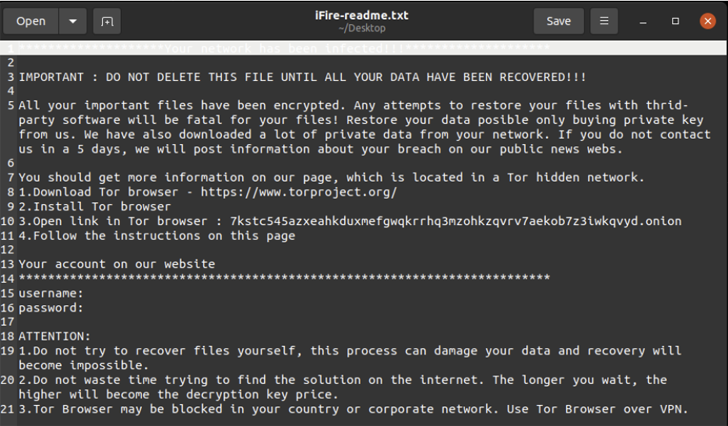
The ransomware binary[11] targeting Linux is a
2.18 MB 64-bit ELF file that’s installed on CentOS hosts running a
vulnerable version of IBM Aspera Faspex file server software.
It’s also capable of avoiding encrypting certain paths so that
the infected machine continues to be operational.
WEBINAR
Discover the Hidden Dangers of Third-Party SaaS Apps
Are you aware of the risks associated with third-party app
access to your company’s SaaS apps? Join our webinar to learn about
the types of permissions being granted and how to minimize
risk.
“In comparison to Windows, Linux is more difficult to deploy
ransomware against–particularly at scale,” Delamotte said. “Many
Linux systems are servers: typical infection vectors like phishing
or drive-by download are less effective. To overcome this, actors
turn to exploiting application vulnerabilities.”
The development comes as Fortinet FortiGuard Labs disclosed[13] a new LockBit
ransomware campaign employing “evasive tradecraft” to avoid
detection through .IMG containers that bypass Mark of The Web
(MotW) protections.
Found this article interesting? Follow us on Twitter [14] and LinkedIn[15] to read more exclusive
content we post.
References
- ^
CVE-2022-47986
(thehackernews.com) - ^
other
(www.trellix.com) - ^
ransomware
(thehackernews.com) - ^
said (s1.ai) - ^
IceFire
(www.sentinelone.com) - ^
MalwareHunterTeam
(twitter.com) - ^
publicized
(www.fortinet.com) - ^
GuidePoint Security
(www.guidepointsecurity.com) - ^
Malwarebytes
(www.malwarebytes.com) - ^
NCC
Group (newsroom.nccgroup.com) - ^
ransomware binary
(www.virustotal.com) - ^
RESERVE YOUR SEAT
(thn.news) - ^
disclosed
(www.fortinet.com) - ^
Twitter
(twitter.com) - ^
LinkedIn
(www.linkedin.com)
Read more https://thehackernews.com/2023/03/icefire-linux-ransomware.html