Jan 27, 2023Ravie Lakshmanan

Cybersecurity researchers have discovered the real-world
identity of the threat actor behind Golden
Chickens malware-as-a-service, who goes by the online
persona “badbullzvenom.”
eSentire’s Threat Response Unit (TRU), in an exhaustive report
published following a 16-month-long investigation, said[1]
it “found multiple mentions of the badbullzvenom account being
shared between two people.”
The second threat actor, known as Frapstar, is said to identify
themselves as “Chuck from Montreal,” enabling the cybersecurity
firm to piece together the criminal actor’s digital footprint.
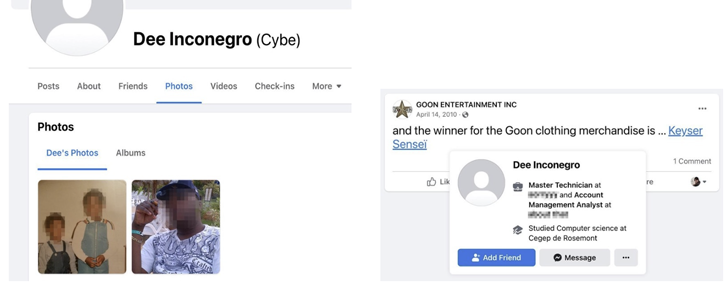
This includes his real name, pictures, home address, the names
of his parents, siblings, and friends, along with his social media
accounts and his interests. He is also said to be the sole
proprietor of a small business that’s run from his own home.
Golden Chickens, also known as Venom Spider[2], is a
malware-as-a-service (MaaS) provider that’s linked to a variety of
tools such as Taurus Builder, software to create malicious
documents; and More_eggs, a JavaScript downloader that’s used to
serve additional payloads.
The threat actor’s cyber arsenal has been put to use by other
prominent cybercriminal groups like Cobalt Group[3]
(aka Cobalt Gang), Evilnum[4], and FIN6[5], all of which are
estimated to have collectively caused losses totaling $1.5
billion.
Past More_eggs campaigns, some dating back to 2017[6], have involved spear-phishing[7]
business professionals[8]
on LinkedIn with bogus job offers that give threat actors remote
control over the victim’s machine, leveraging it to harvest
information or deploy more malware.
Last year, in a reversal[9]
of sorts, the same tactics were employed to strike corporate hiring
managers with resumes laden with malware as an infection
vector.
The earliest documented record of Frapster’s activity goes back
to May 2015, when Trend Micro described[10] the individual as a
“lone criminal” and a luxury car enthusiast.
“‘Chuck,’ who uses multiple aliases for his underground forum,
social media, and Jabber accounts, and the threat actor claiming to
be from Moldova, have gone to great lengths to disguise
themselves,” eSentire researchers Joe Stewart and Keegan Keplinger
said.
“They have also taken great pains to obfuscate the Golden
Chickens malware, trying to make it undetectable by most AV
companies, and limiting customers to using Golden Chickens for ONLY
targeted attacks.”
It’s suspected that Chuck is one of the two threat actors
operating the badbullzvenom account on the Exploit.in underground
forum, with the other party possibly located in Moldova or Romania,
eSentire noted.
The Canadian cybersecurity company said it further uncovered a
new attack campaign targeting e-commerce companies, tricking
recruiters into downloading a rogue Windows shortcut file from a
website that masquerades as a resume.
The shortcut, a malware dubbed VenomLNK, serves as an initial
access vector to drop More_eggs or TerraLoader, which subsequently
acts as a conduit to deploy different modules, namely TerraRecon
(for victim profiling), TerraStealer (for information theft), and
TerraCrypt (for ransomware extortion).
“The malware suite is still actively being developed and is
being and sold to other threat actors,” the researchers concluded,
urging organizations to be on the lookout for potential phishing
attempts.
Found this article interesting? Follow us on Twitter [11] and LinkedIn[12] to read more exclusive
content we post.
References
- ^
said
(www.esentire.com) - ^
Venom
Spider (malpedia.caad.fkie.fraunhofer.de) - ^
Cobalt
Group (unit42.paloaltonetworks.com) - ^
Evilnum
(thehackernews.com) - ^
FIN6
(thehackernews.com) - ^
dating
back to 2017 (www.trendmicro.com) - ^
spear-phishing
(www.proofpoint.com) - ^
business
professionals (www.esentire.com) - ^
reversal
(thehackernews.com) - ^
described
(blog.trendmicro.co.jp) - ^
Twitter
(twitter.com) - ^
LinkedIn
(www.linkedin.com)
Read more https://thehackernews.com/2023/01/experts-uncover-identity-of-mastermind.html