Jan 20, 2023Ravie Lakshmanan

Threat actors associated with the Roaming Mantis attack campaign
have been observed delivering an updated variant of their patent
mobile malware known as Wroba to infiltrate Wi-Fi routers
and undertake Domain Name System (DNS[1]) hijacking.
Kaspersky, which carried out an analysis[2]
of the malicious artifact, said the feature is designed to target
specific Wi-Fi routers located in South Korea.
Roaming Mantis, also known as Shaoye, is a long-running
financially motivated operation that targets Android smartphone
users with malware capable of stealing bank account credentials as
well as harvesting other kinds of sensitive information.
Although primarily targeting the Asian region[3] since 2018, the hacking
crew was detected expanding[4]
its victim range[5]
to include France and Germany for the first time in early 2022 by
camouflaging the malware as the Google Chrome web browser
application.
The attacks leverage smishing messages as the initial intrusion
vector of choice to deliver a booby-trapped URL that either offers
a malicious APK or redirects the victim to phishing pages based on
the operating system installed in the mobile devices.
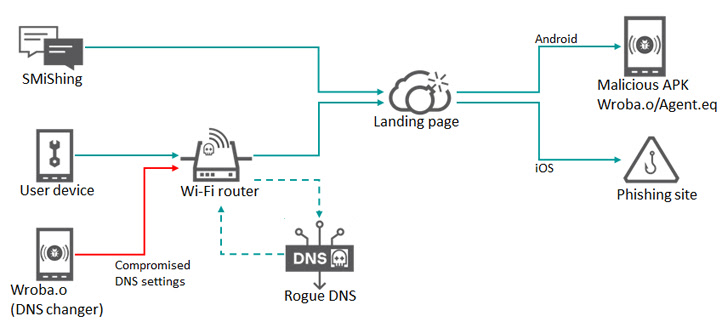
Alternatively, some compromises have also leveraged Wi-Fi
routers as a means to take unsuspecting users to a fake landing
page by using a technique called DNS hijacking[6], in which DNS queries
are manipulated in order to redirect targets to bogus sites.
Regardless of the method used, the intrusions pave the way for
the deployment of a malware dubbed Wroba (aka MoqHao and XLoader)
that’s capable of carrying out a slew of nefarious activities.
The latest update to Wroba, per the Russian cybersecurity
company, involves a DNS changer function that’s engineered to
detect certain routers based on their model numbers and poison
their DNS settings.
“The new DNS changer functionality can manage all device
communications using the compromised Wi-Fi router, such as
redirecting to malicious hosts and disabling updates of security
products,” Kaspersky researcher Suguru Ishimaru said.
The underlying idea is to cause devices connected to the
breached Wi-Fi router to be redirected to web pages controlled by
the threat actor for further exploitation. Given that some of these
pages deliver the Wroba malware, the attack chain effectively
creates a steady stream of “bots” that can be weaponized to break
into healthy Wi-Fi routers.
It’s notable that the DNS changer program is exclusively used in
South Korea. However, the Wroba malware in itself has been spotted
targeting victims in Austria, France, Germany, India, Japan,
Malaysia, Taiwan, Turkey, and the U.S. via smishing.
“Users with infected Android devices that connect to free or
public Wi-Fi networks may spread the malware to other devices on
the network if the Wi-Fi network they are connected to is
vulnerable,” the researcher said.
Found this article interesting? Follow us on Twitter [7]
and LinkedIn[8]
to read more exclusive content we post.
References
Read more https://thehackernews.com/2023/01/roaming-mantis-spreading-mobile-malware.html