It’s no secret that the job of SOC teams continues to become
increasingly difficult. Increased volume and sophistication of
attacks are plaguing under-resourced teams with false positives and
analyst burnout.
However, like many other industries, cybersecurity is now
beginning to lean on and benefit from advancements in automation to
not only maintain the status quo, but to attain better security
outcomes.
Automation across multiple phases of the SOC workflow
The need for automation is clear, and it is apparent that it is
becoming table stakes for the industry. Of all cyber resilient
organizations, IBM estimates that 62%[1]
have deployed automation, AI and machine learning tools and
processes.
Up until now, much of these advancements in automation have been
focused on response, with SOAR and incident response tools playing
an instrumental role in tackling the most urgent phase of the SOC
workflow.
Centering the focus only on response, however, means we’re
treating the symptoms instead of the root cause of the disease. By
breaking down the SOC workflow into phases, it is easy to see more
instances where automation can improve the speed and efficacy of
security teams.
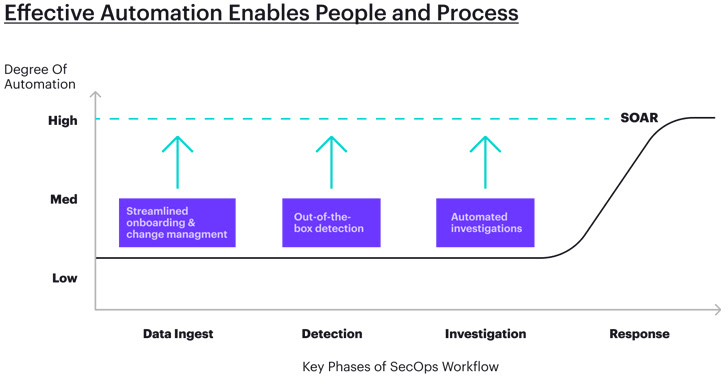
The four phases where it is possible to expand coverage of
automation include:
- Data ingestion and normalization: Automating
data ingestion and normalization can empower teams to handle huge
amounts of data from multiple sources, laying the foundation for
additional automated processes - Detection: Offloading the creation of a
significant percentage of the detection rules can free up time for
security analysts to focus on the threats that are unique to their
organization or market segment - Investigation: Offloading manual and tedious
work to shorten investigation and triage processes - Response: Automatically responding to known
and discovered threats for rapid and accurate mitigation

Data: Laying the foundation for automation
Ingesting huge amounts of data may sound overwhelming to many
security teams. Historically, teams have had a hard time connecting
data sources or have simply had to ignore the data volumes that
they couldn’t handle due to cost-prohibitive models of legacy tools
that charge for the amount of data that they store.
With the world continually migrating to the cloud, it is
imperative that security teams do not shy away from massive data.
Instead, they need to enact solutions that help them manage it and
in turn, achieve better security outcomes by having increased
visibility on the entire attack surface.
Security data lakes have brought with them a paradigm shift in
security operations. They support the ingestion of massive volumes
and variety of data, at the speed of cloud, and allow security
platforms to run analytics on top of them with reduced complexity
and at a predictable cost.
Detection: Automating the 80%
As more data is ingested, there will inherently be more alerts
discovered. Again, this may sound intimidating to overworked
security teams, but automated processes, such as out-of-the-box
detection rules across attack vectors, is another perfect example
where automation can lead to an improvement in coverage.
Generally speaking, there are many similarities in the way
networks are attacked, with approximately 80% of threat signals[2]
being common across most organizations.
A modern SOC platform offers out-of-the-box detection rules that
cover this 80% by plugging into threat intelligence feeds,
open-source knowledge bases, social media, or dark web forums, to
create logic protecting against the most common threats. Combining
those with additional rules written by in-house security teams,
platforms are able to keep up-to-date with threat techniques and
utilize automated detection around them.
Investigation: Separate the signal from the noise
The investigation phase of the SOC workflow is one that is not
often associated with automation. It is traditionally bogged down
by numerous tools and manual investigations limiting the efficiency
and accuracy of security teams.
The processes that can be bolstered with automation within the
investigation phase include:
- Threat-centric clustering of alerts: Security
tools will give you thousands of alerts, but in reality these boil
down to only a few threats. At scale, this becomes an enormous
resource drain. If the alerts are automatically grouped based on
their threat context[3], then security analysts
can more easily understand and respond to single incidents as
opposed to chasing hundreds of alerts and false-positives. - Enrichment: By automatically enriching the
entities associated with each signal or alert with additional
information from many different data sources, teams get all the
available context to understand the risk of the alert. - Correlation: Automatically correlating events
leads to better visibility into the path of attackers within the
organization’s network. - Visualization: Once correlated, attack
“stories” can be mapped and visualized in an easy-to-read timeline
making it easier for analysts and other stakeholders to gain clear
insights.
Together, these automated tasks offer analysts fast indications
of which incidents are the highest priority and need further
investigation. This is a drastic improvement compared to legacy
systems where analysts are constantly checking and rechecking
incidents, investigating redundancies and manually piecing together
events.
Automated investigation, when in conjunction with manual search
practices, can lead to more real incidents investigated, triaged
and understood with more accuracy.
Response: Act quickly and confidently
Once a threat is identified, the obvious next step would be to
respond to it. As mentioned earlier, SOARs do a good job with
automating the response phase with known threats.
The efficiency of this automation, however, relies heavily on
data that is provided by other sources, i.e. when earlier phases of
the SOC workflow can deliver usable and reliable outputs that can
be sent to a response software.
Integrating more accurate data that has been normalized and
investigated by expertly engineered automation makes response tools
much more reliable and effective.
Obviously, not all responses can be automated as attackers
continue to evolve their methods. In many instances, it’s necessary
for analysts to investigate incidents thoroughly and enact
responses manually. But like the other phases of the workflow, the
more that these tasks can be automated, the more security teams
will be freed up to address more complex attacks.
So, why aren’t more companies using automation?
Many teams know that automation will increase their
productivity, but changing processes and software is often
difficult for several reasons:
- Replacing legacy software is time consuming, expensive and
potentially risky - Getting stakeholder approval for major implementations is
challenging and slow - Educating analysts on using new software takes time and
resources - Ever-evolving attack techniques keep security teams occupied
with the “here and now”
These blockers piled on top of extreme personnel shortages can
make the task seem daunting.
But, as automation continues to take center stage, the industry
will continue to see significant reductions in total cost of
ownership (TCO), mean time to detection/response (MTTD/MTTR),
analyst burnout and CISO frustration.
SOC Platforms to the rescue
When several pieces of the SOC workflow are combined and
automated, the weight and pressure of the normal workload begin to
dissolve. Analysts will start to be able to wave goodbye to
spending long hours bouncing from tool to tool, chasing false
positives or simply maintaining traditional SIEM solutions.
The new generation of SOC platforms have a lot to offer, at
every stage of the SOC workflow. Having been born in the cloud, SOC
platforms are able to utilize modern data architectures to more
easily develop additional features and enhancements. This, along
with the advantage of being able to ingest all security data at a
fraction of the cost of legacy tools, has resulted in a trend
towards increased automation embedded in them.
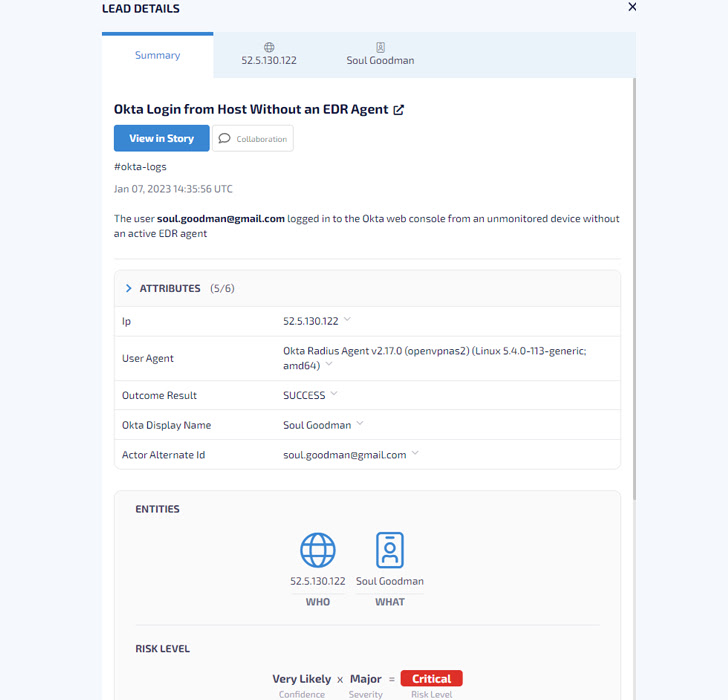 |
| A sample Auto-Investigation summary on the Hunters SOC Platform showing the key entities of an alert generated after a user logged in to the Okta web console from an unmonitored device without an active EDR agent, as well as the Risk Score[4] associated with it |
An example of that can be the investigation of threats: this is
known by most analysts to be a tedious, manual task, involving
sorting through endless false positives. But today’s SOC platforms
have introduced automation, significantly improving the
investigation process. Improvements like automated cross-source
correlation, ML models, and built-in data interrogation queries
have emerged to help analysts through the repetitive and most
laborious threat investigation tasks.
Now is the time to start leveraging automation as it continues
to change the industry. Teams not actively adopting these
innovations will find themselves behind the curve, potentially
leaving their organizations vulnerable and their personnel
overwhelmed.
Learn more about how Hunters SOC Platform can help your SOC:
www.hunters.ai[5]
Found this article interesting? Follow us on Twitter [6]
and LinkedIn[7]
to read more exclusive content we post.
References
- ^
62%
(www.ibm.com) - ^
80% of
threat signals (www.hunters.ai) - ^
alerts
are automatically grouped based on their threat context
(www.hunters.ai) - ^
Risk
Score (www.hunters.ai) - ^
www.hunters.ai
(www.hunters.ai) - ^
Twitter
(twitter.com) - ^
LinkedIn
(www.linkedin.com)
Read more https://thehackernews.com/2023/01/4-places-to-supercharge-your-soc-with.html